For years videographers relied on gimbals to get clean and stable footage. It became part of the routine. You charged the batteries, balanced the camera, adjusted the motors and carried the extra weight throughout the day. It felt normal because there was no other way to keep movement smooth. But today something different is happening. AI video stabilisation is growing so rapidly that many creators are beginning to question if they really need physical stabilisers at all. What once required a gimbal can now be corrected inside software with results that look surprisingly natural.
This shift did not arrive suddenly. It started quietly in phone apps where people noticed that shaky clips suddenly looked steady. The early versions were messy. They warped edges, bent straight lines and made backgrounds ripple. But each year the algorithms improved. They learned how objects move in space. They learned how to track depth. They learned how to understand the direction of motion. They learned how to rebuild missing frames. They learned how to predict movement instead of just reacting to it.
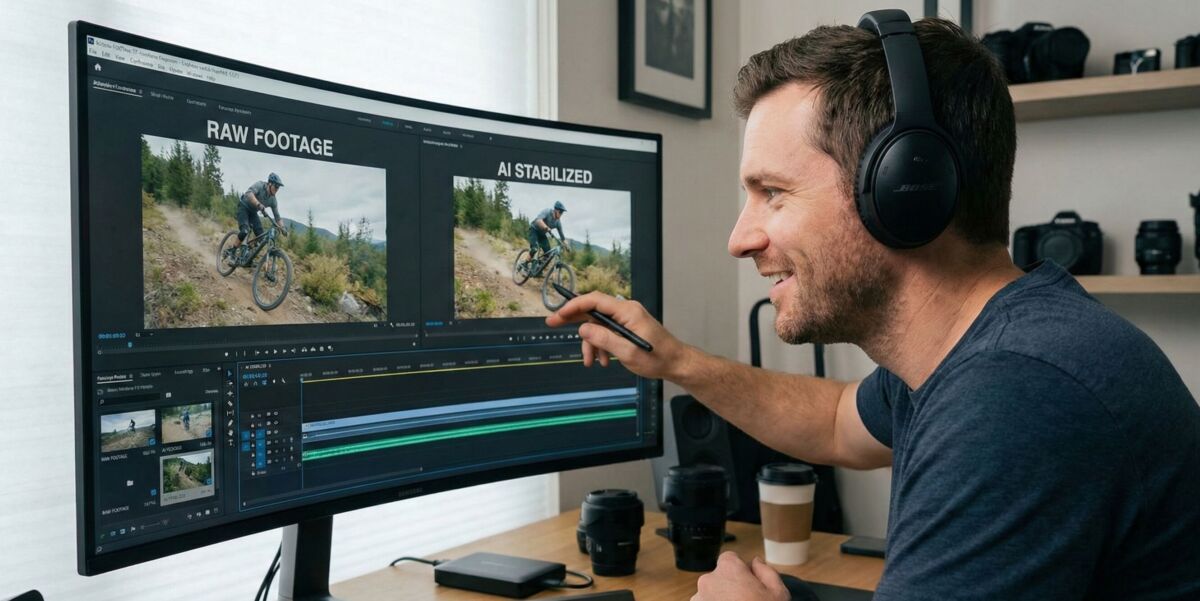
Once this intelligence reached desktop editing tools, videographers began paying attention. Software could analyse thousands of frames and detect how the camera moved. Instead of simply smoothing the shake, it reconstructed motion paths. It mapped the scene and understood where things should be. It knew how far the camera moved and how quickly the subject travelled. This level of calculation made the stabilisation feel less artificial. The result looked closer to what a gimbal produces in real time.
The biggest surprise came when AI stabilisation began handling complex motion better than manual stabilisation. A gimbal reacts physically. When you step on uneven ground or shift weight suddenly, the gimbal absorbs some shock but passes the rest to the camera. AI, however, studies the motion after the fact. It sees the entire movement from start to finish. It understands where the camera should have moved if it were steady. It rebuilds the motion path without the physical limitations of motors. This gives AI a strange advantage. It can fix movements that no stabiliser can fully control.
This does not mean gimbals are becoming useless, but their role is slowly changing. For simple walk and talk shots, AI stabilisation can achieve impressive results with almost no effort. You can shoot handheld and let the software do the heavy work later. This frees creators from carrying heavy rigs all day. It makes spontaneous shooting easier. It makes travel videos lighter. It gives street filmmakers more freedom to react to moments without worrying about setup time.
Another reason AI stabilisation is becoming popular is that it removes the balancing struggle. Every videographer has experienced the frustration of adjusting the gimbal arms, locking the joints and testing the tilt repeatedly. A small change in lens weight can throw off the balance. Shooting with different focal lengths becomes complicated. AI editing does not care about balance. It fixes the movement regardless of the lens or camera weight. This creates a sense of independence from equipment.
AI also helps beginners more than any physical stabiliser. A new creator might not know how to walk smoothly, keep elbows tucked or pace their movement correctly. They may not know how to hold a camera in a way that reduces micro shake. AI stabilisation forgives these mistakes. It smooths their learning curve and allows them to focus on storytelling instead of technique. This gives confidence to people who are just starting and keeps them engaged in the craft.
But AI stabilisation also brings its own problems. It can create distortions when the footage has too much movement. Edges sometimes breathe. Lines may stretch slightly. Backgrounds can wobble if the software misreads depth. These issues do not happen on every clip, but they remind filmmakers that AI is still interpreting the world rather than physically stabilising it. A stabiliser keeps everything real. AI attempts to rebuild the scene based on patterns. This difference becomes stronger in fast action scenes where physical stabilisation still feels more reliable.
Low light brings another challenge. When the footage has noise, AI struggles to track the background clearly. It may misinterpret noise as movement. This leads to jitter or warped areas. Good stabilisation still depends on clean frames. Videographers who shoot in challenging environments notice these limits quickly.
Another factor is rolling shutter. Cameras with heavy rolling shutter distortions create skew when moved quickly. AI can correct some of this, but not always perfectly. A gimbal, on the other hand, reduces the fast movements that cause rolling shutter in the first place. This means physical stabilisers still have an advantage in protecting footage at the source.
Even though AI stabilisation is becoming powerful, it cannot fully replace the emotional feeling of controlled movement. A gimbal creates smooth float like motion that feels physical and cinematic. AI often creates a more corrected motion that feels digital. Some creators prefer this clean look. Others still love the natural glide of a gimbal. It becomes a creative choice rather than a technical requirement.
One of the strongest advantages of AI stabilisation is how it changes workflow. You can shoot more freely, grab more angles and work faster. You do not have to set up before every shot. You can move through crowds, climb stairs, run after a moment or capture raw documentary scenes without stopping. This increases the energy of the shoot. It keeps you connected to the environment. The footage may look rough at first, but AI fixes it later.
Another surprising trend is that many creators who once avoided handheld shooting now embrace it again. AI stabilisation gives handheld footage a more grounded feeling. It keeps the soul of the movement but removes the distracting shake. It creates a balance between realism and stability. Some videographers prefer this to the too smooth look of gimbals that can sometimes feel floaty or disconnected from the scene.
AI stabilisation also pushes companies to rethink camera design. Some brands now include advanced stabilisation inside the camera that works with AI algorithms. This combination allows in camera stabilisation to predict movement better and correct harder shakes. It makes handheld shooting more reliable. It gives creators confidence that their footage will look stable even before editing. This shift suggests that future cameras may rely more on software than mechanical systems.
Another interesting change is happening in editing habits. People who once spent hours correcting shaky clips manually now use AI tools with a few clicks. The computer does the heavy work while the creator focuses on cutting, colour and story. This saves enormous time and reduces mental fatigue. It makes editing more enjoyable and less overwhelming, especially for long projects or travel shoots.
However, the rise of AI stabilisation also creates new expectations. Viewers now expect stable footage even from casual creators. Shaky clips feel outdated. Social media algorithms also prefer visually clean content. This pushes creators to stabilise everything they shoot. AI tools make this easier, but it also increases pressure. A natural handheld look that once felt acceptable now gets judged harshly. The culture of comparison affects how creators make decisions.
The industry is moving toward a hybrid future. AI stabilisation will handle most casual and moderate movements. Gimbals will be used for more controlled, cinematic shots where physical motion matters. Both tools will exist, but the dependency on gimbals will reduce. Beginners may never buy one at all. Experienced filmmakers may carry them only for specific scenes. The rest will be left to AI.
AI stabilisation is not replacing craft. It is changing it. It allows creators to focus on storytelling, timing and emotion instead of technical corrections. It gives people freedom to shoot in ways that felt difficult before. It encourages experimentation. It keeps attention on the moment instead of the equipment. But like every new tool, it requires understanding. Creators must know when AI helps and when it breaks. They must choose intentionally, not blindly.
The future of stabilisation will not be about motors alone. It will be about intelligence. It will be about software that understands motion, depth and perspective in ways that physical devices cannot. It will be about giving creators control without slowing them down. It will be about shaping movement that feels clean but still human. And it has already begun.
FAQ
Is AI stabilisation better than a gimbal
It depends. AI is excellent for simple handheld shots, but gimbals still win in complex motion or fast action.
Does AI stabilisation distort footage
Sometimes. It can warp edges or backgrounds if the scene has heavy movement or noise.
Can beginners rely on AI stabilisation
Yes. It helps them get stable footage without learning advanced walking techniques.
Is handheld shooting coming back because of AI
Yes. Many creators prefer shooting freely and stabilising later for a grounded feel.
Will gimbals disappear completely
No. They will remain essential for cinematic shots, but their everyday use is decreasing.