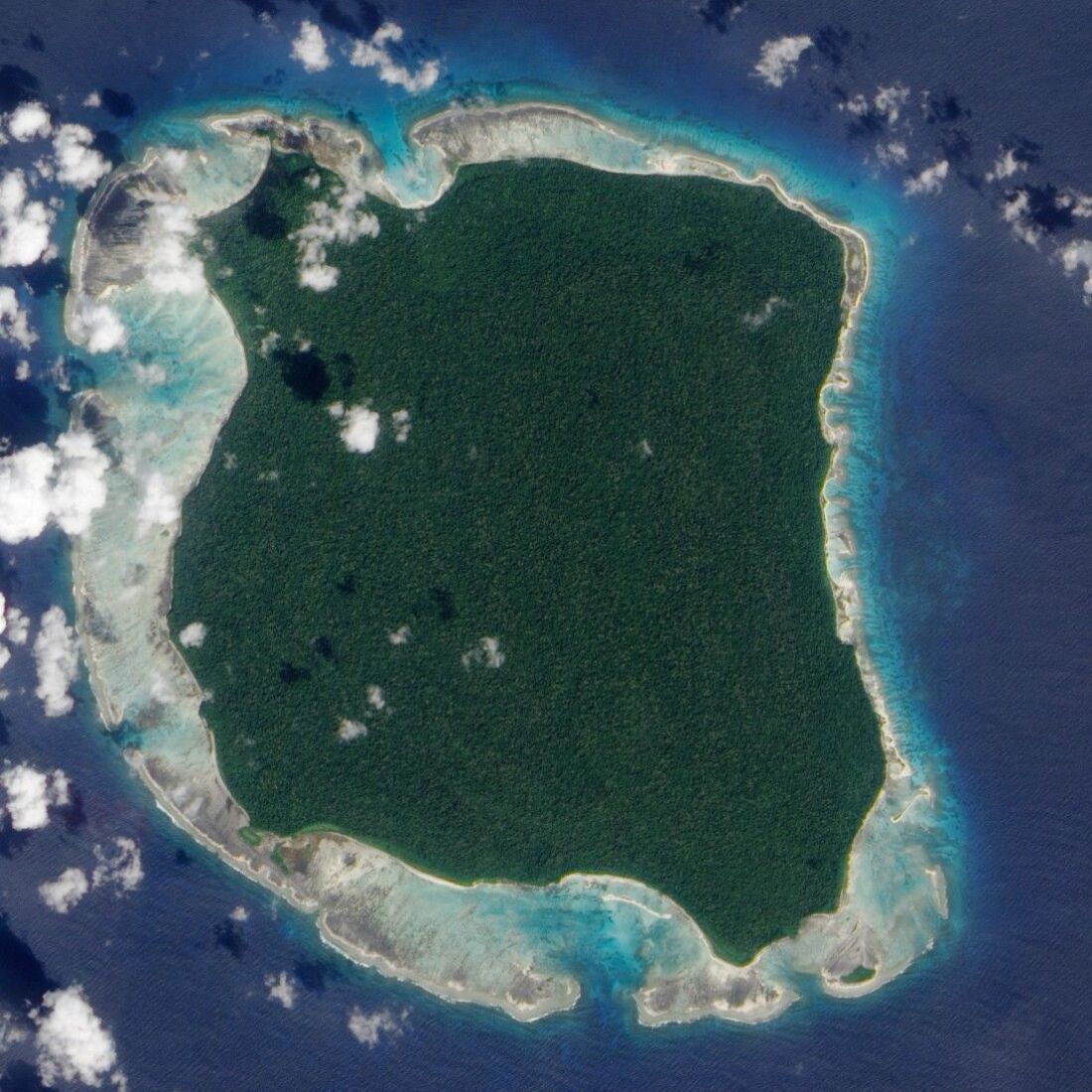
Across the Indian Ocean, scattered islands form the Andaman archipelago, a chain of tropical forests and coral beaches located between India and Southeast Asia. Among these islands lies one of the most isolated places on Earth. North Sentinel Island, covered with dense jungle and surrounded by shallow reefs, has remained largely untouched by the modern world.
The island is home to the Sentinelese, an Indigenous community believed to have lived there for thousands of years. Anthropologists consider them one of the few remaining uncontacted tribes. Their language, customs, and daily life remain largely unknown because meaningful communication with them has never been established.
Unlike many other Indigenous communities that eventually encountered outside societies, the Sentinelese have consistently resisted outside contact. Visitors approaching the island have often been met with arrows or warnings from the shoreline.
These reactions are not unusual in the history of isolated societies. Communities that have lived independently for long periods often view outsiders with caution, especially when earlier encounters involved threats or violence.
Government authorities in India have recognized the importance of protecting the Sentinelese from outside interference. The island is officially designated as a restricted area, and ships are required to remain several kilometers away from its shores.
Anthropologists studying remote cultures often emphasize that isolation can protect communities from diseases carried by outsiders. Many uncontacted tribes lack immunity to illnesses that are common in other parts of the world. Even a minor infection could have devastating consequences.
Because of this risk, Indian officials have adopted a policy of minimal contact with the Sentinelese. The goal is to respect their independence while avoiding actions that might harm the community.
The island occasionally appears in international news when rare incidents occur near its coastline. In most cases authorities reinforce the same message. The Sentinelese should be left alone.
Anthropologist T. N. Pandit, who participated in some of the earliest attempts to observe the tribe from a distance, once described the situation in clear terms.
“They have chosen isolation, and we must respect that choice.”
Satellite imagery of North Sentinel Island shows thick forest stretching across the entire landmass. Beaches and coral reefs form a natural barrier around the island, making landing difficult even for experienced sailors.
From the air the island appears peaceful, with green canopy covering nearly every part of the landscape. Yet what happens beneath those trees remains largely unknown to the outside world.
Modern technology has mapped nearly every corner of the planet, but North Sentinel Island remains one of the few places where human activity continues largely undocumented.
For anthropologists and historians, the island represents a rare glimpse into how small human societies lived before widespread global contact reshaped the world.
For the Sentinelese themselves, however, the island is simply home.
Protected by law and geography, North Sentinel Island remains one of the last places on Earth where a community continues to live according to its own traditions, far removed from the modern world surrounding it.