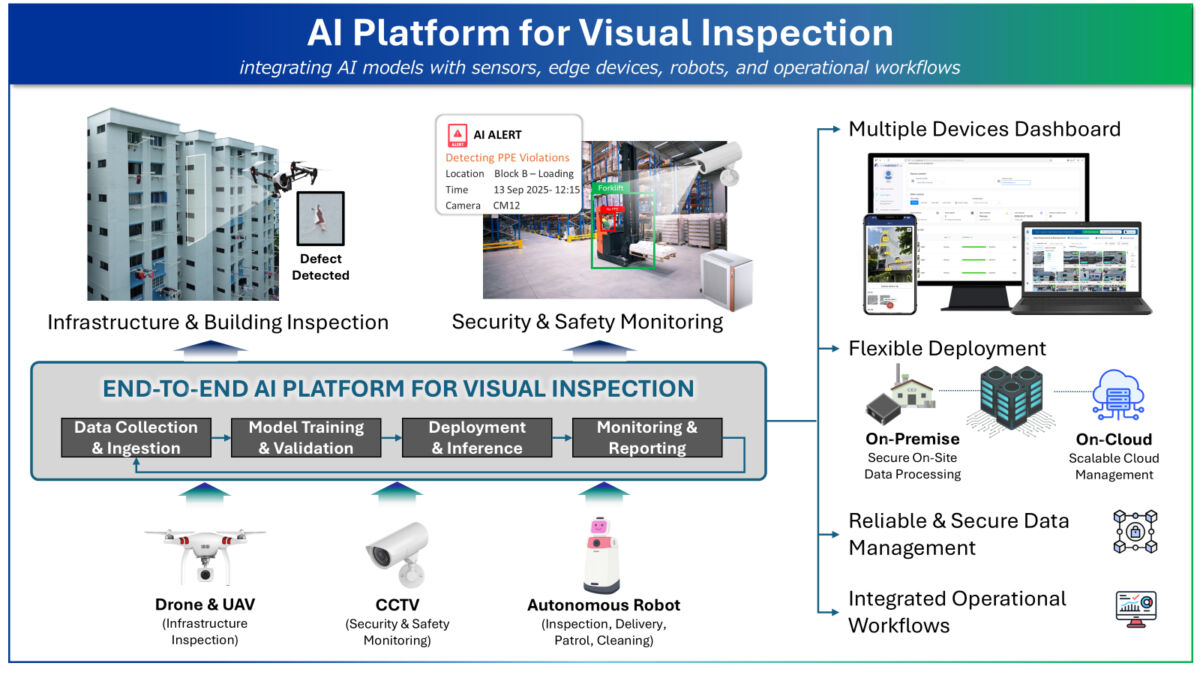
Panasonic Holdings Corporation has announced the global launch of licensing for its AI Platform for Visual Inspection, a technology designed to automate and enhance inspection processes across industries including infrastructure, construction, manufacturing, and safety monitoring. The platform was developed by the Panasonic R&D Center Singapore and represents the company’s first initiative to globally license technologies originating from the Singapore research center.
The new platform aims to support organizations seeking to introduce artificial intelligence into field operations where visual inspection plays a critical role. By combining data analysis, machine learning models, and operational monitoring tools, the system provides an integrated solution that simplifies the adoption of AI-driven inspection systems while reducing development complexity.
Panasonic R&D Center Singapore, established in 1990, has long been a key research hub for the Panasonic Group. Over the decades, the center has contributed to digital technology development including advanced audio visual signal processing and television image processing technologies. In recent years the center has expanded its work in artificial intelligence across multiple business domains such as home appliances, professional AV systems, facial recognition technologies, and automotive solutions.
This technological background provided the foundation for developing the AI Platform for Visual Inspection, which is designed as a comprehensive system that supports the entire lifecycle of AI implementation. The platform covers data management, AI model training, validation, deployment, reporting, and ongoing monitoring. By integrating these functions into a single environment, organizations can move more easily from early testing stages to full commercial deployment.
The platform is designed to operate across a variety of infrastructure environments, including on premises systems, cloud environments, and hybrid configurations. This flexibility allows organizations to deploy the technology according to their operational needs while maintaining strong standards for data security and privacy protection.
Panasonic states that the technology can support a wide range of inspection related tasks. In the construction and infrastructure sectors, the platform can assist in building inspection and construction quality assurance. In manufacturing environments, it can be used for production line inspection and safety monitoring in factories and industrial plants. The system can also integrate with CCTV monitoring networks to support safety management and operational oversight.
A key feature of the platform is its flexible architecture, which supports input from multiple devices including drones, robots, surveillance cameras, and industrial computing systems. This capability enables organizations to deploy visual inspection technologies across complex operational environments while managing data within a unified system.
Another major component of the platform is its focus on data reliability and security. Panasonic has integrated blockchain based data management into the system, helping ensure that inspection records remain tamper resistant and verifiable. This approach supports organizations that must maintain strong data integrity standards for regulatory compliance or operational auditing.
The company notes that the platform has already demonstrated practical applications through real world inspection scenarios such as building facade inspection, factory safety monitoring, and visual analysis within manufacturing environments. These operational use cases have helped refine the platform’s workflows, improving reporting speed and increasing efficiency in field operations.
The technology has also been adopted by NovaPeak Pte Ltd, a Singapore based drone service provider, for its building inspection solution known as LiveInspect.AI. NovaPeak has significant experience operating in safety critical inspection environments and has conducted facade inspections on more than one thousand buildings in Singapore.
Through the integration of drone captured imagery with AI driven analysis and automated reporting, the platform enables inspection teams to conduct large scale assessments more efficiently while maintaining strong standards for accuracy and documentation. Panasonic notes that the system supports operational reliability and auditability, which are essential for large infrastructure inspection programs.
Looking ahead, Panasonic plans to position the AI Platform for Visual Inspection as a key technological foundation for collaboration with partners around the world. The company intends to expand partnerships across sectors such as construction, infrastructure management, manufacturing, logistics, and public services.
By making the platform available through global licensing, Panasonic aims to accelerate the adoption of AI based inspection technologies in a wide range of industries. The company believes the platform will help improve infrastructure safety, increase workforce efficiency, and support organizations seeking to achieve higher levels of productivity and quality in field operations.
Panasonic Holdings Corporation stated that the initiative reflects its broader strategy of delivering advanced technologies developed within its global research network to industry partners and operational environments worldwide.