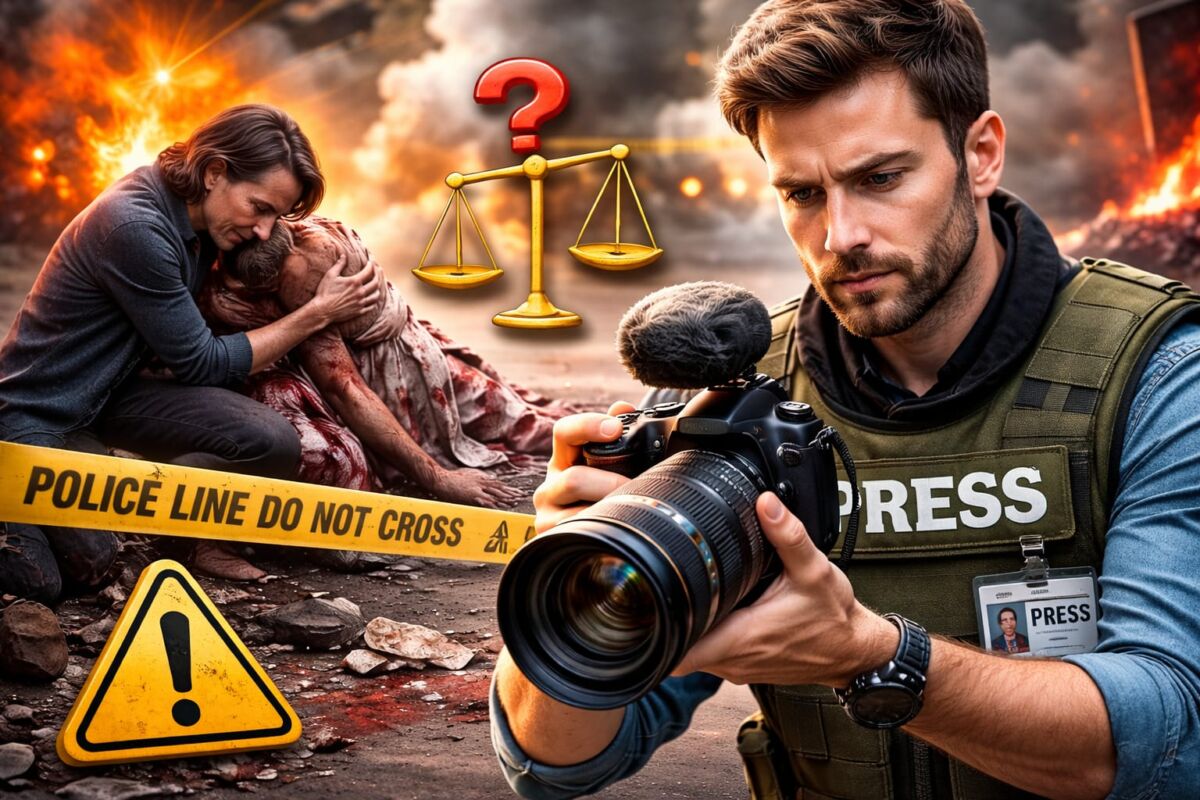
When photographers talk about photojournalism ethics, they often mention accuracy, captions and editing. Those things matter, but they are the easy part. The harder questions appear when you walk into a neighbourhood that has just been torn apart by a fire, a crash, a flood or an act of violence. Photographing tragedy is not just a technical or artistic choice. It is a decision about how you enter someone else’s worst day, how you behave inside it, and how your pictures will live inside that community’s memory long after you leave.
The first thing that usually disappears in these moments is the illusion of invisibility. In calmer situations, documentary photography can feel discreet. On a street corner or at a public event, people may ignore you or fold you into the scene. At a funeral, a crime scene perimeter or an evacuation centre, the atmosphere is entirely different. People see you as soon as you arrive. They read the camera before they read your face. That is where photojournalism ethics really starts. You are no longer just a professional with a job. You are a visible symbol of the outside world walking into a space filled with shock and grief.
Respect in these situations is not a soft extra. It is the base layer. Sometimes that respect looks like asking for permission. Sometimes it looks like moving slower, staying at a distance, or choosing a quieter frame that shows the scene without putting a lens inches from someone who is breaking down. There are also moments when the most ethical decision in tragedy photography is to take no photograph at all. That choice can cost you in the newsroom. An editor may ask why certain frames do not exist. A rival outlet may publish more graphic images. Still, ethics in photography does not disappear because the story is big. The weight of the moment is not a free pass to take everything you can.
The line between documenting and exploiting can be thin, but you feel it in your body long before you can put it into words. Photojournalism ethics asks you to pay attention to that feeling. Are you showing what happened, or are you hunting for expressions that will shock, anger or entertain people who were not there? A wide shot that shows firefighters, smoke and a row of houses may be less dramatic than a tight close-up of a distraught face, but it can still tell the truth. In many cases, the context of the tragedy says more than an image of a person in their most vulnerable moment ever could.
Tragedy photography is rarely tidy. Domestic violence calls, armed stand-offs, road accidents and sudden deaths all carry different kinds of tension. At a wildfire line, people may be exhausted and numb as they watch flames approach. At a fatal crash, loved ones might arrive in waves and learn the news in real time. In those minutes, you are moving around police, paramedics, neighbours and family members. Every step you take has weight. Getting physically closer might make a stronger frame, but if it pulls focus away from safety or increases panic, it is a bad ethical choice, no matter how sharp the image looks on screen.
Photojournalism ethics is also about understanding that you are part of the event, not outside it. Your presence can change how people behave. A grieving parent may shield their child, an officer might reposition themselves, or a witness may hold back from speaking loudly because they see your camera. That shift is unavoidable, but how you manage it is up to you. Speaking to people calmly, keeping your body language open, and showing patience when someone tells you no are all part of responsible news photography.
There is another side to this work that is rarely discussed when we talk about ethics in photography, and that is the impact on the photographer. Being around death, loss and violence does not leave you untouched. You might push the emotions away while you are working, but they often return later in the car, at home, or days afterwards when you least expect it. Good photojournalism ethics includes self-care. That can mean talking with colleagues, taking breaks from the hardest assignments, or seeking professional support when needed. You cannot cover tragedy for long if you pretend it never affects you.
In recent years, the dynamic at tragic scenes has also changed because almost everyone carries a camera. Bystanders film live on their phones, stream to social platforms, and upload images before emergency services have even cleared the scene. It is tempting to believe that if the public is already recording, your standards as a news photographer no longer matter. The opposite is true. Your picture desk, your publication and your own name are attached to images that may be used as reference long after social clips disappear. The way you apply ethics in photography sets a quiet benchmark, even when the wider crowd around you does not.
Trust is the long game in documentary photography. Communities remember how you behaved at your last visit. If you arrived respectfully, kept your distance when needed, and produced work that treated people as human beings rather than props, they are more likely to accept you the next time something happens. The same is true for first responders. Firefighters, medics and police officers notice whether you listen when they ask you to move, whether you stay behind agreed lines, and whether your presence makes their work harder or easier. Ethics in photojournalism is not only about the frame; it is also about how people feel in the moments around it.
None of this means you should stay away from difficult stories. Documentary photography has always played an important role in showing the real cost of disaster, conflict and neglect. Images from tragedies can push authorities to act, keep public attention on long-running crises, and give a face to statistics that might otherwise be ignored. The core idea is simple. You can show what happened without stripping people of their dignity. You can report on a community’s worst days while still seeing the people in front of you as more than subjects.
In the end, the ethics no one teaches you about photographing tragedy are learned slowly: standing at tape lines, talking to families after the camera is lowered, listening to survivors months or years later, and noting which images they can live with and which they cannot. Over time, those experiences shape your instinct more than any policy document ever will. Photojournalism ethics in times of tragedy is not about memorising rules. It is about choosing, again and again, to put respect, care and accuracy at the centre of how you work, even when no one is watching.
What is photojournalism ethics in tragedy coverage?
It is the set of values and decisions that guide how you photograph tragic events, including when to shoot, when to step back, and how to show what happened without exploiting people who are suffering.
How can I photograph tragedy without exploiting people?
Focus on context more than shock, avoid pushing into private grief, ask permission when possible, and choose frames that tell the story without showing people at their most exposed moment.
Why is it important to consider families and communities in tragedy photography?
Families and communities live with those images long after the news cycle moves on. Ethical documentary photography aims to respect their dignity while still showing the reality of the event.
Do I always need consent to photograph tragedy?
In many countries, news photography in public spaces is legally allowed without consent, but ethics goes beyond the law. If a picture will clearly identify someone in deep distress, it is worth stopping to think whether taking or publishing it is necessary.
How can photographers protect their own mental health when covering tragedy?
Talking with colleagues, debriefing after difficult assignments, limiting the volume of traumatic work, and seeking professional support when needed are all part of a healthy long-term approach to covering hard news.