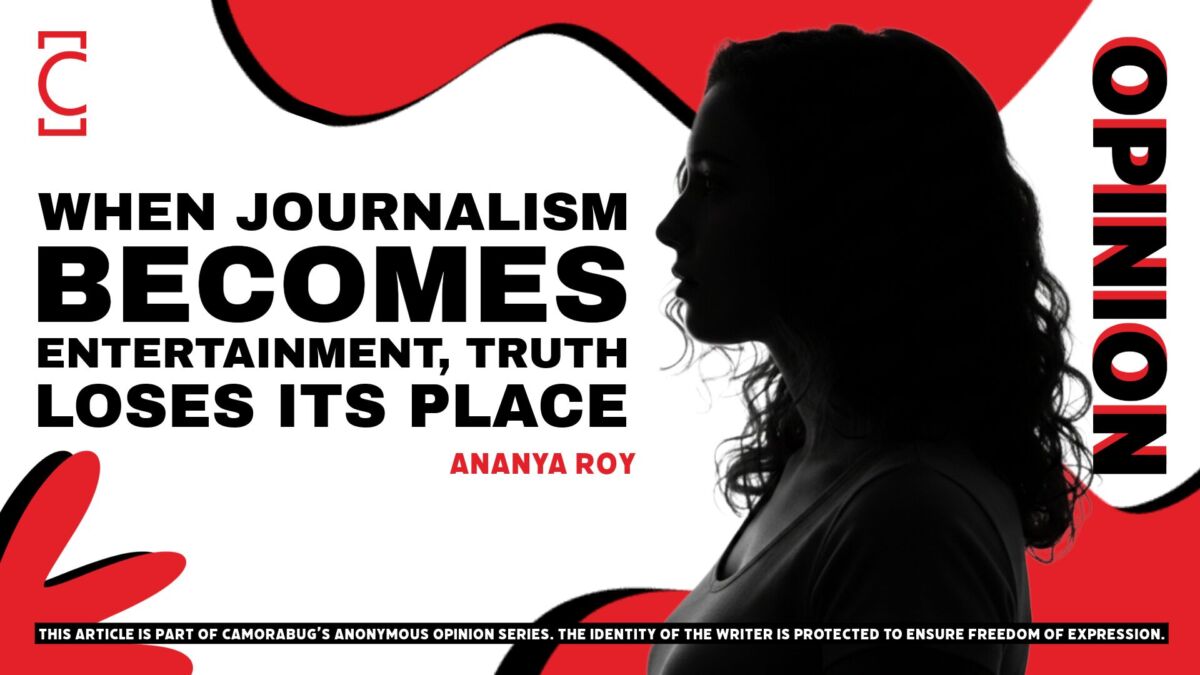
There was a time when journalism was about responsibility. A journalist was someone who stood between power and the public, someone who asked uncomfortable questions, verified facts, and spoke carefully because words had consequences. Today, journalism ethics is slowly being replaced by something far less serious. It is being shaped by entertainment logic. News is no longer presented to inform. It is presented to excite, provoke, and perform.
The shift did not happen overnight. It came quietly, disguised as innovation. Faster updates. Shorter videos. Catchier headlines. Brighter studios. More dramatic delivery. All of it seemed harmless at first. But slowly, the purpose changed. Newsrooms started competing not on accuracy but on attention. Truth became secondary to reaction.
Media sensationalism now defines how stories are framed. A small disagreement becomes a national conflict. A rumor becomes breaking news. A complex issue becomes a shouting match. Context is sacrificed because it slows things down. Balance is avoided because it feels boring. Calm reporting is replaced by aggressive performance.
Digital journalism promised freedom from old limitations, but it brought new chains. Algorithms decide what is important. Metrics decide what gets coverage. Virality decides what is worth discussing. Journalism ethics cannot survive when value is measured only in clicks.
The result is a media environment where noise is rewarded and depth is punished. Journalists are under pressure to become entertainers. Anchors are expected to perform, not reflect. Reporters are expected to provoke, not investigate. This is not journalism. This is stage performance wearing the costume of news.
News credibility suffers in silence. When people sense exaggeration, they stop trusting. When every story feels dramatic, no story feels real. Audiences become tired, skeptical, and emotionally disconnected. They stop listening not because they do not care, but because they no longer believe.
The tragedy is that many journalists themselves are uncomfortable with this change. They enter the profession to tell stories, not to become characters. But the industry pushes them toward spectacle. Quiet truth does not sell as well as loud conflict.
Truth in media requires patience. It requires uncertainty. It requires humility. Entertainment requires certainty, speed, and confidence. These two values cannot coexist easily. One serves the public. The other serves the platform.
We are now in a time where news looks powerful but feels hollow. The presentation is polished, the graphics are impressive, the language is sharp, but the substance is often thin. Journalism ethics cannot survive in a space where appearance matters more than accuracy.
This transformation is dangerous because journalism shapes society’s memory. It decides what matters. It decides what gets remembered. If news becomes entertainment, history becomes distortion.
Real journalism does not need drama. Reality is dramatic enough. It only needs honesty, restraint, and responsibility. It needs journalists who are willing to lose attention to protect integrity. It needs editors who are willing to slow down instead of speeding up.
The future of journalism depends on whether we still value truth more than performance. Whether we still believe news is a public service, not a product. Whether journalism ethics is treated as a foundation or as an inconvenience.
If journalism loses its seriousness, society loses its mirror. And without a mirror, we stop recognizing ourselves.