
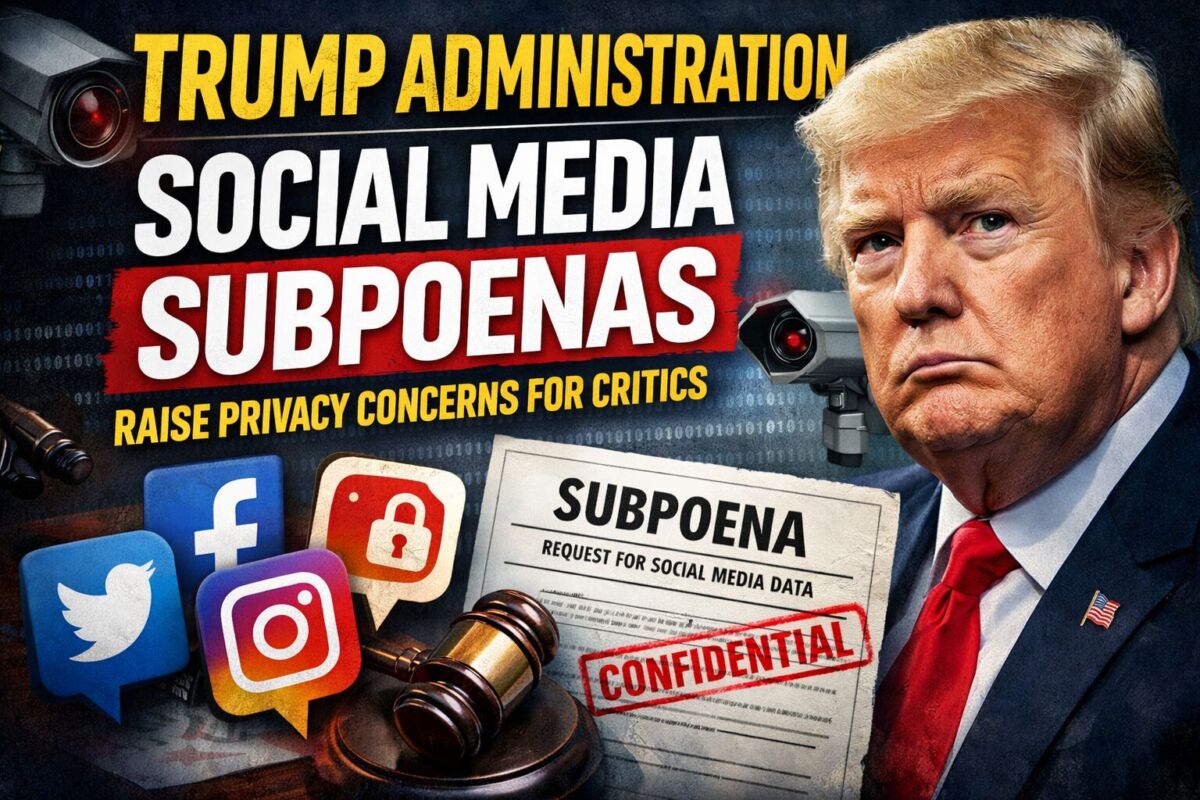
Reports published this week indicate that the U.S. Department of Homeland Security has issued administrative subpoenas to several social media companies, requesting identifying information connected to users who have publicly criticized Donald Trump or who operate anonymous accounts tracking immigration enforcement activity. According to technology outlet reporting, the requests target account data rather than simply public posts, raising questions about how much personal information platforms may be willing to share without a court order.
Administrative subpoenas differ from traditional judicial warrants because they are issued directly by a federal agency rather than a judge. Legal experts note that private companies are not automatically obligated to comply unless the request is backed by a court order. Steve Stransky, an adjunct law professor at Case Western Reserve University, explained in recent commentary that companies can challenge or refuse administrative subpoenas if they choose, though practices vary across the technology sector. Some firms resist broad data demands, while others cooperate, particularly when they interpret requests as falling within existing law enforcement authority.
One high profile case involved Google, which reportedly provided information about a retiree who had emailed a federal prosecutor regarding an immigration matter. After civil liberties organizations intervened, the subpoena in that instance was withdrawn, but the episode highlighted how easily online activity can become subject to federal scrutiny once data resides on corporate servers.
At the center of the debate is a long standing legal principle often referred to as the third party doctrine. Under U.S. Supreme Court precedent, individuals generally have limited privacy protections for information voluntarily shared with third parties, including internet service providers and social media companies. In practical terms, that means posts, messages and metadata stored by platforms may not carry the same expectation of privacy as information kept entirely offline. Most users consent to this framework when they accept terms of service agreements, documents that frequently include provisions outlining how and when companies may disclose data to government authorities.
Critics argue that this legal architecture, developed decades before the modern internet, fails to reflect the scale and intimacy of digital life. Social media platforms function as public squares, private diaries and communication hubs all at once. While a post may be visible only to approved followers, the underlying account information remains accessible to the company itself. If compelled or persuaded to share that data, the company becomes an intermediary between citizens and the state.
The question of whether such efforts infringe on free speech protections is more complex than it first appears. The First Amendment prohibits the government from punishing individuals for protected speech, but it does not prevent authorities from investigating credible threats or criminal conduct. Legal scholars emphasize that the constitutional violation would arise if the government targeted individuals solely because of their political views rather than for legitimate law enforcement purposes. In practice, distinguishing between protected dissent and actionable threats can be contentious.
Paul Gowder, a professor at Northwestern Pritzker School of Law, has noted that while ideological retaliation would clearly raise constitutional red flags, the involvement of private platforms complicates the analysis. When a social media company voluntarily cooperates with a government request, the dynamic shifts from direct state action to a layered relationship between user, corporation and agency. Courts have historically treated these interactions differently from overt censorship.
Technology security professionals add another dimension to the conversation. Dave Chronister, CEO of Parameter Security, has argued that the infrastructure enabling data requests has been in place for years, particularly in immigration and visa screening contexts. Social media vetting of visa applicants began during earlier administrations and expanded over time. What appears new, according to observers, is the alleged focus on critics within the United States rather than solely on foreign nationals.
Even so, experts caution against overstating the practical consequences for the average user. Federal agencies operate within limited investigative resources and typically prioritize cases involving terrorism, cybercrime, narcotics trafficking and national security. Monitoring every critical tweet or post would require vast manpower and would likely divert attention from established enforcement priorities. While selective investigations may occur, broad scale retaliation against millions of users is widely viewed as implausible from an operational standpoint.
That does not mean concerns are unfounded. The broader context is what some analysts describe as a surveillance economy, a system in which enormous quantities of personal data are routinely collected, stored and monetized by private companies. Governments can access this data through subpoenas, contracts with data brokers or publicly available scraping. The boundary between corporate data mining and state surveillance has grown increasingly porous. In that environment, administrative subpoenas become only one pathway among many.
Border enforcement practices illustrate how normalized digital searches have become. Federal agents have, in certain circumstances, inspected phones and social media accounts at ports of entry. Civil liberties advocates argue that such practices blur the line between security screening and invasive monitoring, particularly when travelers are asked to unlock devices or disclose passwords. Although courts have imposed some limits, the legal landscape remains unsettled.
For individuals worried about potential scrutiny, the options are limited. Strengthening account security, understanding platform privacy settings and being aware of terms of service can mitigate some risk, but they do not eliminate the fundamental issue that data stored on corporate servers may be disclosed. Legal scholars frequently point out that the only absolute method of preventing access is not generating the data in the first place, an unrealistic expectation in a world where digital communication underpins professional and personal life.
Ultimately, the controversy surrounding social media subpoenas reflects a deeper tension between national security authority and democratic accountability. In liberal democracies, criticism of elected officials is not merely tolerated but protected. At the same time, governments maintain investigative powers intended to safeguard public safety. The friction arises when citizens perceive those powers as being used to chill dissent rather than address genuine threats.
As debates unfold, the constitutional framework remains intact but contested. Agencies insist that any data requests fall within lawful authority, while civil liberties organizations continue to monitor for overreach. Whether these reported efforts signal a significant expansion of federal surveillance or represent isolated enforcement actions will likely depend on future disclosures and court challenges.
For now, the episode serves as a reminder of how intertwined speech and data have become. A social media post may feel ephemeral, but it travels through systems governed by corporate policy and federal law. In that sense, the question is not only about one administration or one agency, but about the long term balance between privacy, power and participation in a digital society.
Can the government access private social media accounts?
If data is stored by a social media company, the government may request it through legal processes such as subpoenas or warrants. Compliance depends on the company and the nature of the request.
Does this violate the First Amendment?
Targeting individuals solely for protected political speech would raise constitutional concerns. However, investigations tied to credible threats or criminal conduct are treated differently under the law.
Are administrative subpoenas legally binding?
They are issued by federal agencies, but companies can challenge them unless reinforced by a court order.
What can users do to protect themselves?
Understanding privacy settings, limiting personal data shared online and reviewing terms of service can help, though no method guarantees complete privacy once data is stored on corporate servers.
