Photography did not begin with small cameras or digital sensors. Its origins trace back to a time when scientists and inventors were still trying to understand how light could be recorded permanently. For centuries artists had used devices such as the camera obscura, a simple box or room with a small hole that projected an image of the outside world onto a surface.
The projected image looked real but disappeared as soon as the light source changed. The challenge for early experimenters was finding a way to capture that projection and preserve it.
One of the individuals who became deeply interested in this problem was a French inventor named Joseph Nicéphore Niépce. Living in the countryside of Burgundy during the early nineteenth century, Niépce spent years experimenting with chemical substances that might react to light and produce permanent images.
His early attempts involved coating metal plates with materials that hardened when exposed to sunlight. By placing these coated plates inside a camera obscura and allowing light to fall on them for extended periods, he hoped that the brighter areas would become fixed while darker areas remained unchanged.
After many experiments, Niépce finally achieved a breakthrough around 1826 or 1827.
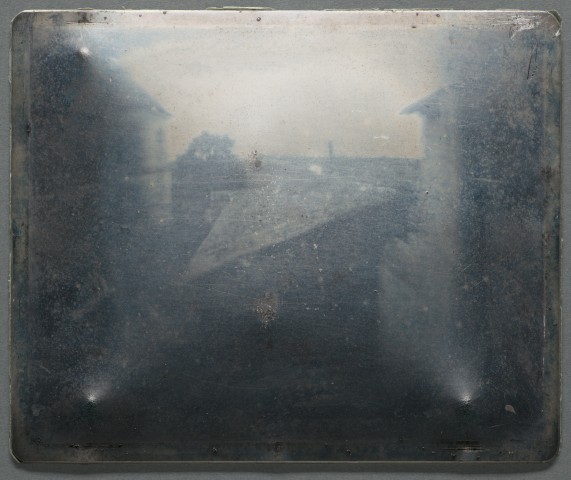
Using a camera positioned at the window of his home, he exposed a pewter plate coated with bitumen of Judea, a naturally occurring asphalt substance that becomes harder when exposed to light. The exposure lasted several hours, possibly as long as eight hours or more.
When the process was complete, the plate revealed a faint but recognizable image of rooftops, buildings, and a courtyard illuminated by the sun.
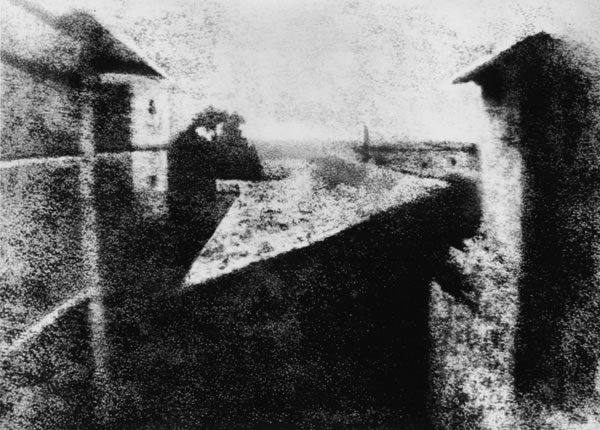
The photograph is known today as View from the Window at Le Gras.
Although the image appears grainy and indistinct compared with modern photography, it represents the first successful attempt to capture and preserve a photographic image from real life.
Photography historian Beaumont Newhall once described the achievement in simple terms.
“It was the first time the camera’s image was permanently fixed.”
The process Niépce used became known as heliography, meaning “sun writing.” While the exposure times were extremely long and the results difficult to reproduce, the invention demonstrated that light itself could be used to record images permanently.
Niépce later began collaborating with another French inventor, Louis Daguerre, who continued developing photographic techniques after Niépce’s death. Daguerre eventually introduced the daguerreotype process in 1839, which dramatically reduced exposure times and produced sharper images.
The announcement of the daguerreotype process is often considered the moment photography entered public awareness. However, the foundation for that breakthrough came from Niépce’s earlier experiments.
Today the original photograph taken by Niépce is preserved at the University of Texas at Austin. Despite its faint appearance, the image remains one of the most important artifacts in the history of photography.
Standing before that small metal plate, viewers can see the moment when humanity first succeeded in capturing the world through a camera lens. The rooftops and courtyard visible in the photograph may appear ordinary, but the process used to record them changed visual history forever.
From that single image captured from a window in rural France, photography gradually evolved into one of the most powerful tools for documenting life, art, science, and history across the world.