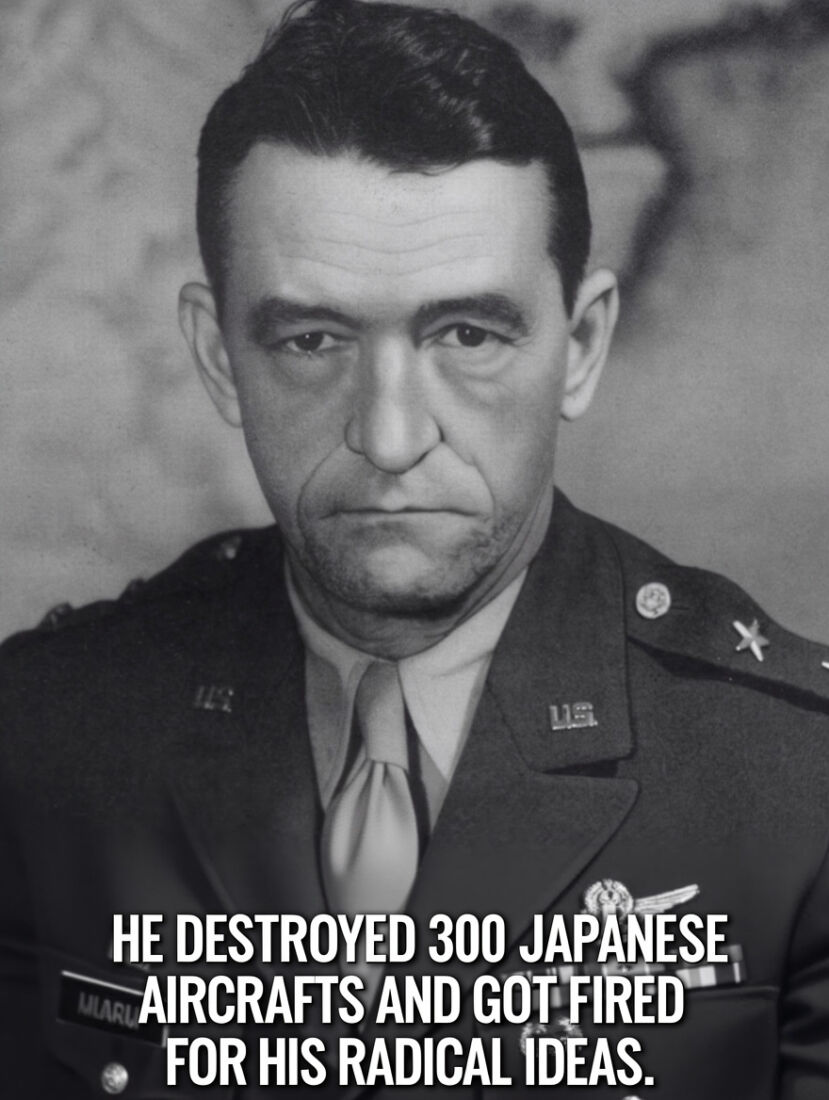
Claire Lee Chennault was a problem.
By 1937, he’d spent 20 years in the U.S. Army Air Corps developing tactical theories that his superiors hated. He believed pursuit aircraft—fighters—should be the backbone of air power, not bombers. He believed tactical coordination and surprise mattered more than raw performance. He believed dogfighting was a sucker’s game.
The Air Corps establishment disagreed. Loudly. They believed in strategic bombing. In massive formations of bombers that didn’t need fighter escorts. In technological superiority solving all problems.
Chennault kept arguing. Kept writing memos. Kept pushing his theories.
In 1937, the Air Corps essentially fired him. They retired him early at the rank of captain due to “health reasons”—chronic bronchitis and partial deafness. The real reason: he was a pain in the ass who wouldn’t shut up about tactics no one wanted to hear.
Claire Chennault was 47 years old, retired against his will, and convinced the entire U.S. military establishment was wrong about how to fight an air war.
Then he got a job offer from China.
Chiang Kai-shek, leader of Nationalist China, was fighting a losing war against Japan. Japanese aircraft were bombing Chinese cities with impunity. China had almost no air defense. They needed help desperately.
They hired Chennault as a civilian advisor.
In 1941, with secret approval from President Franklin Roosevelt, Chennault formed the American Volunteer Group—the AVG. He recruited American pilots from the Army, Navy, and Marines with a simple pitch: come fight in China. We’ll pay you $600 a month plus $500 for every Japanese plane you shoot down.
They were mercenaries, technically. Volunteers officially. Patriots in their own minds.
Chennault gave them Curtiss P-40 Warhawk fighters—planes the British had rejected as obsolete and sold to China instead. The P-40 was tough and heavily armed, but it had critical weaknesses.
It was slower than the Japanese Mitsubishi A6M Zero. It couldn’t turn as tightly. It couldn’t climb as fast. In a traditional dogfight—circling, turning, trying to get on the enemy’s tail—the Zero would win every time.
Most commanders would have looked at that matchup and despaired. Chennault saw an opportunity.
He completely rewrote how his pilots would fight.
“You will not dogfight,” he told them. “You will climb higher than the enemy. You will wait. You will dive at high speed. You will fire one pass. And then you will exit immediately and climb back to altitude. You will not turn with them. You will not chase them. You will not engage in equal combat.”
It was hit-and-run warfare applied to air combat. Use the P-40’s strengths—diving speed, heavy armor, powerful guns—and avoid its weaknesses by never fighting fair.
The pilots hated it at first. They were fighter jocks. They wanted to dogfight. Wanted to prove their skill in turning battles.
Chennault didn’t care what they wanted. “You fight my way or you don’t fight at all.”
Then he did something even more radical: he built a ground warning network across hundreds of miles of Chinese territory.
Chinese villagers were stationed with binoculars and radios. When they spotted Japanese aircraft, they reported altitude, direction, and numbers. Radio operators relayed the information to Chennault’s headquarters. Pilots launched before the Japanese bombers even reached their targets.
By the time Japanese formations arrived, P-40s were already at altitude, positioned perfectly for diving attacks.
The Japanese had no idea what hit them.
On December 20, 1941—two weeks after Pearl Harbor—the Flying Tigers flew their first combat mission. Ten P-40s intercepted a Japanese bomber formation over Kunming.
They climbed to 18,000 feet. Waited. Dove at over 400 mph. Fired into the bomber formation. Climbed back to altitude before the Zero escorts could react.
They shot down three bombers without losing a single aircraft.
The tactic worked exactly as Chennault had designed it.
Over the next seven months, the Flying Tigers flew 31 combat missions. They faced a Japanese air force that outnumbered them, outperformed their aircraft, and had been dominating Chinese skies for years.
The results were devastating. For Japan.
The Flying Tigers destroyed approximately 300 Japanese aircraft. Some estimates go higher. They lost 12 pilots in combat—a kill ratio of roughly 25:1.
Twenty-five to one. With obsolete aircraft. Against superior fighters. Using tactics the American military establishment had rejected.
Chennault had proven his theories were right. He’d just had to go to China and fight a war as a civilian contractor to do it.
The P-40s became iconic. Chennault had them painted with shark teeth on the nose—a design borrowed from RAF aircraft in North Africa. The shark-mouthed P-40s became one of the most recognizable aircraft markings in history, symbols of aggressive, unconventional warfare.
But the real innovation wasn’t the paint. It was the system.
Chennault had built an integrated air defense network in a country with almost no infrastructure. He’d trained pilots to fight against their instincts—to avoid “honorable” combat and fight only on their terms. He’d coordinated ground observers, radio operators, and pilots across hundreds of miles.
He’d done all of this with chronic fuel shortages, limited spare parts, no supply chain, and pilots who were technically civilians fighting in a war their country hadn’t officially entered yet.
After Pearl Harbor, everything changed. The U.S. officially entered the war. The AVG was absorbed into the U.S. Army Air Forces as the China Air Task Force, later the 14th Air Force.
Chennault was recalled to active duty—this time as a brigadier general. The same Air Force that had forced him into retirement now needed him to run air operations in China.
Washington still didn’t fully accept his methods. They still prioritized strategic bombing over tactical air superiority. They still sent him minimal resources while pouring aircraft and supplies into Europe.
Chennault kept fighting. Kept using his hit-and-run tactics. Kept building warning networks. Kept proving that tactical innovation could overcome numerical and technological disadvantages.
By the end of the war, his forces in China had destroyed over 2,600 Japanese aircraft while losing fewer than 500 of their own.
He was promoted to major general. Given command of the entire China theater air operations. Vindicated in every way that mattered.
But here’s what makes Chennault’s story extraordinary: he didn’t just win with inferior equipment. He fundamentally changed how air combat was understood.
Before Chennault, dogfighting was considered the pinnacle of fighter combat. Turning battles. Pilot skill measured by maneuverability.
Chennault proved that was nonsense. The best fight is the one where the enemy can’t fight back. The best tactic is the one that uses your strengths and avoids your weaknesses. The best victory is the one where you don’t give the enemy a chance to win.
“Boom and Zoom” became standard fighter doctrine. Energy fighting. Altitude advantage. Hit fast and disengage.
The tactics Chennault invented with the Flying Tigers became the foundation of jet-age air combat. Korean War. Vietnam. Modern air superiority doctrine.
All of it traces back to a fired Air Force captain who went to China with obsolete planes and volunteer pilots and proved the establishment wrong.
Claire Chennault retired—again—in 1945. He died in 1958, largely forgotten by the Air Force that had rejected him.
But the pilots he trained, the tactics he invented, and the shark-toothed P-40s he led became legend.
“You’ve got to get there first, hit hard, and get out,” Chennault said.
That’s not just a tactical instruction. It’s a philosophy.
Don’t fight on your enemy’s terms. Don’t accept limitations as permanent. Don’t let conventional wisdom dictate what’s possible.
Claire Chennault was told his ideas were wrong. Told his tactics wouldn’t work. Told to retire and stay quiet.
He went to China instead. Took obsolete planes and volunteer pilots. Invented a new way to fight.
And destroyed 300 Japanese aircraft with a 25:1 kill ratio before America even officially entered the war.
Sometimes the person everyone fires is the one who was right all along.
They just had to prove it somewhere else first.
Source
Categories
Stories
Claire Lee Chennault was a problem….