The mechanical duty of any photographic camera, is to make pictures. But the quality of these pictures wholly depends on the skill of the operator.
The market offers you a great variety of cameras. They are designed for many specific purposes as well as for broad field of personal expression. It is YOU who are responsible for good or bad in your photographic pictures. It is YOU who are the directing brain behind your camera and whose will and conception the camera will obey in performance.
At the time you have your camera set to photograph a certain object, you are naturally under the impression that it is the best and most suitable position from which to photograph. You would not waste film if you did not think so. But when you present the print for criticism you discover that the picture you took is far from being perfect and contains many shortcomings.
In the course of friendly criticism of your picture making, you hear that your study is “poorly balanced in composition, flat, lacking life interest, has no meaning,” etc. In addition, there may be other shortages due to imperfect technical handling of the film and print.
As a matter of course, you take these helpful words of criticism with good spirit. You promise yourself not to repeat these mistakes in future pictures. Constructive criticism received from a reliable source is the best school for an aspiring photographer.
Every photographic picture is an accomplished record. It may be good and contain all of the requirements that constitute the pictorial composition. Pictorial composition requires, first of all that the subject of interest in the picture by its placement, action and mood tells the interesting story of its character situation and definition. To recognize the pictorial value of a study is to sense its story at first glance. The pictorial study should possess the quality that would induce the viewer’s mind into mood and imagination and as a consequence to the correct understanding of the concept of the pictorial story.
Let us illustrate it by an example. Suppose. you want to photograph a little girl. The child is pleasingly dressed and adorned with all the necessary additions becoming to a little beauty. If the picture is to be taken indoors, there are several settings may be found that will support and enhance the character study of the child. She may be placed on a large soft chair with a picture book on her lap; she may be placed by the window, looking out, and her little hands pressed against the window pane, or she may be found in the kitchen by the ice box, peeking inside. Many other interesting settings of the home.
life may be found to help in pictorial composition that would create a picture which at a glance will tell the story and depict the character of the little girl. Telling an interesting story by the picture is the requirement of pictorial composition.
If the little girl is to be photographed outdoors, the same requirements to pictorial composition are observed and in addition the value of colors are considered. Every color of the color spectrum has its own interpretation of grey in photography. The picture will appear flat and lacking distance if colored objects composing the picture are not distinctively in contrast with one to another. Supposing the little lady wears a white dress, it would be an error to photograph her against a background that is likewise of light color quality, unless the distance between the girl and the background is interposed by graceful lines of growing plants, fancy lines of tree twigs or something in pleasing but unattractive form to break tit.’. monotony of similar colors.
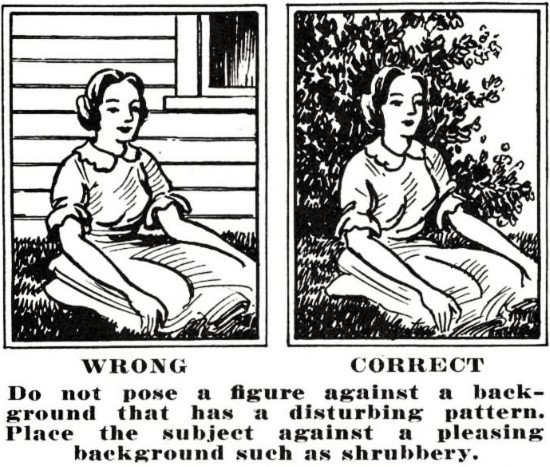
On the other hand, a sudden severe contrast of colors is also harmful. To photograph a white object against a dark background will destroy the illusion of distance and will produce the effort of harsh contrast.
The pictorial composition should include mood in the picture. The viewer’s mind must not only see what is in the picture but by its power, go beyond and be forced to imagine the charm connected with the pictorial print.
Again, we have to illustrate it by an example. Suppose you want to photograph a field. The stretch of a green field is always a tempting subject to photograph. As there are two large spaces occupied by colors, the green of the field and the blue of the sky, which do not harmonize very well by lack of contrast, such contrast must be found in appropriate horizon line which for the purpose may be set off by a line of distant trees or houses.
To portray distance of the field, there should not be trees in the foreground. To indicate a visual movement into the depth of the field, a pathway leading diagonally across the field may be included in the composition. The line of the horizon must be about two-thirds from the bottom of the study.
The spirit of appeal and mood is gained by showing in the foreground of the picture parts of an old fence, tall blades of grass, transparent bushes or a few stems of wild flowers. The insertion of grazing animals is beneficial to the spirit of composition. Human figures are not so appropriate unless they perform some action pertinent to the field. Picking wild flowers is appropriate for female and children figures; laboring, for male figures. For the sake of preserving the spirit of the field such human figures should avoid posing for portrait effects but be photographed as a part of the entire field study.
A pictorial study of any kind must radiate with pleasing appeal. Portraits from the Rogue’s Gallery are cold matter of fact records; while the graceful studies of children, flowers and pets are subjects of interest and admiration. Such pictures become treasured possessions in the home.
In contemplating a photographic study, this spirit of appeal should be strongly considered, especially in amateur photography, where the prints arc to portray episodes of a family’s life. A beautiful scenic view will eventually he forgotten but the inclusion of a familiar figure in the picture, gracefully posed in action will make that study live long.
It is good to photograph a snake on the road hut it is better to snap a young deer. The first will hardly ever be a winning subject for pictorial composition the second will be admired even at the expense of the composition.
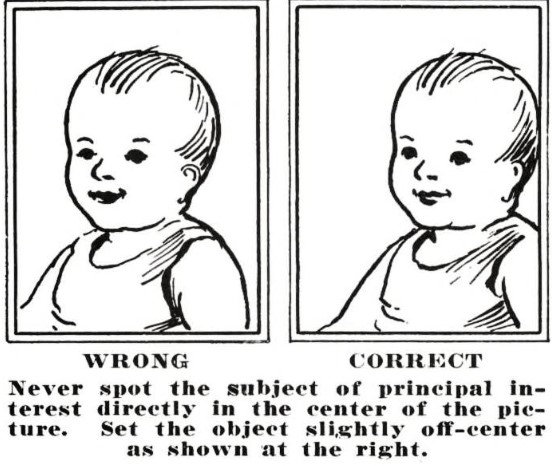
Do not place the main point of interest in the very center of the study. It should preferably be located somewhere in the area of the upper half of the study with the lower half containing leading lines and weight of colors.
The point of interest in its radiation must have sufficient area of space on the study. A portrait in profile should have enough space between the outer line of the face and the edge of the study. The line of horizon should be kept away from the center line of the study.
The line of leading movement must not be obstructed as it starts on the study. If a field has a fence in the foreground, it must show an open gate permitting progress along the pathway or road.
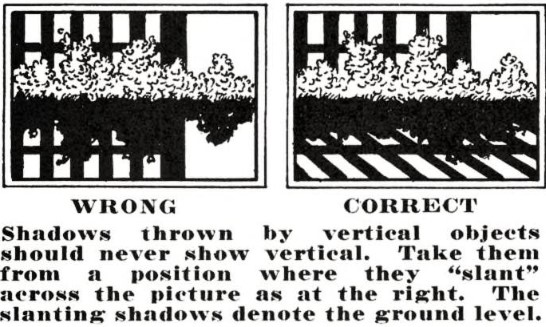
If the study contains long shadows, they add to conformity with pleasing composition if photographed in diagonal movement. These will serve as vital lines in composition. Many narrow shadows, like those of fence or a row of trees, may be vertical ,and so serve the conception of repetition which is one of the qualities of good composition.
The later part of the day is better indicated if the moving figures of the study are photographed on their way out of the picture. There is more vibration in the study if the figure is moving forward. Such conception is used to illustrate the earlier part of a day.
Observe rhythm in your pictorial studies. A beautiful girl gracefully dancing on the sand at the seashore flies her silken scarf. Her dress, her flowing hair, the shore line, the clouds, all should correspond in that movement of rhythm.
The photographic camera is an instrument to produce art. You as the owner of this art producing instrument are an Artist. In your attempts to be a photographer do not be content with just simply clicking the shutter of your camera, go farther.
You have a great sphere to explore and conquer by thinking, by research and by perseverance. Do not become a dark room crank, where only mechanical perfection is the goal, but rather develop that ability to perceive and capture pictures which are standards of art.