
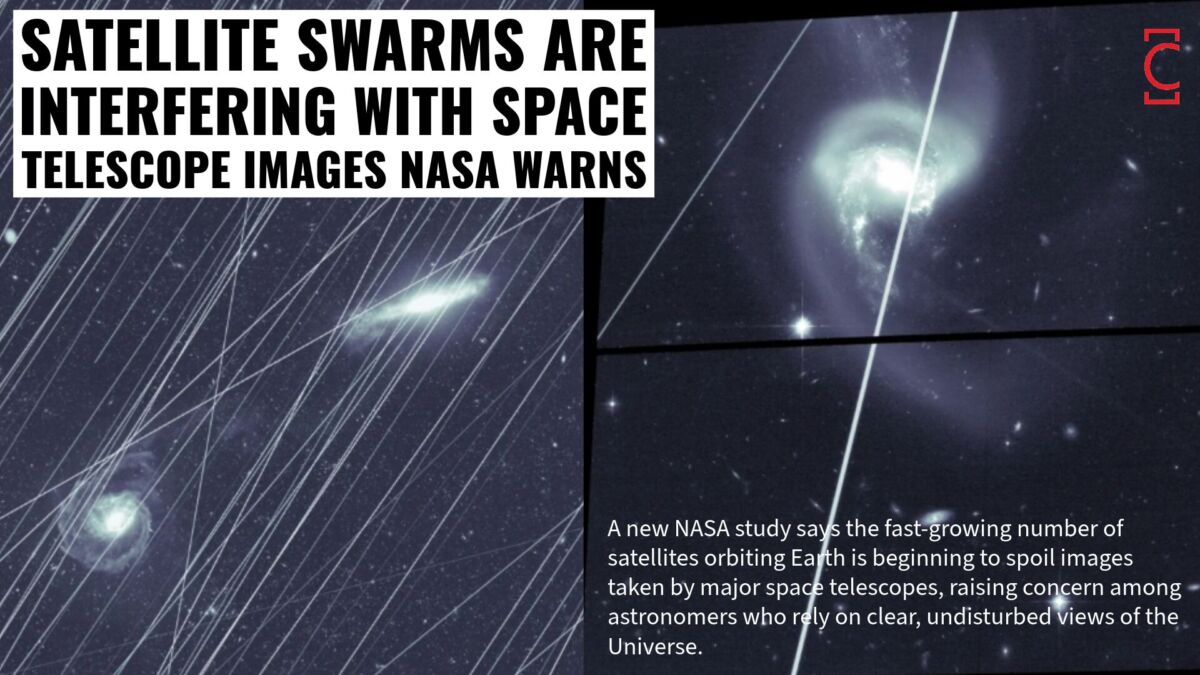
Satellite swarms are becoming an unexpected problem for astronomy. A NASA-led team has released new research showing that the rising number of satellites in low Earth orbit is leaving streaks, bright trails, and reflections across the images captured by space telescopes. The study, published in Nature, says this kind of interference could affect a huge share of scientific pictures over the next decade.
For years, telescopes in orbit were seen as the safest way to observe the Universe. Free from atmospheric haze and city lights, they offered clean views of faint galaxies, star clusters, and distant planets. But NASA scientists say that is no longer guaranteed. The increase in spacecraft used for global internet coverage and communications has created new challenges that no one predicted ten years ago.
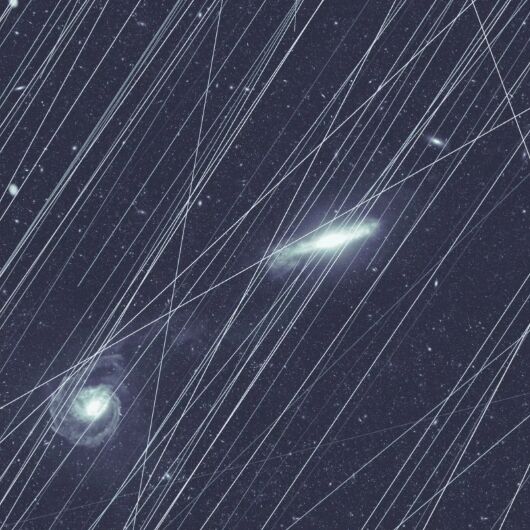
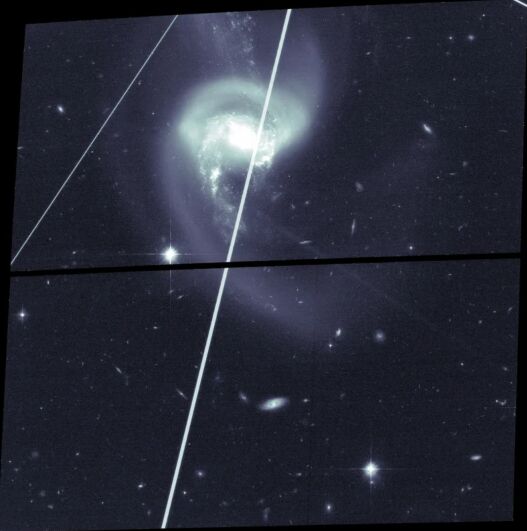
The team looked at four space observatories: NASA’s Hubble Space Telescope and SPHEREx, along with Europe’s planned ARRAKIHS mission and China’s upcoming Xuntian telescope. Their simulations suggest that Hubble could see satellite streaks in roughly 40 percent of its future images. For the other three telescopes, the projections are far worse, with up to 96 percent of images expected to contain some form of contamination. Hubble is less affected only because it studies small portions of the sky at a time.
Orbiting telescopes can normally detect very faint signals because they avoid the distortions created by Earth’s atmosphere. But when a bright satellite crosses the view, it can overpower the dim galaxies astronomers are trying to study. In some exposures, the passing line of light runs straight across the frame, washing out details that cannot be restored.
Alejandro Borlaff from NASA’s Ames Research Center, the lead author of the study, says the source of light pollution has shifted dramatically. In the past, astronomers worried mostly about ground-based interference. Today, it is spacecraft reflecting light from the Sun, Moon, and Earth that threaten to distort images. Borlaff explains that every time a satellite sweeps across a telescope’s view, it can erase part of the faint signal coming from distant cosmic sources.
The numbers behind the problem show how quickly the situation has changed. Around 2,000 satellites were in low Earth orbit in 2019. Today, that figure is close to 15,000. If companies continue with their current launch plans, the total could rise to more than half a million by the 2030s. Borlaff notes that more satellites were launched between 2021 and 2025 than during the entire previous seventy years of spaceflight.
The researchers used computer models to simulate how major satellite constellations behave, including clusters launched by Starlink, Amazon, and China’s Guowang network. They combined these models with the technical details of each telescope, such as orbit, viewing angle, and size of the field of view. By counting how many times satellites crossed each telescope’s line of sight, they measured the scale of the photobombing problem.
Satellites generate glare in several ways. Their solar panels reflect bright sunlight. Their surfaces reflect the glow of the Moon and Earth. Their components give off heat, adding unwanted infrared light. On top of that, radio signals bounce from their antennas, creating extra interference. All of this adds to the streaks scientists now see in images.
This contamination can even affect efforts to track asteroids. Trails from satellites can look similar to the faint signatures left by distant space rocks. Borlaff says this could make it harder to pick out potentially hazardous objects, since the streaks from a satellite can mimic the path of an asteroid.
Not all missions are vulnerable. Spacecraft positioned far from Earth, including the James Webb Space Telescope, Euclid, and NASA’s Nancy Grace Roman Space Telescope, sit well beyond the busy region where most satellites operate. Their more distant orbits keep them safe from the bright trails caused by low Earth orbit constellations.
At the moment, Starlink accounts for almost three quarters of all active satellites. But the study suggests that will change rapidly as new companies launch their own networks. Within twenty years, Starlink may make up only about ten percent of the total, simply because so many new satellites will be added by other providers.
The study notes that the most effective response would be to launch fewer satellites. But with global demand for communications, navigation services, and data growing every year, that option appears unlikely. NASA researchers say astronomers will now need to develop new tools and strategies to protect the scientific value of future space imagery.
For the scientific community, the message is clear. Satellite swarms are creating a new kind of light pollution in the sky, one that affects even the most advanced observatories. Without careful planning, the telescopes designed to show us the farthest corners of the Universe may struggle to see through the glow of the machines circling our own planet.
Space Science Update
Further reading on astronomy research: https://www.skyandtelescope.org
For more newsroom reports, visit https://camorabug.com/in-focus/news/
FAQ
Why are satellite swarms affecting space telescopes?
Because reflected light, heat signatures, and radio emissions from satellites create streaks across telescope images.
Which telescopes are most at risk?
SPHEREx, ARRAKIHS, and Xuntian could see streaks in nearly all of their images, according to NASA’s simulations.
Why is Hubble affected less?
Its field of view is narrow, reducing the chance of satellites crossing each frame.
Can streaks be removed digitally?
Some can be corrected, but many exposures lose scientific detail permanently.
Are all telescopes vulnerable?
No. Observatories in distant orbits such as the James Webb Space Telescope are mostly unaffected.
