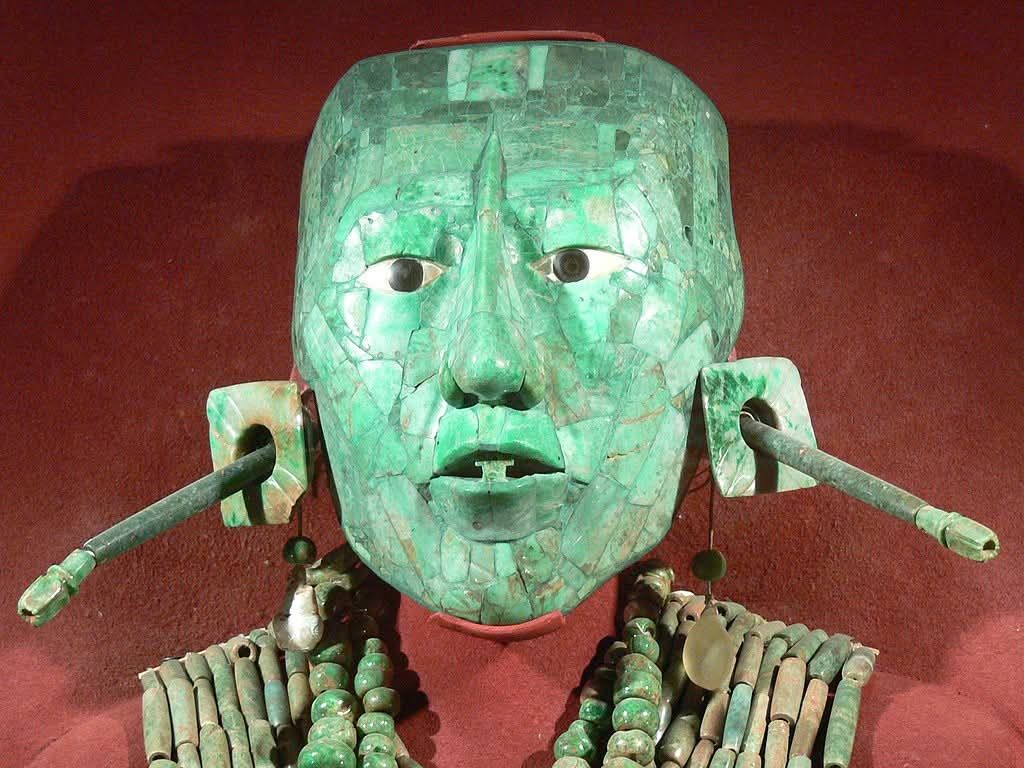
Deep in the jungles of Chiapas, Mexico, nestled within the enduring ruins of the Maya city of Palenque, lies one of the most remarkable discoveries in the history of Mesoamerican archaeology: the funerary mask of K’inich Janaab’ Pakal. This magnificent artifact, meticulously crafted from over 346 individual jade fragments and completed with shell, nacre, and obsidian to represent the eyes and pupils, was found within the tomb of Pakal himself—one of the greatest kings in Maya history—beneath the Temple of the Inscriptions. This jade mask is more than just a burial object. It is a declaration of divinity, an artistic marvel, and a cultural symbol that transcends centuries.
Pakal the Great, as he is often called, ruled the city of Palenque from AD 615 until his death in 683. His reign, spanning nearly seven decades, brought about a flourishing of architecture, art, literature, and astronomical discovery in Palenque. Ascending to the throne as a boy of twelve, Pakal matured into a leader who not only defended his city from rivals but elevated it to one of the most culturally refined capitals of the Maya world. He ordered the construction of numerous temples and palaces, including the towering Temple of the Inscriptions, which was designed to house his sarcophagus and eternal resting place. Unlike most other Maya tombs, Pakal’s was deliberately built within the pyramid itself, making it an architectural innovation of its time.
When Mexican archaeologist Alberto Ruz Lhuillier uncovered Pakal’s tomb in 1952 after years of excavation, he descended a hidden stairway buried beneath the temple and discovered a richly decorated crypt, the centerpiece of which was a large limestone sarcophagus with an intricately carved lid. Inside this coffin lay the skeletal remains of the king, his body adorned with an array of jade jewelry and regalia. But it was the mask placed over his face that captured the imagination of the world.
Crafted from precious green jade, each piece of the mask had been expertly shaped and assembled into a lifelike visage—symmetrical, serene, and noble. The choice of jade was not merely aesthetic. In Maya culture, jade was the stone of life and death, symbolizing renewal, power, and the divine. It was more precious than gold, associated with the breath of life and the maize god, whose resurrection was at the heart of Maya cosmology. To wear a jade mask in death was to assert one’s connection to the gods, to ensure rebirth and immortality.
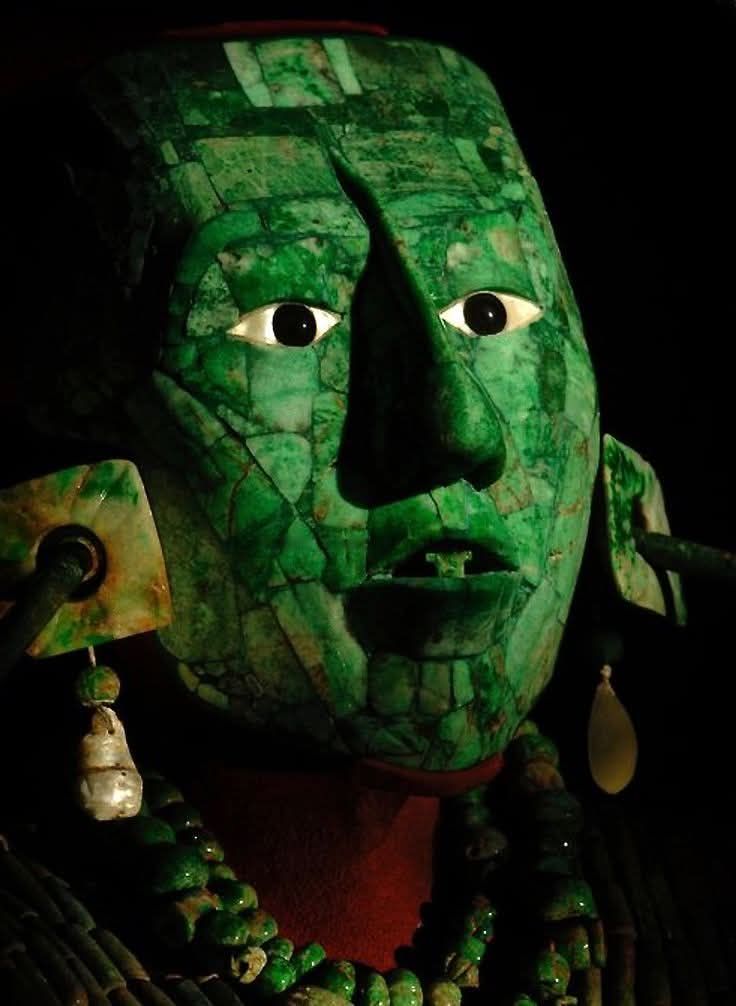
What sets Pakal’s mask apart from other Mesoamerican funerary objects is not only its exceptional artistry but its deeply embedded spiritual symbolism. The obsidian used for the pupils was believed to hold magical properties, capable of seeing beyond the mortal world into realms of spirits and deities. Shell and nacre, materials drawn from the sea, were associated with the underworld and the primeval waters of creation. The mask, therefore, was not just a physical covering—it was a metaphysical tool, guiding the king’s soul through the nine layers of Xibalba, the Maya underworld, and toward his apotheosis as a god.
The mask’s design adheres to the idealized standards of beauty held by the Maya. The elongated face, narrow nose, and full lips all reflect the aesthetic norms of Maya nobility. The Maya often practiced cranial modification to achieve these elongated skull shapes, a sign of elite status. Thus, the mask didn’t just immortalize Pakal; it affirmed his royal legitimacy and divine right in the eyes of his people.
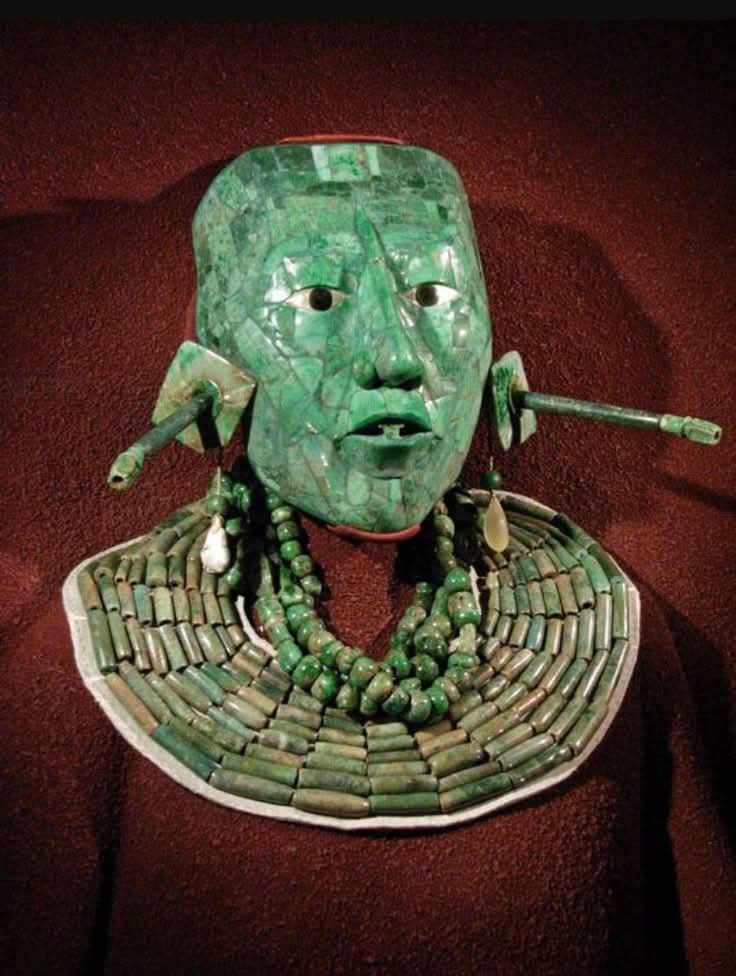
Beyond its spiritual meaning, the mask also reveals the remarkable technological and artistic sophistication of the Maya. Jade is a notoriously hard stone, difficult to cut and shape even with modern tools. The creation of this mask would have required not only immense skill but also months, if not years, of labor by master artisans. Each piece had to be carved, polished, and placed precisely to create a lifelike face that would survive the ages. The level of detail and symmetry achieved in Pakal’s mask underscores the Maya’s profound understanding of material science and artistic composition.
After its discovery, the mask was carefully removed and eventually transferred to the National Museum of Anthropology in Mexico City, where it continues to awe visitors from around the world. Though it now sits behind glass, away from its sacred tomb, the mask continues to project the aura of Pakal’s reign—an era of glory, wisdom, and cosmic purpose. It has become one of the most iconic symbols of the ancient Maya civilization, often used in exhibitions, textbooks, and documentaries to represent the height of pre-Columbian art.
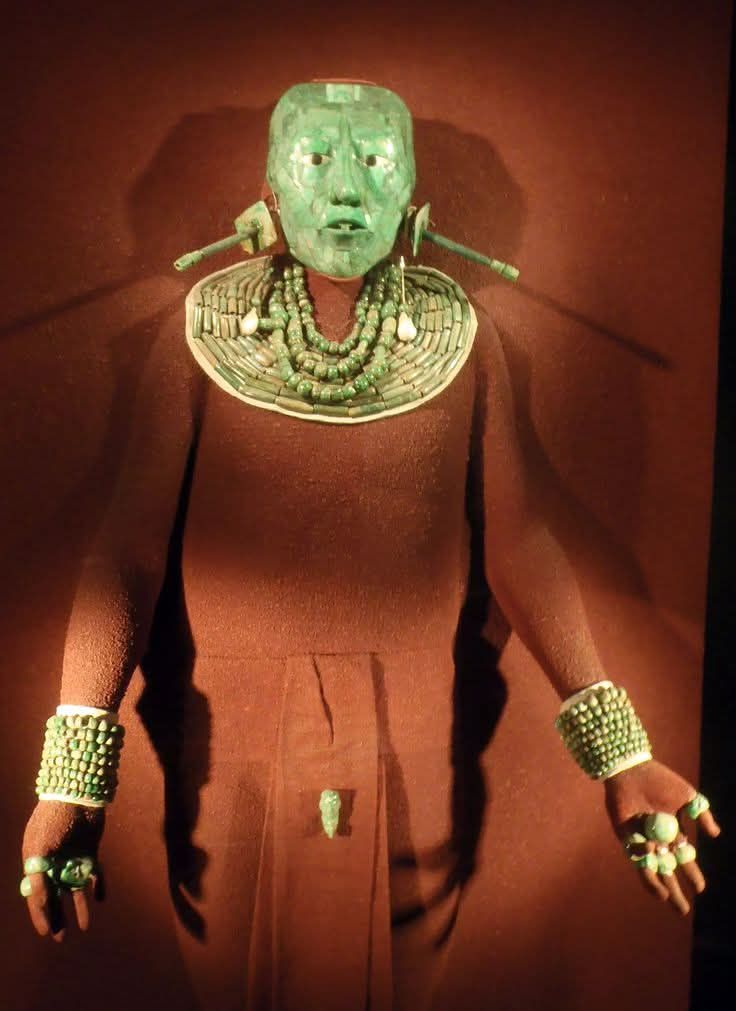
Yet, for all its fame, the mask remains rooted in a specific cultural and spiritual context. To the Maya, death was not a finality but a transition. Kings were not simply buried; they were ritually planted like seeds, expected to rise again in divine form. Pakal’s mask was thus a tool of transformation, allowing him to pass through death’s door and emerge as a celestial entity. The lid of his sarcophagus even depicts him descending into the jaws of the underworld and rising again along the axis mundi—the world tree—into the heavens. His mask ensured that his earthly identity would be preserved even as his spirit ascended.
In contemporary Maya communities, the legacy of Pakal and his mask continues to hold cultural significance. It serves as a reminder of the ingenuity and spiritual depth of their ancestors, and for many, it is a symbol of cultural pride and resistance against centuries of colonial erasure. The jade mask has also become a focal point for discussions about the restitution of cultural artifacts and the need to preserve indigenous heritage on indigenous terms.
The Mask of Pakal is more than a historical relic—it is a bridge between the ancient and the modern, the sacred and the artistic, the mortal and the divine. It challenges us to reconsider how we remember the dead, how we preserve legacy, and how civilizations articulate the mysteries of existence through objects of extraordinary beauty. In Pakal’s carefully constructed visage, there is not just the echo of a king, but the soul of a civilization that dared to see beyond death, crafting eternity one jade fragment at a time.