Just outside the small town of Dumbarton in Scotland stands an old Victorian bridge that appears ordinary at first glance. The structure, known as Overtoun Bridge, crosses a narrow wooded ravine near a historic estate called Overtoun House. Built in the late nineteenth century, the bridge carries a small road over the deep gorge below and has long been part of the surrounding landscape.
For many years, however, the bridge became known for something deeply unusual. Beginning in the middle of the twentieth century, reports emerged that dogs walking across the bridge would suddenly leap from its stone walls into the ravine below. Owners described the behavior as sudden and completely unexpected.
The stories began attracting wider attention during the 1950s and 1960s when several similar incidents were reported in a relatively short period of time. Witnesses claimed that otherwise calm dogs would run toward the edge of the bridge and jump without hesitation.
Local residents gradually began referring to the structure as the “dog suicide bridge,” a phrase that spread through newspapers and later through online discussions. Over the decades dozens of incidents were reportedly connected to the site.
One resident who had heard about the events described the strange pattern in an interview.
“Dogs seem to suddenly bolt toward the same side of the bridge as if something caught their attention.”
What made the situation even more puzzling was that many of the incidents appeared to occur at a similar location along the bridge, typically between two specific stone parapets on one side of the structure.
Curiosity about the phenomenon eventually drew researchers and animal behavior specialists to investigate the environment surrounding the bridge.
One theory focuses on scent and wildlife activity in the ravine below. The wooded area beneath the bridge is home to animals such as mink and small rodents that produce strong scents. Dogs possess an extremely sensitive sense of smell, far more powerful than that of humans.
Animal behavior expert David Sexton later conducted investigations at the site. He suggested that certain dogs may be reacting to scents drifting upward from the ravine.
“Mink scent is extremely strong to dogs and may trigger a sudden instinctive response.”
Another factor may be the design of the bridge itself. The stone walls are relatively high, which means dogs walking along the path cannot easily see what lies beyond the edge. From their perspective, the top of the wall blocks the view of the drop below.
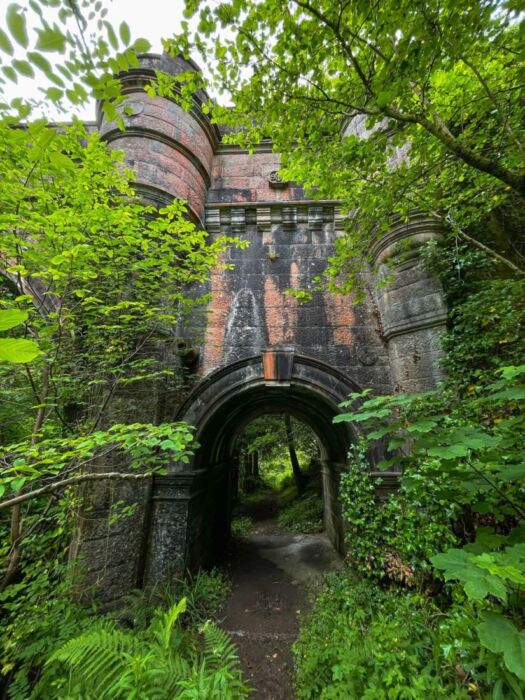
When a dog jumps toward a scent or movement beyond the wall, it may not realize that there is a steep drop on the other side.
Environmental conditions may also contribute to the pattern of incidents. Wind flowing through the ravine can carry animal scents upward toward the bridge, creating a concentrated smell that attracts curious dogs.
Despite these scientific explanations, the bridge’s reputation has also inspired local folklore and supernatural speculation. Some stories describe the area as having a mysterious atmosphere linked to the nearby historic estate.
While such ideas have no scientific support, they have contributed to the bridge’s enduring reputation as one of Scotland’s strangest landmarks.
Today warning signs have been placed near Overtoun Bridge advising visitors to keep dogs on a leash while crossing. The surrounding area remains a popular walking route for hikers exploring the quiet countryside.
Standing on the bridge today, the stone structure appears peaceful and ordinary, surrounded by trees and the sounds of wind moving through the valley below. Yet its unusual history continues to attract travelers curious about the stories connected to this otherwise unremarkable crossing.
The mystery of Overtoun Bridge shows how a simple location can gain worldwide attention when unusual events repeat often enough to challenge our understanding of animal behavior.