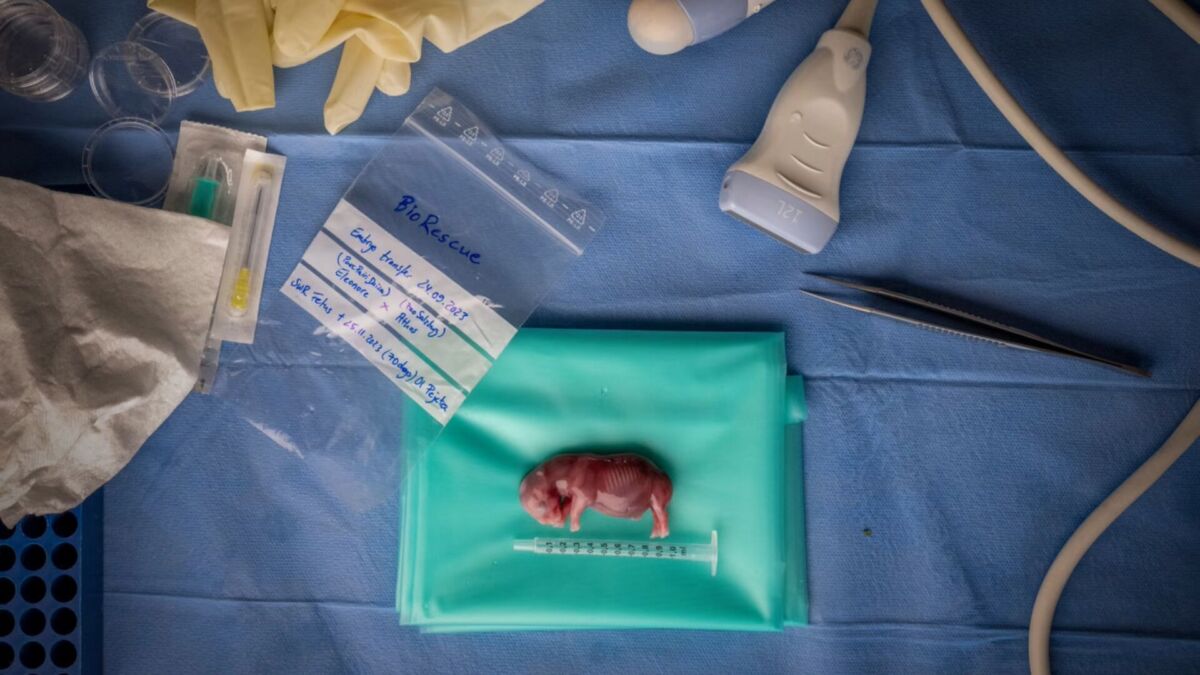
The photograph at the heart of this story shows something fragile enough to stop you for a moment. It is the image of a tiny rhino foetus created through IVF, the first of its kind, and a reminder that saving a species can hang on the thinnest thread of luck and timing. Only two female northern white rhinos remain alive today. Their names are Najin and Fatu. Both live in a conservancy in Kenya, watched carefully day and night, but neither can carry a pregnancy. The last male died in 2018. The species has been called functionally extinct ever since.
For more than fifteen years, the BioRescue Project has been quietly trying to build a path back. Scientists have collected and saved sperm from deceased males. Using that genetic material along with egg cells from Fatu, they have created thirty eight embryos. It sounds like a healthy number, but it is not. Embryos alone do not rebuild a species. Without a mother who can carry a pregnancy, those embryos stay frozen in tanks. That is why the team turned to southern white rhinos. They belong to a related subspecies and have healthier reproductive conditions. To even begin, the team had to prove that their method could work with southern white rhino embryos before risking any of the northern embryos.
It took thirteen attempts before one embryo settled and began to grow. The foetus in the photograph is the result. It should have grown for more than a year, but the surrogate mother died from a sudden bacterial infection seventy days into the pregnancy. It was a painful setback, but it also showed that the science itself works. For researchers who have spent years living between hope and heartbreak, that knowledge meant everything.
What makes the image stand out is not the scientific achievement, but the feeling behind it. It is not a picture of a living animal. It is not even a picture of the species everyone hopes to save. It is something more delicate. It is a sign of how close the world came to recovering a species that has hovered on the edge for so long. The photographer, Jon A Juárez, captured it while the scientists performed DNA checks. The room was quiet. The air felt heavier than usual. Everyone knew the moment mattered even though the pregnancy had ended.
Ethics guide every step of the BioRescue Project. A dedicated ethics team reviews each procedure to avoid causing suffering. The northern white rhinos in Kenya live under constant care, surrounded by people who treat them as their last responsibility to a species already pushed too far by human actions. Some people may feel unsure about IVF and surrogacy in animals, but the team approaches every choice with caution, patience, and respect. The project’s lead, Professor Thomas Hildebrandt, often says that science cannot be used to repeat the mistakes that harmed wildlife in the first place. Conservation and science must work side by side.
Juárez understands this deeply. Before he became a photographer, he studied biology. He once imagined a life in research, but that path slipped away. Photography brought him back into the world he thought he had missed. Years ago, he met the press officer for the BioRescue Project in Berlin, and in 2020 he was invited to document embryo transfers in Germany. The experience changed him. As he describes it, the work felt like a return to a childhood dream. He followed the team from German zoos to the open landscapes of Kenya as the project moved forward.
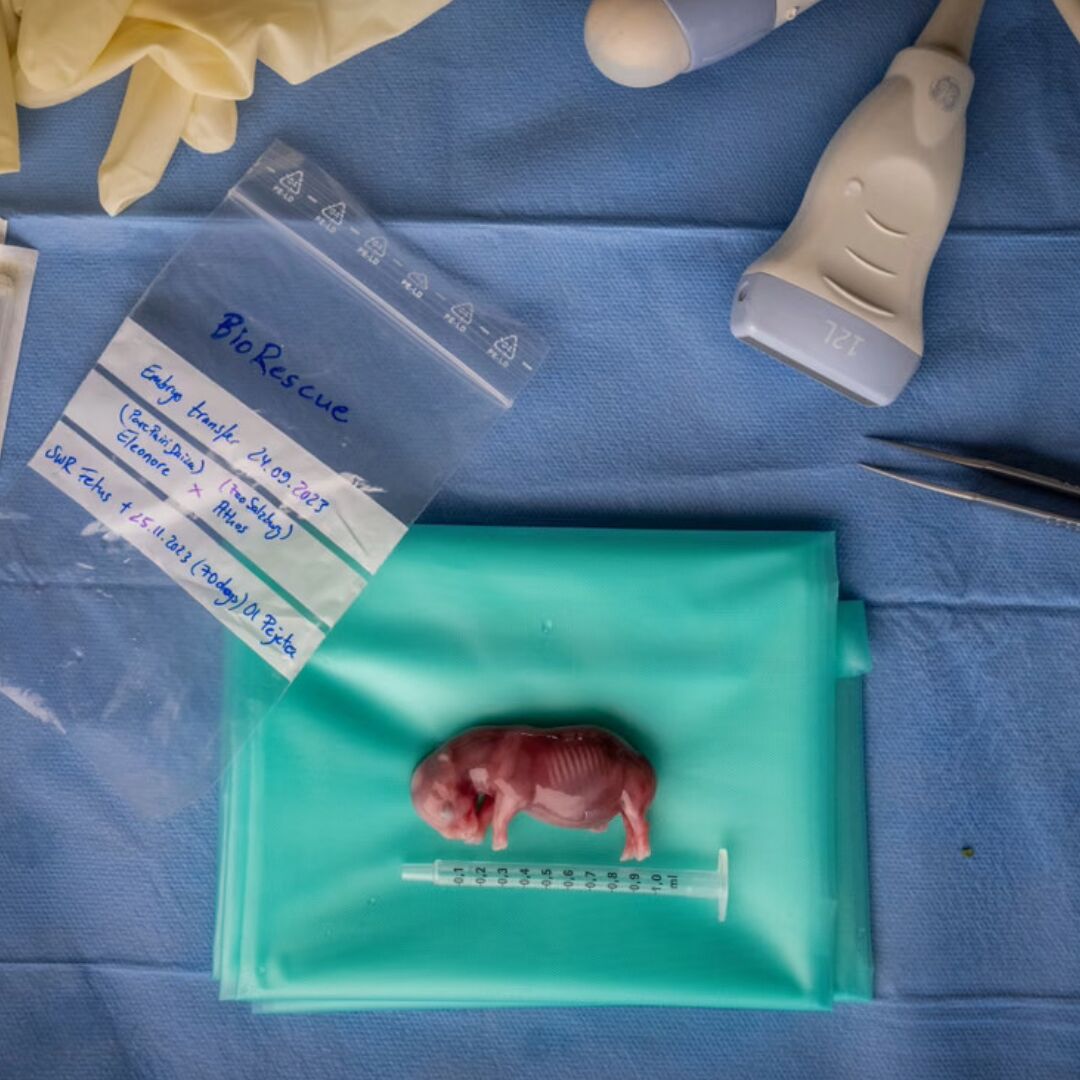
He remembers standing in an airport in Germany, ready to fly to Kenya to witness what they hoped would be the first full surrogacy. The team was excited, but while they waited to board, the message arrived. The surrogate mother had died. The flight continued, but the mood changed. The sense of loss settled in quietly. The photograph of the foetus was taken soon after, during a moment filled with both sadness and belief. It was the closest the team had ever been to saving the species.
What makes the image powerful is the contradiction it holds. It speaks of success and failure at the same time. It shows that the technique can work while also reminding us that the species is slipping further away each year. It captures how a scientific milestone can feel like both a celebration and a warning.
The story is bittersweet, but there is still time. The foetus proves that the barrier is no longer scientific. It is now a matter of support, patience, and commitment. If people listen to the scientists and take their work seriously, this species can still be brought back from the edge. Projects like this need resources, energy, and long term belief. Unfortunately, the future is uncertain. The German government, which has funded the project since 2019, has not yet confirmed if support will continue. The next decision comes at the end of November. Without it, progress may slow or even pause, affecting not only the northern white rhino but many other endangered species that depend on similar breakthroughs.
Juárez’s photograph has already been recognized. It won the photojournalism category in the sixty first Wildlife Photographer of the Year competition. It will be displayed among one hundred awarded images at the Natural History Museum in London. The recognition brings visibility to the story, but the larger hope is that it brings responsibility too.
Jon A Juárez was born in Blanes, Spain, in 1987. He taught himself photography after discovering it during his last year studying biology. He often mentions the photographers who shaped his eye, including Sebastião Salgado, Sandra Bartocha, Bruno D’Amicis, and his partner Elena Gyldenkerne. He remembers the joy of his first assignment in Namibia for a conservation project. He also remembers being rejected by every gallery he approached when he first moved to Berlin more than ten years ago. His advice to young photographers is simple. Good things need time. If you believe in something, stay with it and give it the time it asks for.
The same message could be said about saving a species. Patience. Time. Refusal to give up. The project came painfully close to success, and it will succeed if the world chooses to keep trying.