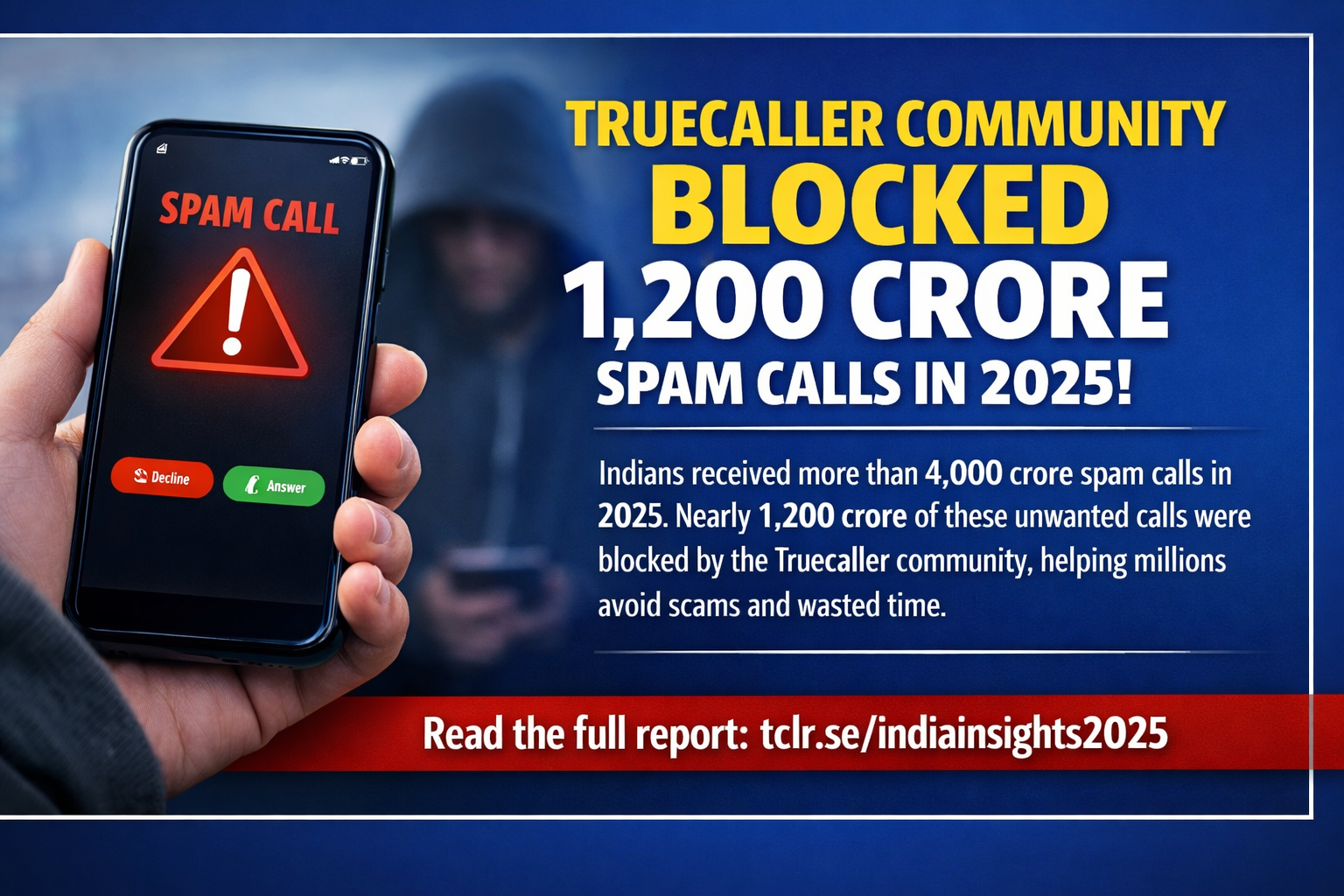
Indians received more than 4,000 crore spam calls in 2025, reflecting the growing scale of fraud, disruption, and digital risk in everyday communication. At the same time, the Truecaller community blocked nearly 1,200 crore unwanted calls before they reached users, preventing millions of potential scam attempts and helping people avoid wasted time and financial loss.
The figures come from Truecaller’s 2025 India Insights Report, which provides a detailed view of how spam and fraud are reshaping the country’s communication landscape and how technology is helping protect millions of users across India.
With more than 100 crore active phone connections in the country, mobile communication has become central to commerce, governance, and personal relationships. Phone calls often carry important opportunities, information, and services. However, as India’s digital ecosystem continues to expand, the risks associated with spam calls and fraud have grown significantly.
According to the report, Truecaller identified more than 4,168 crore spam calls across India during 2025. These calls ranged from telemarketing disruptions to sophisticated scam attempts designed to impersonate trusted institutions. Out of this massive volume, 1,189 crore unwanted calls were successfully blocked by the Truecaller community before they could reach users.
In addition, the report detected approximately 770 crore fraudulent calls during the year. Many of these scams involved impersonation of banks, government agencies, digital payment platforms, and well known brands. Such calls often rely on creating urgency or fear to pressure victims into sharing personal information or transferring money.
“In a country where connectivity is powering opportunity at every level, trust has become our most valuable digital asset,” said Rishit Jhunjhunwala, CEO of Truecaller. “Fraud today is not just a technical problem, it is a human one. It exploits fear, urgency, and uncertainty in moments that matter most. Our responsibility is to make sure that no Indian has to choose between staying connected and staying safe. Our focus at Truecaller is simple: help people stay connected without compromising their safety and stop risk before it turns into loss.”
Spam messaging also remains a major concern. The report shows that more than 12,903 crore spam SMS messages were identified in India during 2025. Spam messaging volumes increased significantly in the second half of the year, highlighting how scammers continue to adapt their strategies across multiple communication channels.
The growing overlap between legitimate alerts and fraudulent messages has made it harder for users to quickly distinguish between genuine communication and potential scams. Banks, government platforms, delivery services, and businesses all rely heavily on SMS notifications, which creates an environment where fraudulent messages can easily blend in with real alerts.
Beyond the volume of spam activity, the report also highlights the real world impact of blocking unwanted calls. Based on an average spam call duration of approximately 1.8 minutes, blocking 1,189 crore calls translated into Indians avoiding nearly 21.7 lakh hours of wasted time every single day.
On a weekly basis, this means more than 1.5 crore hours saved that would otherwise have been spent answering disruptive or potentially fraudulent calls. When calculated cumulatively, the time saved by users every day through spam blocking is equivalent to roughly 250 years of human life.
These savings represent more than simple convenience. Avoiding scam interactions reduces stress, preserves attention, and prevents impulsive decisions that often lead to financial loss. By blocking suspicious calls early, users are able to focus on meaningful communication rather than constant interruptions.
The report also warns that fraud tactics are expected to evolve further in the coming years. Among the scam techniques likely to become more prominent in 2026 are identity verification scams, impersonation using trusted institutions, multi step fraud schemes that combine text messages and phone calls, and the use of AI generated voice messages designed to sound like real individuals.
Another emerging trend is the migration of scams to third party messaging platforms, where fraudsters attempt to continue conversations after initiating contact through phone calls or SMS messages.
As these threats become more complex, identifying fraud will increasingly depend on patterns of behaviour, community reporting, and long term activity analysis rather than relying only on single alerts or warnings.
Truecaller continues to encourage users to remain cautious when receiving unexpected calls or messages. People are advised to verify urgent requests through official channels, avoid sharing sensitive personal information with unknown callers, and rely on trusted caller identification tools that help detect suspicious activity.
The findings in the Truecaller 2025 India Insights Report are based on anonymised metadata and spam classification signals collected from Truecaller users in India between January 1 and December 31, 2025. During this period, the system identified more than 4,168 crore spam calls and 12,903 crore spam messages.
Spam blocking results from active community reporting and automated spam detection signals within the platform. The insights presented in the report highlight observed national level communication trends and patterns of fraud activity, although they do not represent exact measurements of every spam or scam attempt across the country.
A downloadable version of the full report is available at https://tclr.se/indiainsights2025.