
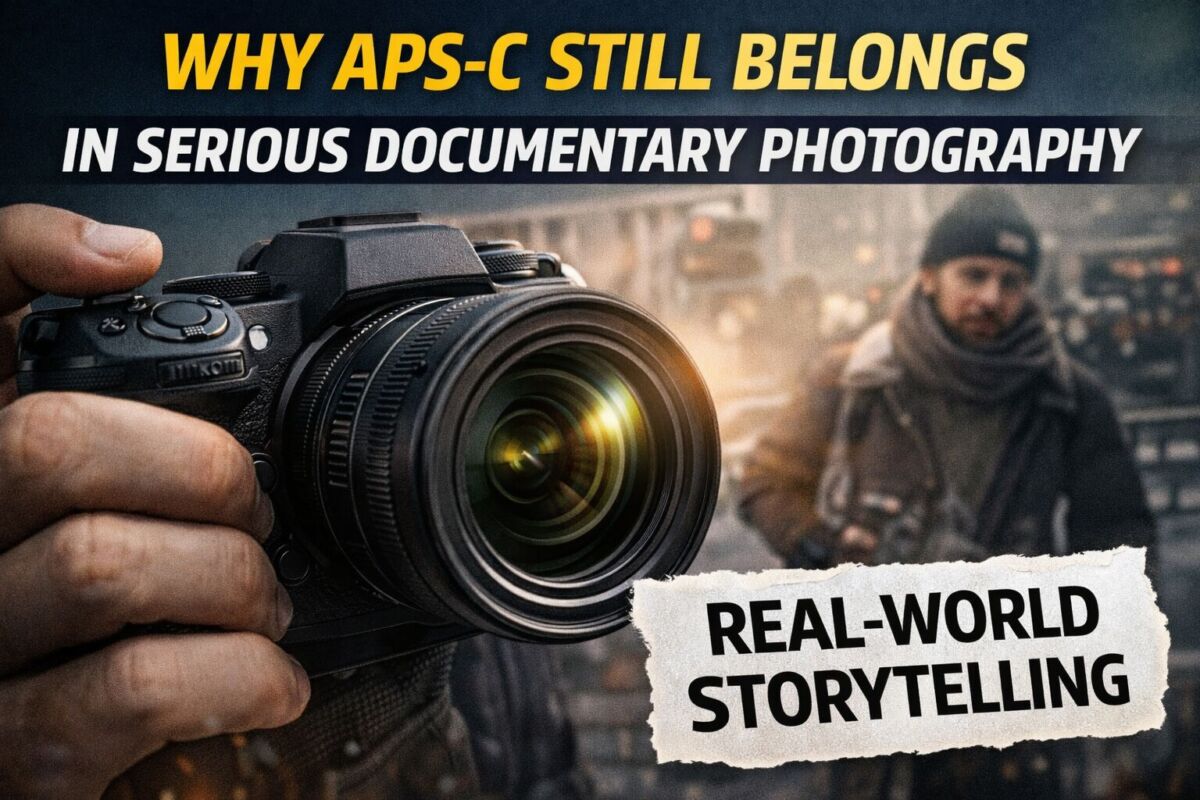
There is a strange silence around APS-C in documentary photography today. It is not openly criticised, but it is rarely celebrated either. In reviews, it is usually described as “good for beginners” or “useful for travel,” as if serious work must always come from larger sensors. This idea has slowly shaped how photographers talk about professionalism. But documentary photography has never been about size, status, or technical dominance. It has always been about access, presence, and persistence. On those terms, APS-C has always been one of the most honest formats available.
Documentary work is not done in controlled environments. It happens in heat, dust, rain, crowds, conflict, long journeys, and uncertain situations. The camera becomes part of the body. Weight matters. Size matters. Battery efficiency matters. Reliability matters. APS-C cameras have quietly served these needs for decades, long before full frame mirrorless systems became fashionable.
The rise of full frame as a status symbol has changed how gear is marketed, but it has not changed how stories are found. In many parts of the world, a large camera attracts attention that a documentary photographer does not want. APS-C bodies are usually smaller, less intimidating, and easier to blend into everyday environments. They allow photographers to remain present without becoming the centre of the scene. That invisibility is not a weakness. It is a strength.
Historically, many of the most important documentary photographs were not made on the largest or most technically advanced equipment of their time. They were made on tools that allowed photographers to stay close, stay mobile, and stay unnoticed. APS-C follows that tradition in the digital era. It is the modern equivalent of small 35mm film cameras that once defined street and documentary work.
Speed is another overlooked advantage. APS-C sensors often allow higher burst rates, faster readouts, and smaller data files. In documentary photography, moments are unpredictable. A small difference in responsiveness can decide whether a frame exists at all. APS-C cameras are often faster to operate, faster to clear buffers, and faster to recover between bursts. These things do not appear glamorous in spec sheets, but they define real-world reliability.
Then there is reach. The so-called “crop factor” is not a limitation. It is a built-in advantage for photographers who work with distance. Whether covering protests, rituals, wildlife in human spaces, or sensitive social environments, APS-C allows tighter framing without carrying enormous lenses. It compresses systems. It simplifies choices. It allows photographers to work lighter while seeing further.
The obsession with shallow depth of field has also distorted how APS-C is perceived. Documentary photography rarely depends on background blur. It depends on context. It depends on showing environments, relationships, and layers of meaning. APS-C naturally encourages deeper depth of field, which often aligns better with documentary storytelling. More of the story remains visible in a single frame.
Low light performance is often used as an argument against APS-C. But modern APS-C sensors have improved dramatically. Noise performance, dynamic range, and ISO flexibility have reached levels that satisfy almost all documentary needs. More importantly, documentary photography values emotional clarity over technical perfection. Grain has never destroyed a story. Missed moments do.
Another factor that rarely gets discussed is endurance. APS-C systems usually consume less power. Batteries last longer. Cameras run cooler. Files are easier to store and transmit in the field. For photographers working in remote areas or under limited resources, these things are not minor. They are essential.
There is also a psychological comfort in working with a lighter camera. When gear becomes physically demanding, it changes behaviour. Photographers hesitate. They move less. They stop exploring. APS-C encourages freedom of movement. It invites curiosity instead of caution. That alone makes it powerful for long-form documentary projects.
The return of serious APS-C bodies in modern mirrorless systems signals something important. Camera companies are beginning to recognise that APS-C is not only about cost or size. It is about purpose. Cameras like the rumored Nikon Z90 reflect an understanding that APS-C can be professional when treated with professional intent. When APS-C bodies receive advanced autofocus, strong weather sealing, and robust build quality, they become tools for commitment, not compromise.
Documentary photographers do not need dominance. They need trust. They need equipment that stays quiet, dependable, and present for long periods of time. APS-C has always done this well. It just stopped being talked about.
There is also a cultural bias in how cameras are judged. Bigger cameras signal authority. Smaller cameras signal accessibility. But documentary photography does not need authority. It needs empathy. A smaller camera can feel less invasive. It can reduce the psychological barrier between photographer and subject. That change alone can transform how stories unfold.
APS-C also supports long-term projects better than many realise. Its lighter ecosystem reduces physical and financial strain. It allows photographers to sustain projects over years instead of months. Documentary work is slow. APS-C aligns with that pace.
The idea that APS-C is “less professional” is not rooted in practice. It is rooted in marketing language and online culture. Real documentary photographers care about consistency, responsiveness, and endurance. APS-C delivers all three.
In many ways, APS-C has always been closer to the heart of documentary photography than full frame ever was. It values efficiency over dominance, discretion over display, and presence over performance.
Its quiet strength is exactly what documentary work requires.
APS-C also reshapes how photographers interact with space. Documentary photography is often about negotiation. You negotiate access, trust, time, and movement. A smaller system makes those negotiations easier. People respond differently to a compact camera than to a large, intimidating one. It feels less transactional, less industrial. It feels closer to observation than extraction. That subtle difference changes how long people allow you to stay and how honestly they behave in front of the lens.
In many communities, especially those that have been over-photographed or misrepresented, a large professional camera can create instant distance. APS-C bodies soften that first impression. They feel closer to everyday devices, less like instruments of authority. For documentary photographers who work in sensitive social spaces, that matters more than any technical advantage.
There is also the issue of physical sustainability. Documentary projects are rarely short. They stretch across months and years. Carrying heavy full-frame systems every day slowly changes posture, energy, and patience. APS-C allows photographers to stay physically present without exhausting themselves. When fatigue is reduced, attention increases. And attention is the true currency of documentary photography.
APS-C also encourages restraint in lens choices. With smaller bodies and lighter lenses, photographers are more likely to commit to one or two focal lengths. That limitation strengthens visual consistency. Documentary work thrives on coherence. A stable visual language makes stories feel grounded and intentional. APS-C systems naturally support this discipline.
The idea that APS-C is only for beginners ignores how many professionals quietly use it as a secondary or even primary system. Some use it for travel. Some use it for risky environments. Some use it because it feels honest. They may not talk about it publicly, but their work depends on it.
What matters in documentary photography is not sensor size but continuity. The ability to keep showing up. The ability to remain invisible when needed and present when required. APS-C supports both.
In the digital age, where images circulate instantly and attention spans are short, the role of documentary photography becomes even more fragile. It must resist spectacle and remain rooted in patience. APS-C aligns with that philosophy. It does not shout. It does not perform. It simply works.
The renewed interest in APS-C bodies by manufacturers reflects a growing awareness that not all photographers want excess. Many want balance. They want speed without burden. They want quality without intimidation. They want tools that feel human.
APS-C is not a fallback format. It is a format shaped by realism. It belongs where stories are unpredictable, environments are demanding, and presence matters more than power.
If documentary photography has a future that remains grounded and honest, APS-C will remain part of it. Quietly, consistently, without needing validation.
Is APS-C good enough for professional documentary photography?
Yes. APS-C has always been good enough. Professionalism in documentary work comes from consistency, access, and storytelling, not from sensor size.
Why do many photographers still believe full frame is superior?
Because marketing and online culture often equate bigger sensors with higher status. This does not reflect how documentary photography actually functions in the field.
Does APS-C limit image quality?
Modern APS-C sensors offer excellent dynamic range, color, and low-light performance. For documentary work, they exceed what is practically required.
Why is APS-C better for long-term projects?
It is lighter, consumes less power, reduces physical fatigue, and lowers system cost. All of these help sustain long projects.
Is APS-C more discreet in public spaces?
It is lighter, consumes less power, reduces physical fatigue, and lowers system cost. All of these help sustain long projects.
Is APS-C more discreet in public spaces?
Yes. Smaller cameras attract less attention and reduce tension between photographer and subject.
What kind of documentary photographers benefit most from APS-C?
Street photographers, social documentarians, travel journalists, and anyone working in sensitive or unpredictable environments.
Does APS-C work for video-based documentaries as well?
Absolutely. APS-C bodies are increasingly powerful for video, offering strong performance in compact and efficient systems.
Will APS-C remain relevant in the future?
As long as documentary photography values mobility, discretion, and endurance, APS-C will remain essential.
