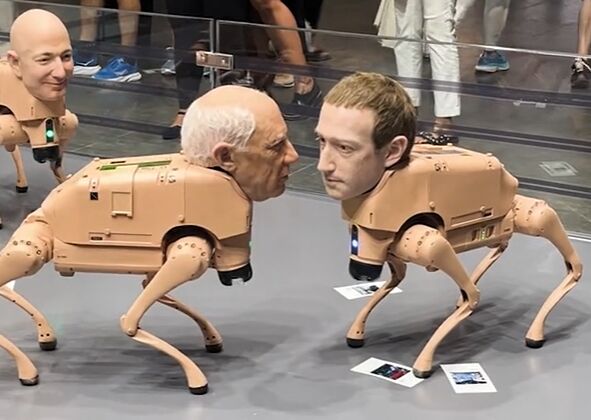
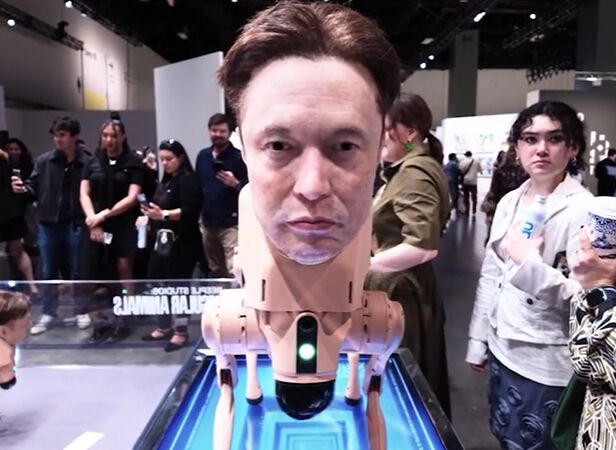
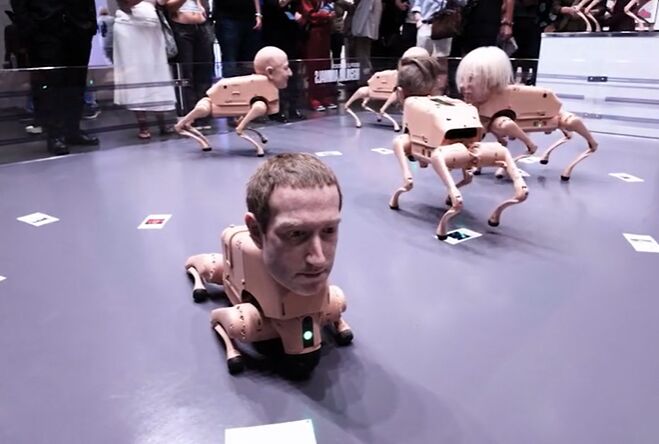
The digital artist known as Beeple, whose work often blends satire, surreal imagery, and commentary on modern technology, has launched a new exhibition that immediately caught the attention of visitors at Art Basel Miami Beach. In the middle of one of the most watched art events of the year, he has presented a series of robotic dog like figures wearing hyper realistic masks of well known tech leaders and cultural icons.
The sculptures portray figures such as Elon Musk, Mark Zuckerberg, Jeff Bezos, Andy Warhol, Pablo Picasso, and even Beeple himself, whose real name is Mike Winkelmann. The robot dogs wander around the space as though they have minds of their own, taking photographs, reacting to their environment, and producing prints in a way that blurs the boundary between absurdity and reflection. For visitors who have followed Beeple’s career, the combination of humour and pointed commentary feels familiar. His new exhibition, called Regular Animals, pushes that approach even further.
The idea behind the work is simple but striking. Each robot dog moves through the space capturing images, calculating which moment is worth keeping, and then producing a print that emerges from the back of the machine. Some of these prints are NFTs, continuing Beeple’s long association with digital art on blockchain platforms, while others are physical pieces accompanied by certificates. The prints themselves are unpredictable, transforming the captured photographs into styles inspired by the character wearing the mask. Musk’s robot creates schematic images, Zuckerberg’s produces visuals that resemble a digital world, and Picasso’s robot transforms its photos into Cubist interpretations.
Visitors have described the experience as both funny and unsettling. The robotic animals seem to move freely, with their cameras constantly scanning the room, quietly recording, reimagining, and responding. The entire setup feels like a living commentary on how images are created today and how quickly they are processed by systems that operate with little explanation. Beeple has said he wanted to show how easily tech leaders and artists can shape what the public sees. According to interviews, he believes that the control these figures have over information and visual culture is far more powerful than people realise.
In a conversation with Art Plugged, Beeple explained that the installation draws attention to the power held by those who guide digital platforms. He noted that when certain leaders decide to make changes to their platforms, they do not need to negotiate or seek broader approval. A decision can reshape the way millions of people see the world. For Beeple, turning these figures into robot dogs became a symbolic way of questioning the systems that influence everyday perception. The exhibition is meant to encourage viewers to consider how modern tools, platforms, and algorithms filter reality.
Part of the humour in the exhibition comes from the way the prints are presented. Some of the pieces include intentionally absurd text, such as certificates claiming that the work has been tested as “100% pure GMO free, organic” and using language meant to sound both scientific and ridiculous. These details add to the satirical tone, poking fun at the seriousness sometimes attached to high value art and the sometimes confusing world of NFT culture.
Beeple is known for challenging what digital art can be. His long running project Everydays: The First 5,000 Days, which sold for more than sixty nine million dollars in 2021, brought global attention to the world of NFTs. That sale also marked a turning point in discussions about digital ownership, blockchain based art, and the future of creative work online. Many of the themes from that period reappear in this new exhibition, but this time they are delivered through sculpture, performance like movement, and physical prints.
The robot dogs have also attracted interest for another reason. According to certain reports, each of the robotic pieces has already been purchased for one hundred thousand dollars. Private collectors appear eager to own part of the installation, even though the artwork includes both absurd imagery and commentary that is critical of wealth, influence, and the divide between public and private control. The contradiction between the message of the exhibition and the market response adds another layer to the experience, creating questions about the value of art that critiques the very audience that buys it.
For Beeple, the project is not simply about humour. The installation reflects his ongoing interest in the way people consume visual information. He has said that the robotic dogs reinterpret images using AI in a manner similar to how people increasingly rely on digital tools to understand the world. The idea is that the dogs are not just producing prints; they are creating a vision shaped by algorithms, personalities, and artificial intelligence. Visitors watching the robots move through the exhibition have become part of this process.
Art Basel Miami Beach is known for bringing together artworks that stretch imagination and challenge convention. Regular Animals fits comfortably within that atmosphere, offering an experience that feels engineered to provoke thought while also entertaining through its unexpected visuals. The exhibition stands out not only for its technical execution but also for the questions it raises about who controls what we see, how images are produced, and how technology shapes perception.
Whether viewed as satire, social commentary, performance, or digital sculpture, the piece captures a modern moment. It speaks to a time when images circulate faster than people can interpret them, when digital personalities influence culture on a global scale, and when the boundary between human creativity and algorithmic interpretation grows thinner by the day. As the robots continue to wander through the space, taking photos, selecting images, and presenting their strange interpretations, they offer a playful yet pointed reflection on how rapidly visual culture is evolving.
For many who attended the show, the experience was memorable not because of the shock value but because of the sense of recognition. The viewer becomes both observer and subject, caught in the process of being scanned, interpreted, and reproduced. Beeple’s exhibition asks what it means to live in a world where cameras operate constantly and where someone else, whether a person or an algorithm, decides which version of that moment becomes the one people remember.
Art Exhibition Update
Further reading on contemporary digital art: https://www.theartnewspaper.com
For more newsroom reports, visit https://camorabug.com/in-focus/news/
FAQ
What is Beeple’s new exhibition about?
It features robot dog sculptures with human like masks of tech leaders and famous artists, capturing and transforming images in real time.
Where is the exhibition located?
It is being shown at Art Basel Miami Beach.
How do the robot dogs create art?
They take photographs, rank them, and reimagine the images using AI before producing physical prints.
Why are the sculptures considered satirical?
The work comments on the power of tech leaders and the influence of algorithms on how people see and understand information.
Have the robot dogs been sold?
Yes, reports say each piece has been sold to private collectors for one hundred thousand dollars.