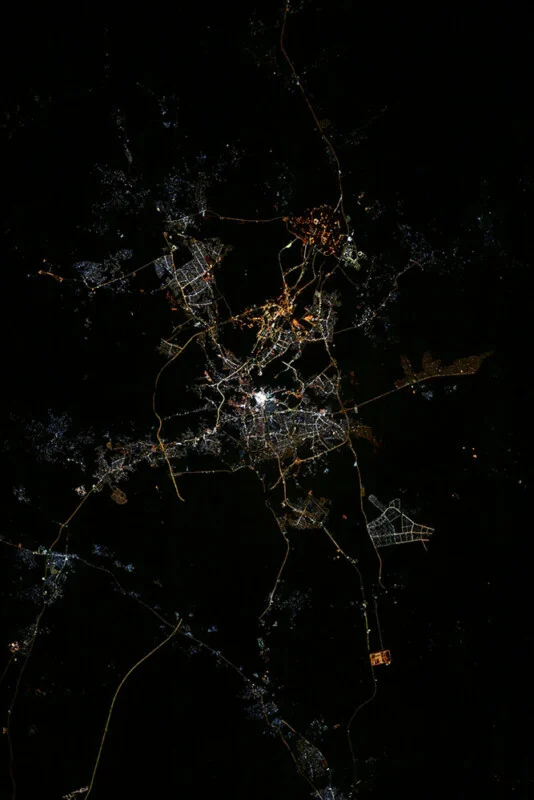
Astronaut Don Pettit has brought home a fresh set of photographs from his most recent six month stay on the International Space Station, and one image in particular has caught the attention of people around the world. As the ISS passed over the Arabian Peninsula late at night, Pettit photographed the Grand Mosque in Mecca, the bright heart of the city visible from 400 miles above Earth.
Pettit shared the picture on social media shortly after returning, describing the bright point at the centre of the frame as the Kaaba, one of the most important sites in Islam and the structure Muslims around the world face during daily prayer. Even from orbit, the Kaaba shines clearly, surrounded by the tightly packed lights of the mosque complex and the wider city.
The photograph comes from a long standing personal interest. Although Pettit regularly captures images of stars, auroras, and the ever changing atmosphere, he also spends time looking down at Earth and recording the sights below. During a mission that lasts months at a time, cities at night, coastlines, storms, and patterns of human life become subjects just as fascinating as distant galaxies.
The ISS circles Earth at roughly 17,500 miles per hour, which means astronauts must work carefully to capture sharp images. The speed makes long exposures nearly impossible without special equipment. Pettit has spoken in the past about how he handled the challenge on earlier missions. During one expedition more than a decade ago, he even built a simple barn door tracker from loose parts on the station to steady his camera for nighttime photography. While that inventive tool is no longer needed, the approach shows how seriously he takes documenting life from orbit.
Today, astronauts rely on modern mirrorless cameras for their imaging work. Pettit’s most recent mission used the Nikon Z9, which can shoot with much higher ISO performance than cameras used on the station in previous years. This improved sensitivity helps freeze fast moving scenes while keeping details intact, especially when photographing cities lit only by artificial light.
Although Pettit is known for photographing Earth, he has also produced some of the most memorable images of space from the ISS. His earlier missions include pictures of the Milky Way curling across the darkness, auroras sweeping over continents, and the glow of entire fishing fleets mistaken for towns when viewed from above. Many of these images have been shared widely and used to explain what astronauts can see as they orbit the planet.
Pettit continues to post his work online, giving the public a rare chance to see the Earth through the perspective of someone living off the planet for months at a time. His Instagram and X accounts often feature short videos and still frames from his experiments with light, motion, and the constantly shifting patterns of the planet below.
For many viewers, the new image of Mecca stands out not only because of its beauty, but because of the feeling it carries. The Grand Mosque is one of the most significant sites on Earth, visited by millions of people each year. Seeing it glowing from so far above offers a reminder of how connected and fragile the world appears from the windows of the space station. The photograph captures a moment where science, faith, and human presence meet in a single frame, suspended between Earth and space.
Space Photography Update
Further reading on astronomy and ISS imagery: https://www.skyandtelescope.org
For more newsroom reports, visit https://camorabug.com/in-focus/news/
FAQ
Why did Don Pettit photograph Mecca from the ISS?
He regularly photographs cities and landscapes from orbit, and Mecca’s brightness and significance made it a striking subject.
What camera does Pettit use on the space station?
Astronauts currently use the Nikon Z9 for their photography.
Why is photographing from orbit challenging?
The ISS travels at high speed, so astronauts must use fast shutter speeds and high ISO settings to get clear images.
How high was the ISS when he took the photo?
About 400 miles above Earth, moving through low Earth orbit.
Where can people see more of Pettit’s images?
He posts regularly on Instagram and X under his official accounts.