
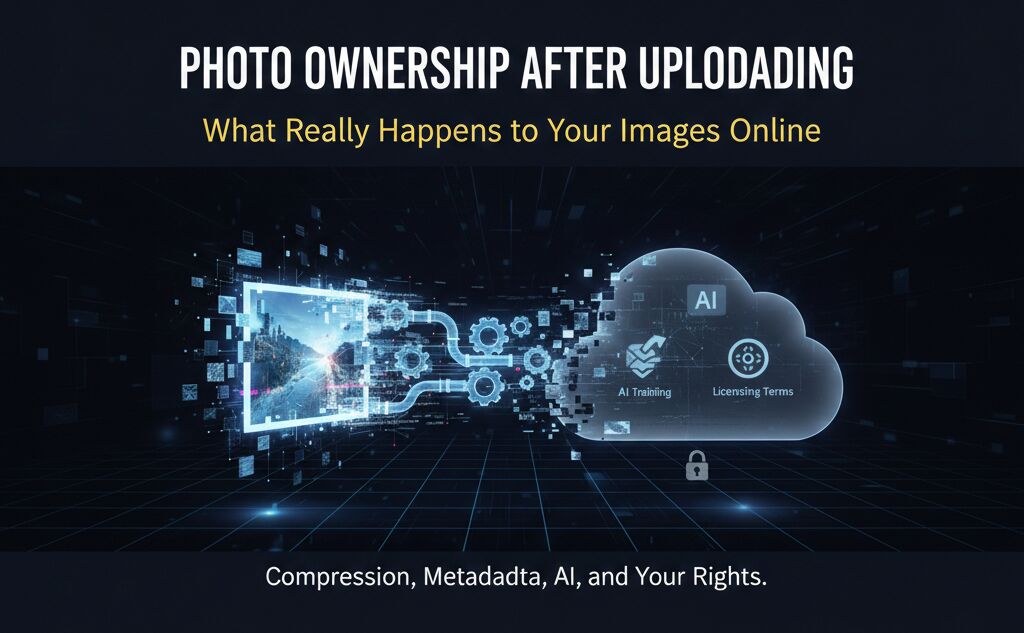
Photo ownership once felt straightforward because the relationship between a photographer and their work was direct. You created an image, you stored it, and you decided how and where it would be shown. That clarity begins to change the moment a photograph is uploaded to any online platform. What appears to be a simple act of sharing is actually an entry point into a complex technical and legal system that reshapes the image, redistributes its control, and quietly alters how ownership functions in practice. The photo still carries your name, and you may still hold the copyright, but the environment in which that photo now exists is no longer governed only by your intentions. It is governed by algorithms, infrastructure needs, and platform policies that prioritize efficiency, scalability, and data processing over creative authorship.
The first transformation happens through social media compression, a process that almost every platform uses to reduce file size and maintain fast loading speeds. Compression is not merely a technical adjustment; it permanently changes the visual character of your photograph. Fine textures soften, subtle tonal transitions flatten, and micro details disappear. This is not visible at first glance on a phone screen, which is why most users never notice it, but for photographers who work carefully with light, contrast, and texture, the difference is significant. The public version of the image is no longer the same photograph you created. It becomes a derivative optimized for distribution rather than fidelity, and once that compressed version exists, it is the one that circulates, gets saved, reposted, and archived across the internet. Your original remains in your possession, but the world interacts with a version that you no longer technically control.
That loss of control deepens when image metadata removal enters the process. Metadata acts as a photograph’s internal identity card. It can include the camera used, the date and time of capture, location details, and sometimes copyright or author information. Many platforms strip this data automatically, sometimes to protect user privacy, sometimes to standardize storage formats, and sometimes to reduce file size. Regardless of intention, the effect is the same: the image loses the invisible information that links it to its creator. When that photo is copied or reposted elsewhere, it carries no internal proof of who made it. Authorship becomes fragile, not because people are dishonest, but because the system itself has erased the technical evidence that supports ownership. This is one of the main reasons photographers find their work circulating online without credit. The structure of the platform makes attribution optional rather than embedded.
As compression reshapes visual quality and metadata stripping weakens authorship, photo upload privacy also shifts in meaning. Privacy is often understood only as visibility, whether a photo is public or private. In reality, privacy also concerns how an image is processed internally. Platforms analyze every uploaded image for moderation, categorization, recommendation systems, and content filtering. Even when a photo is shared with a limited audience, it still passes through automated systems that read, classify, and evaluate it. Your image becomes part of a data flow that supports platform functionality. This is not inherently malicious, but it does mean that your photograph is no longer a static object. It becomes an active participant in computational systems that learn from patterns and behaviors.
This is where AI training images enter the discussion, adding another layer to the changing nature of photo ownership. Many modern platforms now include clauses in their terms of service allowing uploaded content to be used to improve artificial intelligence models. This does not always mean that your image will appear somewhere else or be reproduced directly. It means that your photo can be analyzed as part of large datasets that teach machines how faces look, how environments are structured, how lighting behaves, and how visual styles function. Once your image contributes to this process, its influence becomes irreversible. You cannot remove your contribution from a trained model because it is absorbed into a mathematical structure. Ownership in this context becomes symbolic rather than practical. You still own the photo legally, but its visual information has become part of a system that extends beyond individual control.
The legal language that enables this is often overlooked because it is written in technical terms that most users do not read carefully. Platforms typically state that you retain your copyright while granting them a broad license to use, reproduce, modify, and distribute your content. These licenses are usually worldwide, royalty free, and transferable. This is not a contradiction. It is a structural necessity for platforms that operate at global scale. They need legal freedom to compress, resize, analyze, store, and display your image across multiple servers and formats. However, this also means your photograph becomes part of their operational framework. Ownership remains with you in theory, but usage rights become shared in practice.
This is why free hosting quietly changes ownership dynamics. You are not paying money, but you are paying with permission. Your photograph becomes currency in a system that thrives on engagement, data processing, and technological development. The platform does not exist primarily to protect your art. It exists to maintain an ecosystem where content flows continuously and efficiently. Your image becomes one unit in a vast structure of visual data that supports advertising, recommendation systems, and increasingly, artificial intelligence research.
The cumulative effect of social media compression, image metadata removal, weakened photo upload privacy, and the expansion of AI training images reshapes what photo ownership truly means. Ownership is no longer absolute. It is layered. You own the original file. You own the copyright. But the versions of your image that live online are governed by systems that prioritize automation over authorship. Control becomes shared, fragmented, and difficult to enforce.
For photographers, this realization often comes slowly. At first, sharing feels empowering. It offers exposure, visibility, and connection. Over time, the emotional cost becomes visible. Images appear without credit. Work is reused in ways that feel disconnected from its original intent. Enforcing ownership becomes exhausting because it requires constant monitoring across platforms that were not designed to protect creators first. The law may still be on your side, but the infrastructure rarely is.
Even cloud storage services participate in this ecosystem, although in a quieter way. While they may not display your images publicly, they still scan files for security, compliance, and sometimes system improvement. The assumption that private storage is untouched by automated systems is increasingly outdated. Photo upload privacy today is defined less by isolation and more by controlled processing.
This does not mean photographers or everyday users should withdraw from digital platforms. It means participation should be informed. Uploading a photo is not a neutral act. It is an agreement between your creative work and an automated infrastructure that will reshape how that work exists in the world. Awareness allows choice. You may decide to upload reduced versions, keep high resolution originals offline, embed visible copyright marks, or choose platforms that restrict AI usage. These are not acts of fear. They are acts of conscious ownership.
For everyday users, the story is equally important. Family photos, personal memories, and casual snapshots follow the same rules as professional work. They are compressed, processed, analyzed, and stored within corporate systems. They do not exist solely between you and your audience. They exist within technical frameworks that treat images as data as much as memory.
Photo ownership in the modern age is therefore not just a legal concept. It is a relationship between creativity and technology. It is shaped by systems that value speed, scale, and automation. Understanding this does not require rejecting technology. It requires using it with intention. When you upload a photograph, you are not just sharing an image. You are placing it into an ecosystem that will reshape how that image lives, moves, and is understood. Ownership still exists, but it exists alongside structures that redefine control.
What does photo ownership mean after uploading?
You retain copyright, but you grant platforms broad licenses to use and process your images. Ownership becomes shared in function, even if not legally transferred.
Do platforms remove image metadata?
Yes, most platforms strip or reduce metadata, weakening traceability and authorship protection.
Is social media compression permanent?
Yes. Once compressed, the uploaded version cannot be restored to its original quality.
Are my photos used for AI training?
Many platforms reserve the right to use content to improve AI systems. This is increasingly common.
Is photo upload privacy guaranteed?
Privacy applies mainly to visibility. Internal processing still occurs.
How can photographers protect themselves?
Keep originals offline, upload reduced copies, watermark selectively, and review platform AI policies carefully.

1 comment
Users can use Jimpl to view and remove metadata in photos