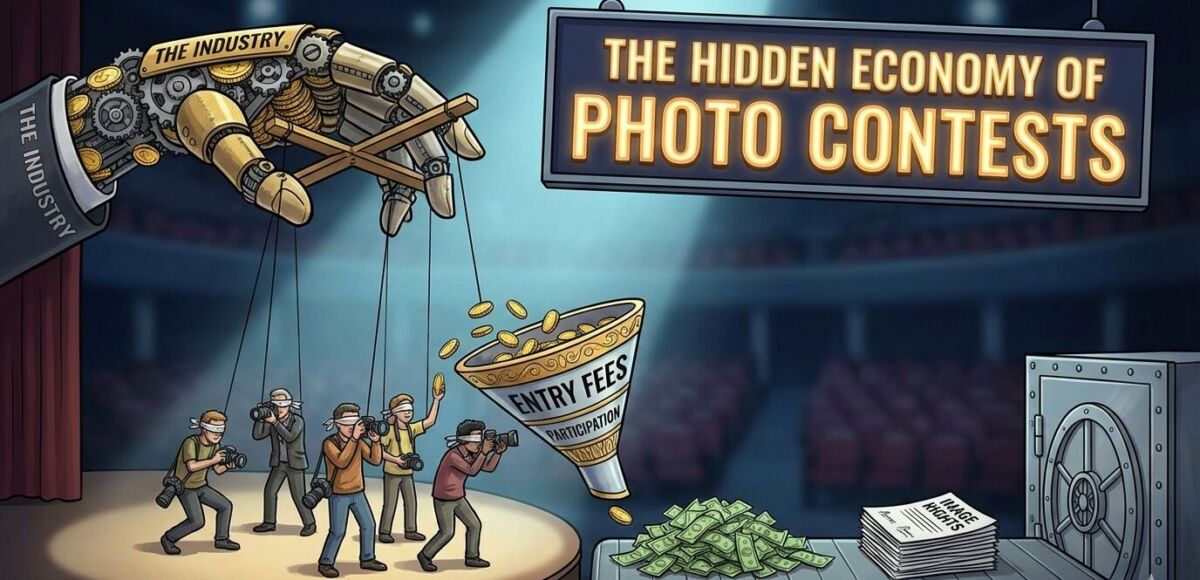
Photo contests occupy a respected space in the photography world. They are associated with credibility, professional recognition, and the promise of visibility. For emerging photographers especially, contests appear to offer a direct path into wider acknowledgment. The language used by organisers reinforces this idea, emphasising opportunity, community, and artistic celebration. Yet behind this reassuring surface lies a financial structure that is rarely discussed openly. Most contests are not cultural institutions sustained by grants or patrons. They are businesses whose stability depends primarily on entry fees paid by photographers themselves.
The economic logic is straightforward. A competition that charges a modest fee and attracts several thousand entries generates significant revenue before judging even begins. The cost of prizes, marketing, and administration is usually fixed, while income increases with each additional submission. In effect, participation itself becomes the financial engine of the contest. Photographers are not only competitors; they are the primary source of funding. This changes the nature of the relationship. The contest is not simply evaluating work. It is also selling access to visibility and prestige.
Judging is central to maintaining confidence in the system, yet it is also one of its least transparent elements. Contests often highlight the credentials of their jurors, creating an impression of rigorous and thoughtful evaluation. What is rarely explained is how judging functions when thousands of images must be processed. In such circumstances, early selection rounds are necessarily rapid. Images are filtered rather than carefully reviewed. This does not imply dishonesty, but it does challenge the idea that every photograph receives equal attention. The lack of clarity around this process allows the ideal of pure meritocracy to remain intact.
When photographers are rejected, the absence of transparency encourages a personal interpretation. They assume the work was insufficient, rather than recognising the structural limitations of large scale competitions. This reinforces continued participation. The system relies on photographers believing that success is just one submission away, even when statistical probability suggests otherwise.
Contracts provide the clearest insight into how contests operate as businesses. Almost all competitions require entrants to grant broad rights over submitted images. These rights typically allow organisers to reproduce, distribute, modify, and display photographs for promotional and marketing purposes without time limitation or additional payment. In many cases, these rights apply to every participant, not only to winners. This means a contest acquires both financial income and a large visual archive that can be used indefinitely to promote its brand.
Organisers often reassure photographers by stating that copyright remains with the creator. Legally, this is true. Practically, however, the ability to control how and where an image is used is largely surrendered. The term “non-exclusive” appears frequently in contracts, but it offers little real protection. It simply means the photographer may use the image elsewhere. It does not restrict the contest’s own use in any meaningful way.
Some agreements extend usage rights to partners and affiliates, enabling images to be shared with sponsors or commercial collaborators. Others allow modification of photographs, which can include cropping, overlaying logos, or placing images into advertising layouts. Once these permissions are granted, the photographer no longer controls the context in which their work appears.
Winners play a particularly important role in this structure. Their images and stories are used to demonstrate the legitimacy and prestige of the contest. A winning photograph may appear repeatedly in promotional material for future editions, encouraging new entries and reinforcing the contest’s reputation. In commercial terms, winners become brand assets. The promotional value generated by their work often exceeds the financial value of the prize awarded.
This relationship is rarely described in such direct terms. Instead, it is framed as honour and recognition. While many photographers benefit from the exposure, the imbalance remains. The contest gains long-term branding value, while the photographer typically gains short-term visibility.
Financial patterns across contests show remarkable consistency. Entry fees form the core revenue. Sponsorships supplement but rarely replace this income. Marketing is prioritised to ensure steady participation. Prize funds remain carefully controlled. Automation reduces administrative costs. The model is efficient, predictable, and sustainable precisely because photographers continue to fund it.
What sustains the system most effectively is prestige. Prestige functions as a form of currency. It encourages photographers to accept financial costs and legal compromises in exchange for symbolic value. Recognition becomes more powerful than contractual scrutiny. This is why rights clauses are often overlooked and judging processes remain unquestioned.
A professional approach to photo contests requires reframing participation as a business decision rather than an artistic gamble. Photographers should assess what they are paying, what rights they are giving, and what they are realistically receiving in return. A contest is not a gift. It is a transaction.
Before submitting, photographers should consider whether image usage applies to all entrants or only to winners, whether commercial use is permitted without compensation, whether sublicensing is allowed, whether AI analysis or training is mentioned, whether there are limits on how long images may be used, and whether judging procedures are explained with clarity. These are not signs of distrust. They are signs of professional awareness.
The hidden economy of photo contests is not concealed through secrecy. It is concealed through normalisation. Entry fees feel routine. Contracts feel technical. Judging feels distant. Together, they form a system where photographers collectively finance the industry that evaluates them.
Understanding this structure does not diminish the value of photography or competition. It strengthens it. When photographers engage with contests as informed participants rather than hopeful applicants, the balance of power begins to shift. Participation becomes deliberate rather than emotional. That shift represents a more sustainable and respectful relationship between creative work and the industry that surrounds it.
Are all photo contests profit driven businesses?
Not all contests operate purely for profit, but most rely heavily on entry fees as their primary source of income. Even contests that position themselves as cultural initiatives usually depend on participant funding to remain operational. This makes them commercial systems, whether or not profit is their stated objective.
Do photographers lose copyright when they enter photo contests?
In most cases, copyright remains with the photographer. However, contests usually require very broad usage rights. These rights often allow organisers to use images indefinitely for promotion, marketing, exhibitions, and partner activity. Legal ownership remains, but practical control is reduced.
What does “non-exclusive license” actually mean?
It means the photographer is free to use the image elsewhere. It does not limit how extensively the contest can use the same image. The term often gives a false sense of protection while granting organisers wide operational freedom.
Are submitted images used even if the photographer does not win?
Yes, in many contests. Rights clauses frequently apply to all submissions, not only winning entries. Images may appear in social media posts, websites, printed material, and advertising campaigns.
Why is judging rarely explained in detail?
Detailed disclosure would reveal the scale-based limitations of large contests. Many images are filtered quickly due to volume, not quality. Vague language protects the perception of fairness and merit-based evaluation.
Do contests allow AI analysis or training of images?
Some do, either directly or through platform policies. This may be described as “data analysis,” “system improvement,” or “technology development.” It is important to check whether such permissions are included.
Is avoiding contests unprofessional?
No. Many professionals choose exhibitions, editorial work, or direct commissions where contracts and compensation are clearer. Contests are only one possible pathway, not a requirement.
How should photographers view contests professionally?
As contractual and financial agreements, not purely artistic opportunities. Every submission is a business decision involving money, rights, and exposure.