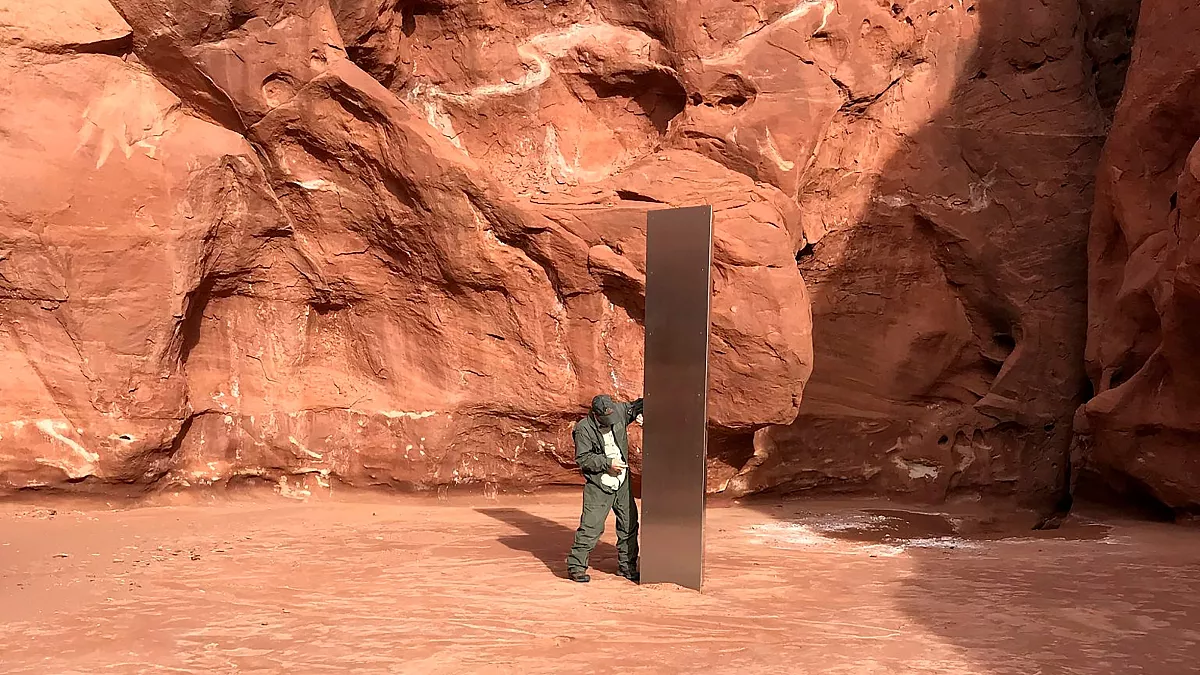
The discovery happened during what was supposed to be a routine wildlife survey. In November 2020, a helicopter crew from the Utah Division of Wildlife Resources was flying across the rugged red-rock landscape of southeastern Utah. Their task that day was simple. They were counting bighorn sheep that live among the remote canyons and cliffs of the region.
As the helicopter moved slowly above the desert terrain, one of the crew members noticed something unusual on the canyon floor below. Between the sandstone walls stood a tall metallic object reflecting sunlight. The crew asked the pilot to circle back for a closer look.
When they landed nearby, they discovered a strange structure embedded in the ground. The object was a tall triangular metal column roughly three to four meters high. Its surface appeared smooth and reflective, made from metal panels carefully fastened together.
What made the scene even stranger was the location. The structure stood in a remote desert canyon far from roads or settlements. Reaching the site on foot required navigating rough terrain and narrow rock passages.
Pilot Bret Hutchings, who was part of the flight crew, later spoke about the discovery.
“It was the strangest thing that I’ve come across out there in all my years of flying.”
The crew speculated about how the structure might have arrived in such an isolated place. One idea was that it could be an art installation placed there by an unknown artist. Others joked that it looked like something from science fiction films.
Photographs of the monolith were released to the public shortly afterward. Within days the images spread rapidly across the internet. News organizations around the world began reporting on the strange object in the Utah desert.
Curiosity quickly turned into a global discussion. People compared the structure to the mysterious monolith featured in Stanley Kubrick’s film 2001 A Space Odyssey. Online discussions speculated about possible explanations ranging from secret art projects to extraterrestrial technology.
Despite the speculation, local authorities emphasized that the object was most likely the work of human hands. Officials from the Utah Bureau of Land Management noted that installing structures on public lands without permission is generally illegal.
As interest in the monolith grew, adventurous travelers began searching for its location. Satellite imagery and online clues eventually helped some explorers locate the site.
Yet just as suddenly as it appeared, the monolith disappeared.
Less than two weeks after its discovery, visitors arriving at the canyon found that the structure had been removed. In its place someone had left a small metal pyramid and a message that read simply, “Leave no trace.”
The sudden disappearance added another layer of mystery to the story. While some individuals claimed responsibility online, no single artist or group was definitively confirmed as the creator.
Interestingly, similar metal monoliths soon appeared in other parts of the world, including Romania and California. These objects were usually discovered suddenly and removed just as quickly, fueling further curiosity.
Most researchers and investigators now believe the Utah monolith was likely a modern art installation placed secretly in the desert years earlier. Some observers have suggested it might have been inspired by minimalist sculpture traditions or experimental land art.
Regardless of its origin, the object succeeded in something rare. For a brief moment, a simple metal structure placed in a quiet desert canyon captured the imagination of people across the world.
Standing alone in the red rock landscape, the monolith reminded many observers how a single unexplained object can transform an ordinary place into a global mystery.