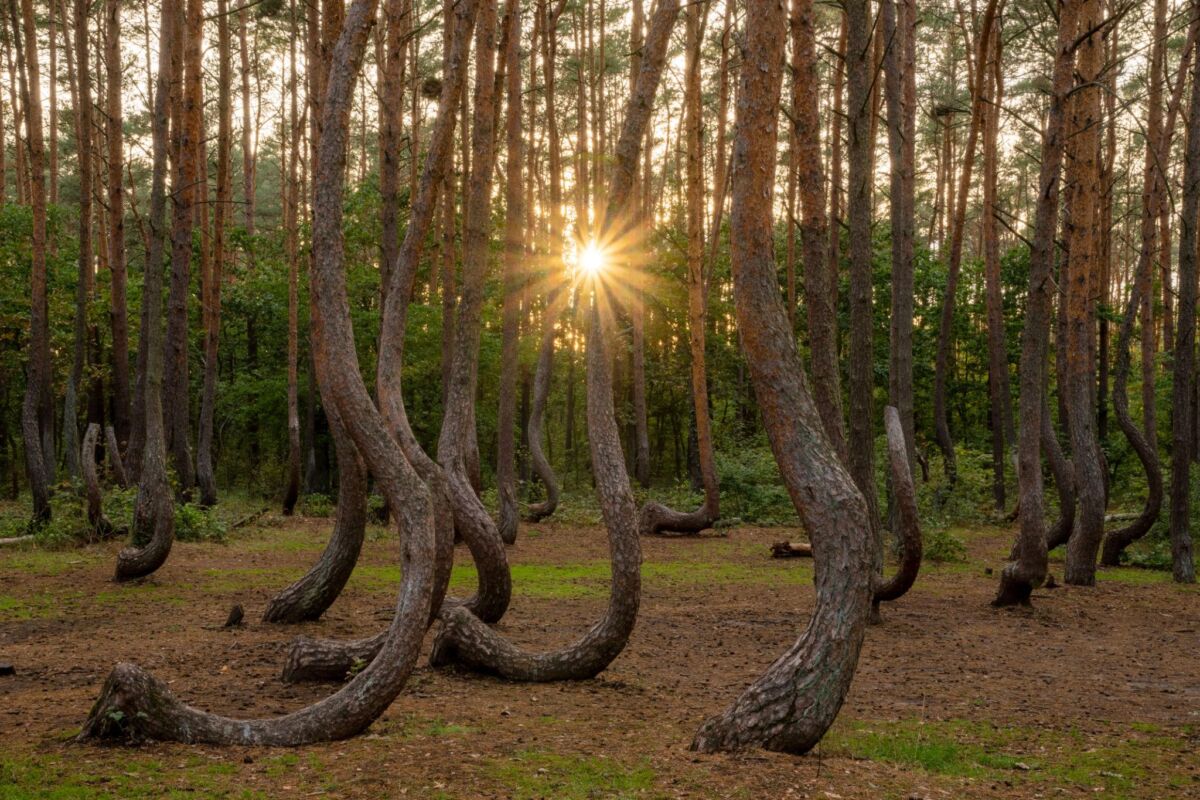
Travelers exploring the quiet countryside near the Polish town of Gryfino sometimes arrive expecting to see an ordinary forest. Instead they find a scene that feels subtly unsettling. Rows of pine trees stand across the woodland floor, yet each trunk begins with an identical curve. At the base, the tree bends sharply sideways before slowly turning upward again toward the sky.
The effect is striking because the pattern repeats itself again and again. Hundreds of trees follow the same unusual shape. Each trunk bends in roughly the same direction, forming a long curved arc before growing vertically. From a distance the forest looks almost as if the trees were pushed over and then somehow continued growing.
This place is known as the Crooked Forest, and despite decades of attention, the exact reason behind the twisted trees remains uncertain.
The trees themselves are Scots pines planted sometime around the early 1930s. At first glance the forest appears otherwise normal. The trees reach similar heights and display healthy green canopies. Only the dramatic bend near the base separates them from other pine forests found across northern Europe.
Because the curvature appears near the lower portion of each trunk, researchers believe the trees were deliberately manipulated when they were young saplings. The bend usually occurs just above ground level, suggesting that something influenced their growth during the early years of development.
One widely discussed explanation points to forestry practices from the early twentieth century. Some historians believe the trees were intentionally bent to produce curved timber for shipbuilding or furniture manufacturing. Curved wood pieces were historically valuable for constructing boat frames or specially shaped wooden tools.
Under this theory, young trees may have been forced to grow along a horizontal frame or weighted down until the trunks developed a permanent curve. Once the desired shape formed, the trees would have been allowed to continue growing vertically.
However, historical records supporting this explanation remain limited. The outbreak of the Second World War disrupted many activities in the region, and forestry operations may have been abandoned before the trees were harvested.
Another theory suggests that heavy snowfall might have bent the young trees during winter storms. Yet this explanation struggles to account for the consistent direction of the curves. Natural snow damage usually produces irregular patterns, not the uniform shapes seen in the Crooked Forest.
Other observers have proposed that human intervention remains the most likely cause. Some local residents believe farmers or foresters experimented with shaping trees during the interwar period, perhaps intending to harvest specially curved wood later.
Despite these ideas, no definitive documentation has ever confirmed exactly what happened in this forest.
The mystery surrounding the Crooked Forest has only increased its appeal. Photographers and travelers are drawn to the unusual landscape where the repeating curves create patterns across the forest floor. In early morning fog or soft evening light, the bent trunks cast long shadows that emphasize their strange forms.
Scientists studying tree growth continue to examine the forest, hoping that subtle clues in the wood structure might reveal how the trees were shaped. Tree rings and growth patterns sometimes record the stresses a tree experiences during its early life.
Even if the original explanation is eventually discovered, the Crooked Forest already holds a unique place among the world’s unusual landscapes. It stands as a quiet reminder that forests sometimes preserve traces of forgotten human activities long after the people responsible have disappeared.
Walking through the Crooked Forest today, the trees appear calm and ordinary despite their unusual beginnings. Their curved trunks slowly rise toward the sky, forming a landscape that continues to puzzle visitors nearly a century after the first saplings were planted.