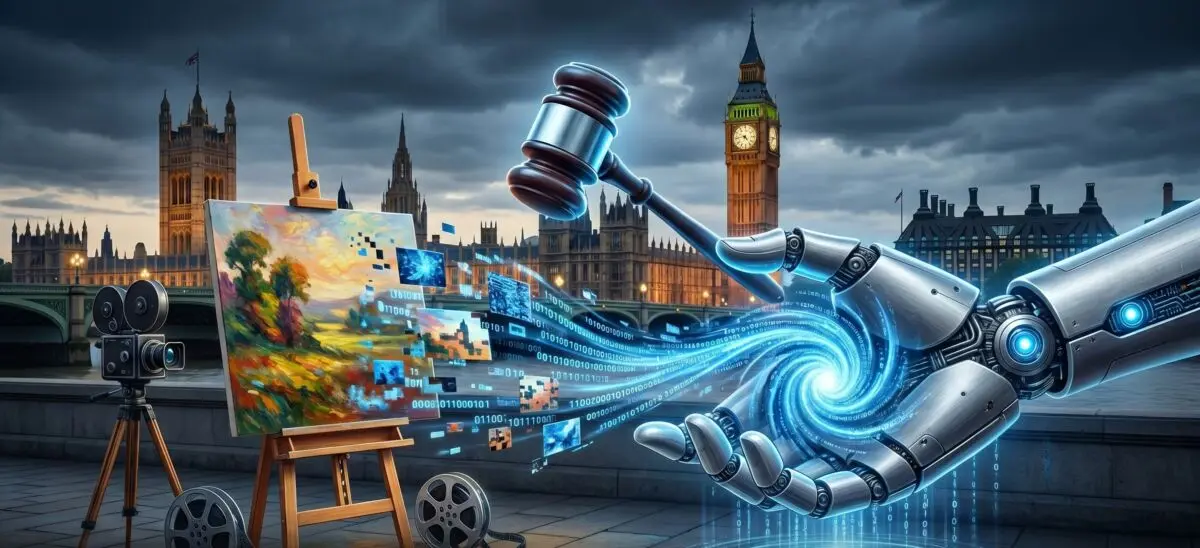
A massive legislative battle is currently unfolding in London that could permanently shape the financial future of photographers, digital artists, and writers. The United Kingdom’s creative sector, which contributes a staggering £146 billion annually to the national economy, is facing an unprecedented crossroads. This thriving ecosystem of human expression is confronting what the House of Lords communications and digital committee has explicitly labelled a “clear and present danger” from the rapid proliferation of generative artificial intelligence companies. At the heart of this conflict is a fundamental question of ownership: who profits when human creativity becomes the raw fuel for machine learning?
The epicenter of this controversy is the finalized Data (Use and Access) Bill, a piece of legislation that has become a battleground for two wildly divergent visions of the future. On one side, technology developers and deep-pocketed tech giants have been aggressively lobbying the government to loosen restrictions on data access. Their goal is to seamlessly train their advanced AI models by effectively treating the open web as a free buffet of training data. From high-resolution photography and intricate digital illustrations to published literature and journalistic archives, these models require vast amounts of human-generated content to learn, mimic, and ultimately generate new material.
In response to this aggressive push for deregulation, the creative industry has mounted a fierce and organized resistance. Over 400 top creatives, artists, and business leaders have united to pen an urgent, impassioned letter to the Prime Minister. Their primary demand is transparency regarding the copyrighted works that have already been ingested by these AI models. They issued a stark warning that the UK risks losing its hard-earned position as a global creative powerhouse if it willingly gives away its cultural and intellectual property at the behest of a handful of powerful, largely overseas technology companies. For these creators, the issue is not merely theoretical; it is a direct threat to their livelihoods and the integrity of their craft.
The mechanics of this digital scraping have profound implications for individual creators. Photographers and visual artists are increasingly finding their distinct styles, years of technical refinement, and copyrighted portfolios mimicked by image-generation software that was trained on their very own work. Because tech companies have historically operated in a black box, refusing to disclose exactly what data their algorithms have consumed, creators are left with little recourse to prove infringement or demand compensation. This asymmetry of power has transformed the digital landscape into a space where human artists are unwittingly subsidizing the development of technologies that may eventually replace them.
Fortunately for the creative sector, the pushback from lawmakers is gaining incredible momentum. A recent, highly critical report by parliamentary peers strongly urged government ministers to abandon any legislative proposals that would grant tech firms carte blanche to use the work of artists without explicit permission. Instead of acquiescing to the demands of Silicon Valley, the committee insisted that a proper, robust licensing regime must be developed and strictly enforced. This would ensure that if an AI model wishes to learn from an artist’s portfolio, the developer must first seek permission and provide fair financial compensation.
The rhetoric from key political figures has been sharp and unforgiving. Committee chair Baroness Barbara Keeley articulated the stakes perfectly when she stated that watering down copyright protections merely to lure massive US tech companies is a dangerous “race to the bottom.” She emphasized that the government has a duty to protect domestic talent and must not sacrifice the long-term viability of the creative industries for the promise of “jam tomorrow” or what she aptly categorized as “speculative AI gains.” Her words encapsulate the frustration of an industry tired of being told that technological progress must inherently require the dismantling of their fundamental rights.
If the UK government forces AI developers to adopt a transparent licensing model, it will set a monumental global precedent. Currently, the international legal framework surrounding AI and copyright is fractured and highly contested. A strong stance from London would send a clear message worldwide that the unauthorized scraping of intellectual property is not an inevitable byproduct of innovation, but a deliberate choice that can and must be regulated. It would prove that technological advancement and artificial intelligence can coexist with human artistry, provided the foundational rules of consent and compensation are respected.
For the thousands of photographers, writers, and digital artists fighting against unauthorized style mimicry and corporate overreach, the outcome of this London-centric legislative battle is nothing short of critical. It represents a line in the sand. If the tech industry is forced to open its black boxes and pay for the data it consumes, it could usher in a new era of ethical AI development. If, however, the lobbyists succeed in eroding copyright protections, the “speculative gains” of a few tech billionaires may come at the irreversible cost of a £146 billion industry and the creative soul of the nation.