Flying over the southern coast of Peru reveals a landscape that at first appears empty and lifeless. The Nazca Desert is a vast stretch of dry ground between the Andes Mountains and the Pacific Ocean, a place where rain rarely falls and the wind moves slowly across the flat terrain. Yet hidden within this quiet desert lies one of the most remarkable archaeological landscapes on Earth.
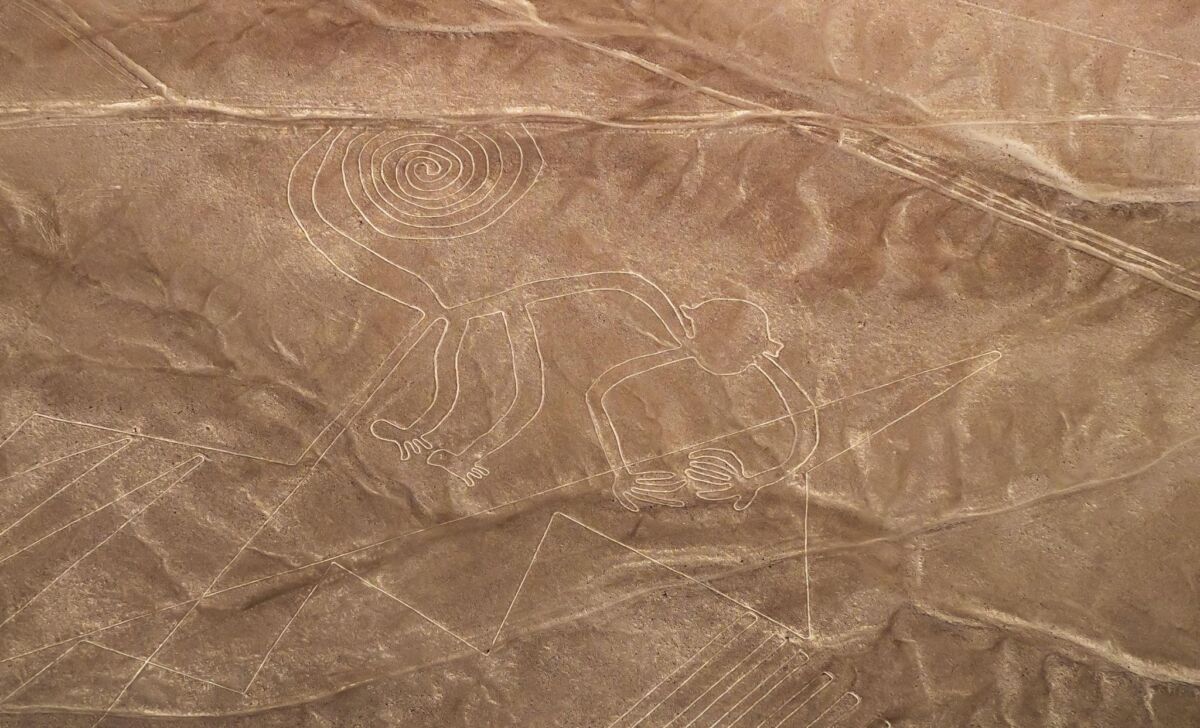
Across the reddish-brown surface of the desert are thousands of lines carved into the ground. Some run straight for several kilometers, cutting across the plains like carefully drawn pathways. Others form enormous geometric shapes such as spirals, trapezoids, and triangles. Scattered among them are large figures depicting animals including monkeys, hummingbirds, spiders, and even a whale.
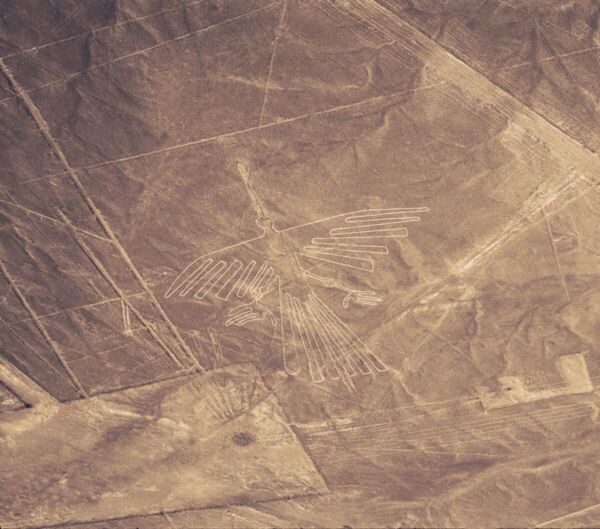
What makes the Nazca Lines so unusual is their size. Many of the figures stretch hundreds of meters across the desert floor. From ground level they are almost impossible to recognize because the lines are so large that only small sections are visible at a time. Their full shapes become clear only when viewed from high above.
The lines were first widely noticed in the early twentieth century when airplanes began flying over the region. Pilots looking down at the desert realized that the faint lines forming across the ground were not random patterns but deliberate drawings created on a massive scale.
Archaeologists later determined that the lines were created by the Nazca culture, a civilization that lived in the region roughly between 200 BCE and 600 CE. The people who made the drawings used a surprisingly simple method. The desert surface is covered with dark stones that have been oxidized over time by the sun. By removing these stones and exposing the lighter soil beneath, the Nazca people created lines that contrast with the surrounding ground.
Because the desert climate is extremely dry and calm, the exposed soil has remained largely undisturbed for centuries. Without heavy rainfall or strong winds to erase them, the drawings survived for nearly two thousand years.
Despite understanding how the lines were made, researchers have long debated why they were created in the first place. Some early investigators believed the figures might have served astronomical purposes, perhaps aligning with stars or seasonal events.
One of the earliest researchers to study the lines extensively was German mathematician Maria Reiche, who spent decades mapping and protecting the drawings. She believed that many of the shapes might represent astronomical calendars related to the movement of the sun and stars.
Later studies have suggested additional interpretations. Some archaeologists believe the lines may have been ceremonial pathways used during religious rituals. Others think the figures could have been offerings to deities associated with water and fertility, particularly important in a desert environment where rainfall was rare.
Modern technology has also revealed that the Nazca Lines are part of a much larger network of geoglyphs scattered across the region. Satellite imagery and drones have helped researchers discover new shapes and patterns that were previously unnoticed.
Even today scientists continue to debate the exact meaning of the lines. What remains clear is that their construction required careful planning and cooperation within the Nazca society. Creating figures hundreds of meters long would have required people to work together across large areas of desert while maintaining accurate proportions.
Standing on the ground among the lines, it is difficult to imagine their full scale. The desert stretches quietly in every direction, and the faint markings appear as simple shallow grooves in the soil. Only when viewed from the sky does the landscape reveal the enormous designs created by a civilization that lived nearly two millennia ago.
The Nazca Lines remain one of the most remarkable examples of ancient human creativity. Carved into one of the driest deserts on Earth, they continue to raise questions about how ancient cultures understood their environment and expressed their beliefs on a scale visible only from above.