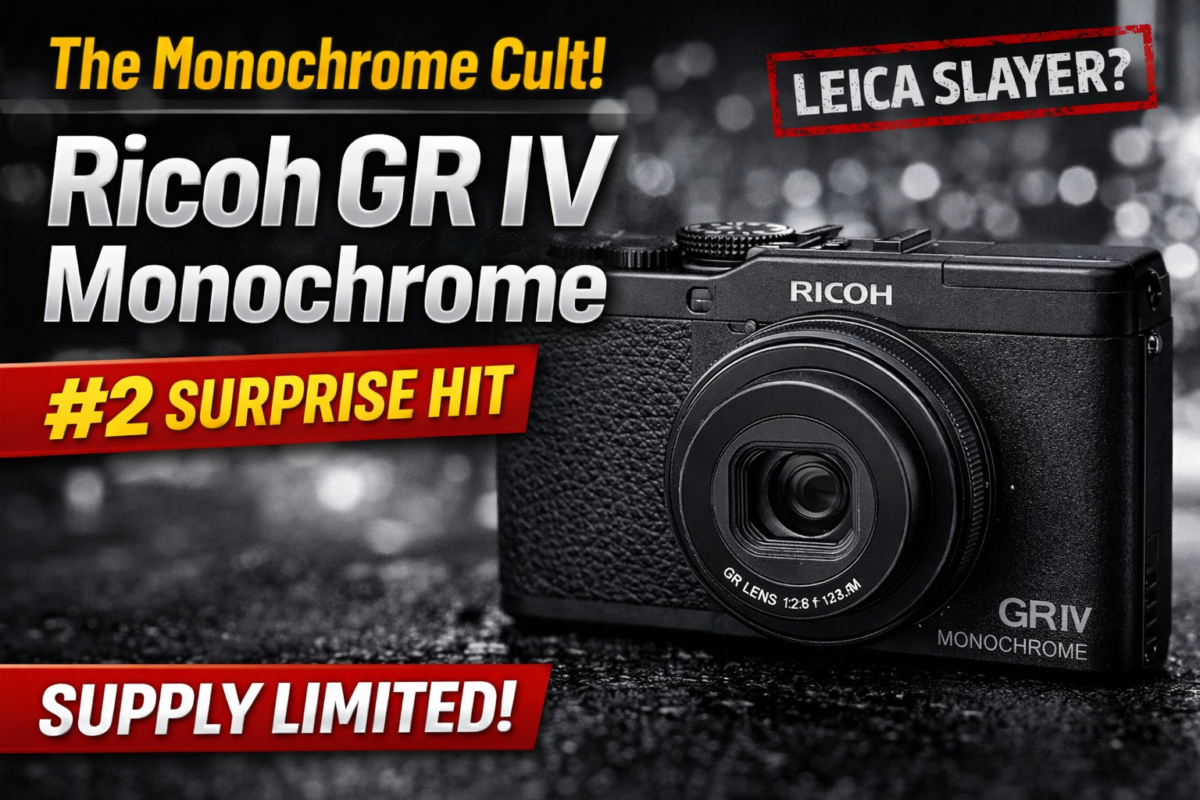
The latest release from Ricoh has delivered one of the most unexpected market responses of the year. The Ricoh GR IV Monochrome, a dedicated black and white compact camera, has rapidly moved to the number two position in global sales rankings, according to early retail data and distributor reports.
The speed of this rise has caught industry observers off guard. In a market that has largely been driven by hybrid cameras and video capable systems, the success of a stills only monochrome device suggests a different kind of demand is gaining momentum.
Retailers across multiple regions are already reporting limited availability. Initial stock allocations appear to have been absorbed within days, with waiting lists forming as supply struggles to keep pace with interest. The surge is being driven primarily by street photographers and long time Ricoh users, many of whom have been waiting for a dedicated monochrome option in the GR lineup.
The camera is being widely described as a compact alternative to high end monochrome systems, particularly those associated with the Leica M Monochrom series. The comparison has led to informal references to the GR IV Monochrome as a “Leica slayer,” though the positioning is notably different in both form factor and pricing.
At the core of the camera is a sensor designed specifically for black and white capture. Unlike conventional colour sensors that rely on a Bayer filter array, monochrome sensors remove this layer entirely. The result is improved sharpness, better light sensitivity, and more precise tonal rendering. For photographers who work primarily in black and white, this difference is not just technical but visual.
The GR series has long been associated with street photography due to its compact size and discreet design. Models such as the Ricoh GR III established a strong following by offering high image quality in a body that can be carried effortlessly. The GR IV Monochrome builds on that reputation while narrowing its focus to a single visual language.
This decision appears to align with a broader shift among photographers toward more intentional shooting practices. In recent years, there has been a noticeable increase in interest around simplified tools that remove distractions rather than add features. The success of the GR IV Monochrome reflects that shift.
Early user feedback highlights the camera’s ability to produce high contrast images with strong tonal depth straight out of the camera. The absence of colour encourages photographers to focus more on light, shadow, and composition. For many, this is seen as a return to a more fundamental approach to photography.
At the same time, the camera’s popularity raises questions about how manufacturers are interpreting current market trends. While much of the industry continues to emphasise video capabilities and hybrid workflows, the GR IV Monochrome suggests there is still a significant audience for cameras built around a single purpose.
Supply constraints are expected to continue in the short term. Distributors indicate that production is being scaled, but demand remains high enough that availability may stay limited through the initial launch period.
The rapid climb in sales rankings also places the GR IV Monochrome in direct competition with more feature rich cameras. Its performance in this context highlights the strength of niche products when they are clearly defined and well executed.
For Ricoh, the success of this release reinforces the identity of the GR line. Rather than expanding into broader categories, the company appears to be doubling down on its core audience.
Whether this momentum will sustain over the coming months remains to be seen. However, the early response to the Ricoh GR IV Monochrome indicates that, even in a market driven by constant innovation, there is still strong demand for cameras that focus on a singular photographic vision.