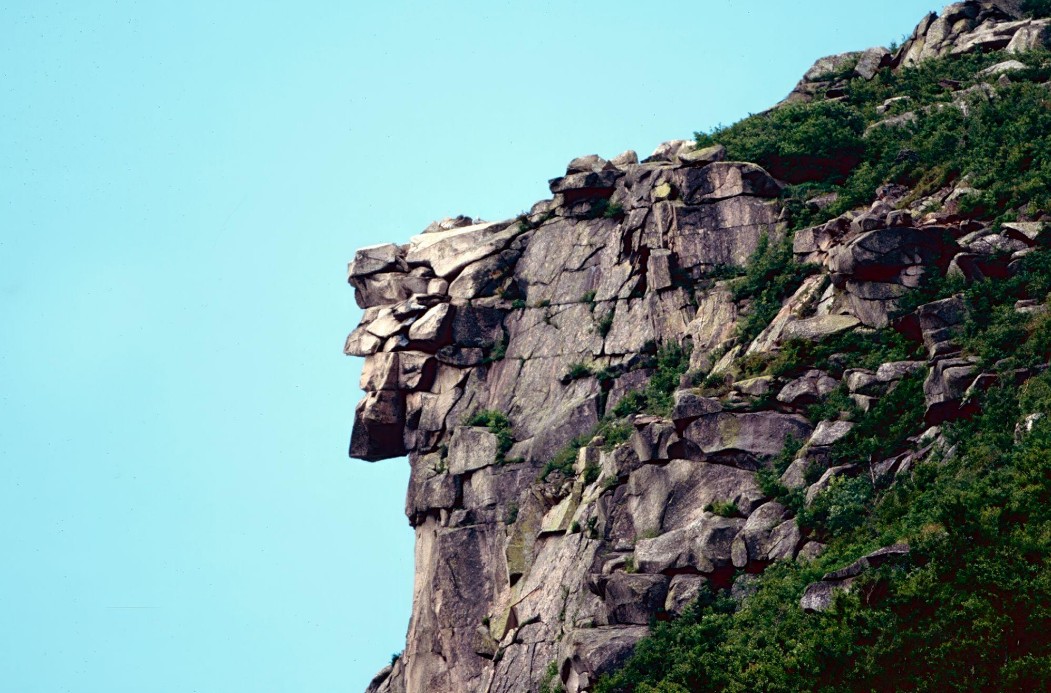
Travelers driving through the White Mountains of New Hampshire once encountered a sight that seemed almost too perfect to be accidental. High on the side of Cannon Mountain, a series of granite ledges formed a shape that looked unmistakably like the profile of an elderly man staring out across the valley.
From certain angles the resemblance was remarkable. The stacked rock formations created the appearance of a forehead, nose, lips, and chin carved into the mountain. When sunlight struck the cliff at the right moment, the illusion became even stronger, giving the impression that a giant stone face had been sculpted by nature itself.
This natural formation became known as the Old Man of the Mountain, and for more than two centuries it served as one of the most recognizable landmarks in the state of New Hampshire.
The first widely recorded mention of the formation dates back to 1805 when surveyors working in the region noticed the unusual rock profile. Word of the strange mountain quickly spread among travelers exploring the rugged terrain of the northeastern United States.
During the nineteenth century the profile attracted writers, artists, and tourists who traveled long distances to see the unusual formation. The famous American author Nathaniel Hawthorne wrote about the mountain in one of his short stories, helping to cement its place in American cultural history.
Visitors who saw the formation often expressed surprise at how clearly the rock resembled a human face. One observer described the sight in simple terms.
“It appears as if nature herself carved the profile of a wise old man into the side of the mountain.”
Geologically, the formation was created by a combination of natural forces acting over thousands of years. Cannon Mountain is made largely of granite that fractured along natural joints as the rock cooled deep underground millions of years ago.
Over time weathering gradually separated several large slabs of rock from the main cliff face. These slabs remained balanced in such a way that when viewed from the valley below they formed the distinctive profile.
The formation was never a single piece of stone. Instead it consisted of five separate granite ledges stacked together along the mountain’s edge. Gravity and natural erosion constantly threatened to destabilize the structure.
For many years engineers attempted to preserve the formation by installing support rods and turnbuckles to hold the rocks in place. These efforts were intended to slow the natural process of erosion that slowly weakened the ledges.
Despite these precautions, the forces of nature eventually prevailed.
On May 3, 2003, after centuries overlooking the valley below, the Old Man of the Mountain collapsed. Large sections of the rock formation broke away from the cliff during the night, leaving behind only fragments where the famous profile once stood.
News of the collapse spread quickly across the region. For many residents of New Hampshire, the formation had been more than just a geological curiosity. It had become a symbol of the state and appeared on license plates, coins, and official emblems.
When the profile disappeared, many people expressed a sense of loss.
One local resident reflected on the moment by saying,
“We knew it would happen someday, but that doesn’t make it any easier to see the mountain without its face.”
Today visitors can still stand at the same viewing area in Franconia Notch State Park where generations of travelers once looked up at the granite profile. Although the original formation no longer exists, markers now indicate where each section of the face once appeared.
The story of the Old Man of the Mountain illustrates how landscapes constantly change over time. Natural formations that appear permanent are often temporary when viewed on the scale of geological history.
For nearly two hundred years a series of granite ledges created one of the most recognizable faces in North America. Even after its collapse, the memory of that remarkable natural illusion continues to shape the identity of the region where it once stood.