There was a time when a photographer’s work could be recognised without a name attached to it. The light, the framing, the way people were approached, the way silence or chaos was handled inside a frame all carried a signature. It took years to build that kind of visual language. It came from mistakes, hesitation, stubborn choices, and long periods of doubt. Today, recognition happens differently. A photograph is recognised not because of who made it, but because it resembles what is already popular.
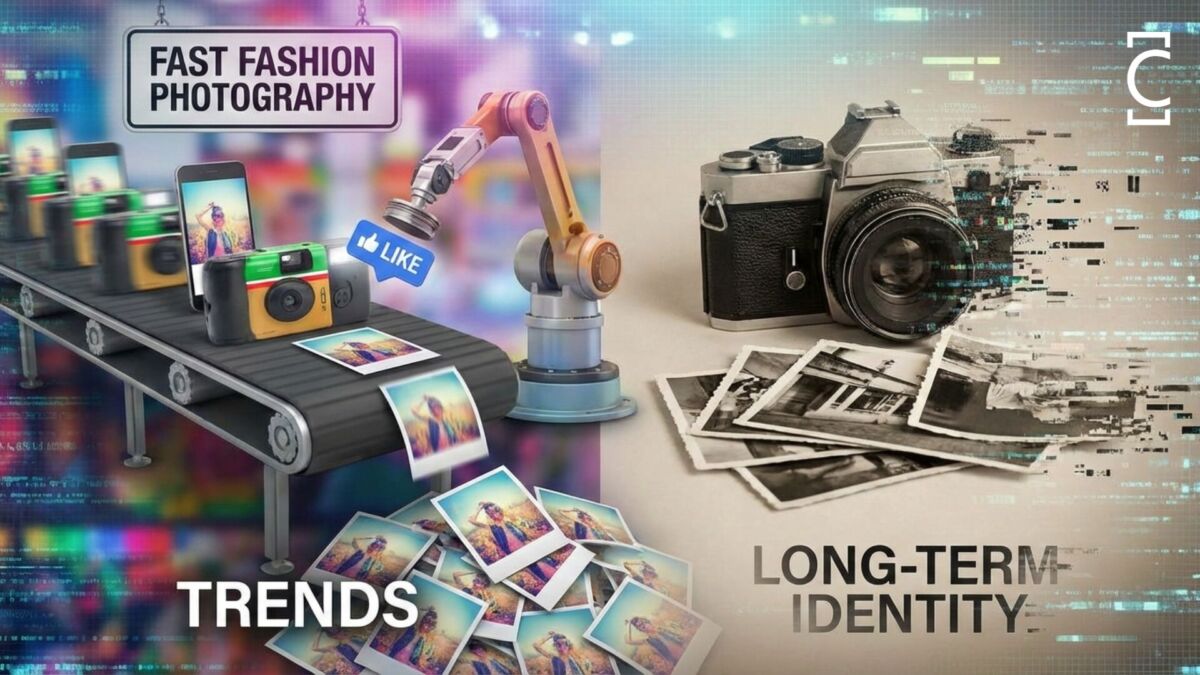
Photography has begun to function like fast fashion. Styles are consumed quickly. Trends appear, dominate, and disappear. Presets replace personal colour decisions. Compositions are copied because they perform well. Visual risk is reduced because risk does not travel well through algorithms. The result is a culture where photographs look technically polished but emotionally interchangeable.
Fast fashion is built on speed, imitation, and disposability. Photography now follows the same logic. The industry rewards those who adapt quickly to trends rather than those who develop slowly into themselves. Visual culture has become seasonal. One month it is muted tones and soft shadows. The next month it is harsh contrast and cinematic blues. Then comes grain, then comes blur, then comes artificial nostalgia. Each phase arrives with urgency and leaves without responsibility.
Presets are at the centre of this shift. They promise consistency, but what they often deliver is uniformity. Thousands of photographers apply the same tonal decisions to entirely different subjects, cultures, and stories. The photograph stops being a response to reality and becomes a response to a filter. Editing is no longer a continuation of seeing. It is an imitation of what is already trending.
In earlier generations, editing was slow. It was uncertain. It was guided by print limitations, by chemical processes, by mistakes that became discoveries. Today, editing is immediate. A photograph can be styled before it is even understood. This speed removes reflection. It replaces interpretation with application. Photography becomes a design product rather than a personal response to the world.
The problem is not presets themselves. The problem is dependence. When a photographer cannot visualise without a downloaded aesthetic, identity begins to dissolve. The work becomes modular. Replaceable. Interchangeable with any other account following the same trend.
Viral styles are another pillar of fast fashion photography. Certain compositions, lighting conditions, and subjects are repeated endlessly because they are proven to perform. Not because they matter, but because they travel well. The algorithm does not reward depth. It rewards recognition. When an image feels familiar, it is processed faster. When it is processed faster, it is shared more. When it is shared more, it becomes a model to be copied.
This creates a closed loop. Original work struggles to be seen. Copied work rises quickly. Over time, photographers internalise this logic. They stop asking what they want to say and start asking what will perform. Identity is traded for visibility. Long-term vision is traded for short-term reach.
The photography feature article culture reinforces this cycle. Publications increasingly select work that already fits popular aesthetics because it aligns with audience expectations. Editors become trend curators instead of risk-takers. Photographers learn to shape their work for selection rather than truth. The entire system begins to reward familiarity.
In fast fashion, clothing is designed to be worn briefly and replaced. In modern photography culture, images are designed to be noticed briefly and forgotten. They are not meant to age. They are meant to scroll well. They are not meant to deepen with time. They are meant to peak quickly.
This destroys long-term photographic identity because identity requires continuity. It requires the courage to repeat one’s own language even when it is unfashionable. It requires staying with questions that do not immediately generate applause. Fast fashion photography punishes that patience.
Another quiet cost is cultural flattening. When global presets dominate, local light disappears. Regional colour disappears. Cultural differences are neutralised into the same aesthetic template. A street in Assam, a café in Paris, and a wedding in New York begin to look edited by the same visual hand. Photography stops documenting diversity and starts enforcing sameness.
From a photographer rights perspective, this shift also weakens authorship. If your work looks like everyone else’s, it becomes harder to defend as distinct. Visual originality is not just artistic, it is legal. Identity protects ownership. Uniformity weakens it.
The photography industry reality is that platforms benefit from fast fashion photography. Trend-driven content keeps users engaged. It creates predictable cycles of consumption. It reduces risk. It keeps photographers producing constantly. Identity-driven photography is slower, harder to categorise, and more difficult to monetise. Algorithms are not designed for patience.
Photography becomes labour instead of authorship. Production instead of reflection. Volume instead of meaning.
Young photographers are especially vulnerable. They enter an industry where copying is rewarded immediately. They build portfolios based on templates. They are taught that style is something you download, not something you discover. By the time they realise something is missing, their visual habits are already shaped by trend dependency.
The tragedy is not that trends exist. Trends have always existed. The tragedy is that they now dominate the entire value system. In the past, trends moved around strong identities. Today, identity is built inside trends.
Fast fashion photography does not fail technically. It fails culturally. It produces images that look right but feel empty. It creates photographers who are visible but not grounded. It replaces long memory with short attention.
Real photographic identity is inconvenient. It is inconsistent. It changes slowly. It makes mistakes publicly. It refuses to fit cleanly into a feed. That is why it struggles in the current system.
The damage caused by fast fashion photography is not always visible immediately. It reveals itself slowly, over years, when a photographer looks back and finds no continuity in their own work. There is no thread, no long conversation with the world, no gradual sharpening of voice. There are only phases. A dark preset phase. A cinematic phase. A pastel phase. A monochrome phase. Each one disconnected from the last. Each one shaped more by external influence than by internal conviction.
This is not growth. It is drift.
Growth in photography used to be uncomfortable. It involved returning to the same questions again and again, refining the same instincts, resisting easy applause. Now growth is measured by adaptation speed. The faster you adapt to trends, the more successful you appear. But speed does not equal direction. A photographer who changes constantly without intention is not evolving, they are reacting.
Fast fashion thrives on the idea that nothing needs to last. Photography has absorbed the same logic. Images are no longer made to be revisited. They are made to be consumed once and replaced. Even photographers treat their own work this way. A shoot is posted, validated, and forgotten. There is no relationship with one’s own archive. There is no long-term stewardship of work.
This erodes responsibility. If an image is not meant to last, it does not need to be honest. It only needs to be appealing. It only needs to be legible to the algorithm. Photography becomes surface-level communication rather than a record of experience.
Presets accelerate this culture because they remove struggle from the process. Struggle is where identity forms. When everything is immediate, nothing is earned. A photographer who never sits with uncertainty never develops a language of their own. They develop a dependency.
The idea of “consistency” is often used to defend presets. But consistency without authorship is branding, not identity. True consistency comes from repeating a way of seeing, not repeating a colour profile. It comes from returning to the same emotional questions, the same visual instincts, the same ethical position toward the subject. Presets offer the appearance of consistency without its substance.
Viral photography also distorts how photographers understand success. Success becomes external validation rather than internal coherence. A photograph is judged by reaction rather than relevance. The danger is subtle. A photographer may be widely seen yet deeply replaceable.
Fast fashion photography encourages replacement. One trend replaces another. One style replaces another. One photographer replaces another. The industry does not need loyalty, only production. This is why visual culture feels crowded but shallow. There is abundance without attachment.
The photography feature article system plays a role in sustaining this. Publications that rely on trend-aligned visuals ensure stable engagement. Work that challenges trends risks lower performance. Over time, editors become cautious. Selection becomes predictive rather than exploratory. The result is a cultural feedback loop where originality is quietly filtered out.
This does not mean publications act maliciously. They respond to economics. But economics shape culture. When cultural value is measured through engagement metrics, depth becomes secondary.
Fast fashion photography also alters how photographers relate to their subjects. When style becomes the priority, people and places become backdrops. They are used to display an aesthetic rather than to be understood. This weakens ethical responsibility. Photography becomes extractive. It takes appearance without investing in relationship.
Long-term photographic identity requires intimacy. With a place. With a community. With a question. With one’s own doubt. Trend culture does not allow for intimacy because intimacy is slow and inconsistent. It does not produce predictable output.
The tragedy is that many photographers feel this loss but cannot articulate it. They sense that something is missing. That their work feels hollow despite technical perfection. That they are busy but not fulfilled. That they are visible but not rooted. This is the emotional cost of fast fashion photography.
The photography industry reality is that platforms benefit from volume, not depth. They benefit from predictability, not risk. They benefit from replication, not authorship. Identity-driven photography threatens this because it is not easily controlled. It refuses to conform.
True photographic identity is inefficient. It wastes time. It produces fewer images. It questions its own direction. It does not always look good online. That is why it struggles.
But history is not written by efficiency. It is written by persistence. The photographs that remain are not those that followed trends but those that resisted them long enough to form a language.
Photography has not become fast fashion because photographers failed. It has become fast fashion because the systems around photography reward speed over sincerity. Yet photographers still hold agency. Identity is a decision. It is the decision to stop reacting and start insisting. To choose continuity over novelty. To choose responsibility over reach.
Until that choice is made consciously, photography will continue to mirror fast fashion: stylish, abundant, and culturally thin.