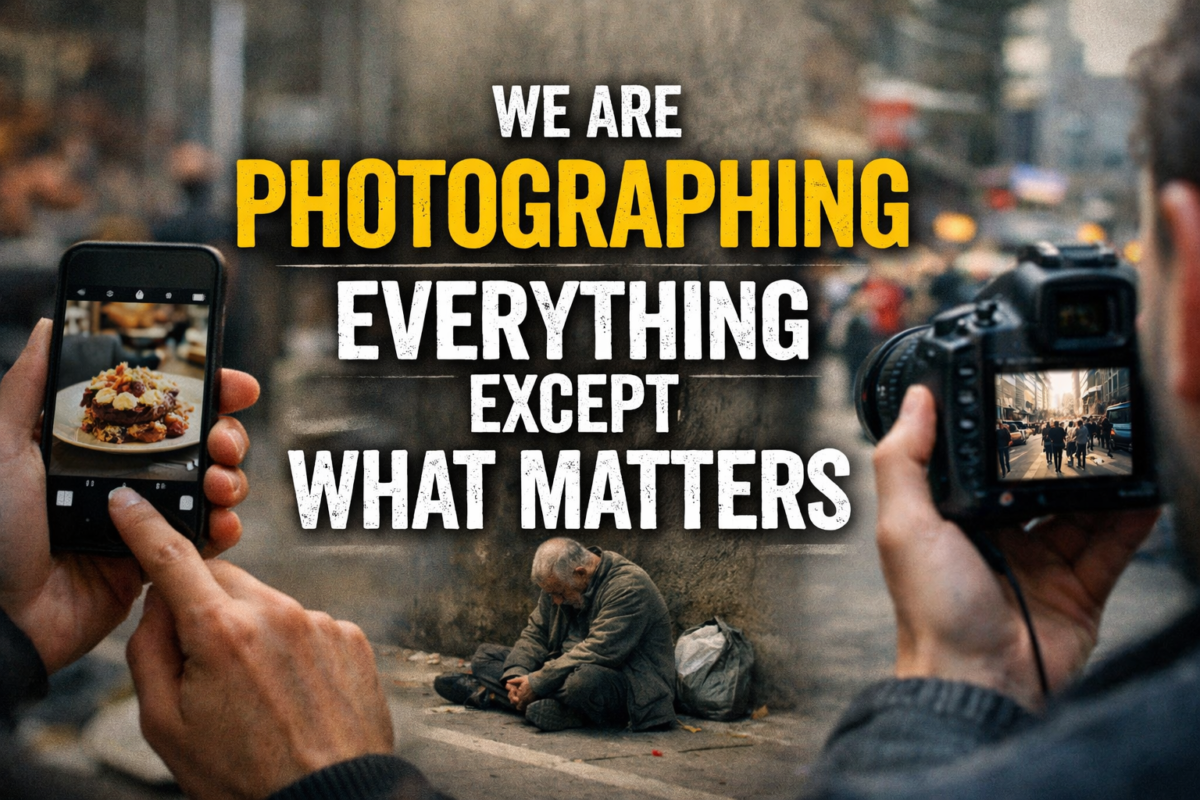
The problem is not that we are taking too many photographs. The problem is that nothing feels difficult enough to photograph anymore, and when nothing feels difficult, nothing feels important. The world presents itself in ready-made frames, and the camera in your hand responds instantly, often before you have decided why you are lifting it in the first place.
Photography has become easy in a way that goes beyond technology. The gap between noticing and capturing has almost disappeared. A moment appears and is immediately recorded, sometimes before it is even understood. The process is smooth, fast, and continuous, and while that efficiency may feel like progress, it quietly removes something essential from the act itself.
There was a time when taking a photograph required a pause, however brief. You stood still, watched longer than necessary, and allowed the moment to settle before responding to it. That pause was not a limitation but a form of engagement. It gave the photograph weight because it came from attention rather than impulse. Now the camera often reacts first, and the understanding follows later, if it comes at all.
This shift changes more than just workflow. It changes perception. When you begin to rely on capturing as a way of processing the world, you start to move through moments instead of staying with them. The photograph becomes a substitute for attention, a way to deal with a scene quickly rather than experiencing it fully. Over time, this creates a habit where shooting replaces seeing.
On the surface, everything appears stronger than ever. Images are sharp, colours are controlled, and compositions are refined. Technically, the standard is high across the board. Yet despite this, very few photographs stay with you. They pass quickly, leaving no trace beyond the moment they were viewed. The issue is not technical failure but the absence of depth.
That absence comes from a lack of selection. When everything becomes a subject, nothing is prioritised. The act of choosing, which once defined photography, begins to dissolve. Moments that carry meaning are treated the same as those that do not, and the frame becomes a record of presence rather than a statement of intent.
Without selection, there is no hierarchy. Without hierarchy, there is no meaning.
This is why so much work begins to feel interchangeable. The images are not necessarily empty, but they are not anchored to anything either. They exist within a constant stream of production, shaped by the need to remain visible and active. Over time, this rhythm influences not just what is photographed, but how it is seen.
The system surrounding photography reinforces this pattern. Speed is rewarded, consistency is expected, and absence is discouraged. The camera becomes part of a cycle that prioritises output over reflection. Waiting begins to feel unproductive, and silence becomes something to avoid rather than something to work within.
But meaningful photography does not emerge from constant activity. It emerges from attention, and attention requires time. It requires staying with a scene beyond the obvious, noticing what does not immediately stand out, and allowing something subtle to reveal itself. These are not moments that demand to be photographed. They are moments that must be recognised.
Recognition cannot be rushed. It depends on presence, on the willingness to remain with uncertainty instead of resolving it too quickly. It also depends on restraint, on understanding that not every moment needs to be captured. In fact, the ability to leave moments unphotographed is often what gives the photographed ones their significance.
Without restraint, everything becomes continuous. You shoot constantly, hoping that meaning will appear somewhere within the volume. But meaning does not come from quantity. It comes from clarity, from knowing why something matters enough to be framed, and why something else does not.
This clarity is increasingly difficult to maintain in a culture built around visibility. Images are expected to communicate instantly, to fit into a flow that moves quickly and leaves little room for reflection. In this environment, photographs are often made to be consumed rather than considered. They are designed to move with the stream, not to interrupt it.
Photographs that matter behave differently. They hold attention instead of passing through it. They reveal themselves slowly, offering something that cannot be understood at a glance. They do not rely on perfection but on presence, on the sense that the photographer was fully engaged with what was in front of them.
That presence cannot be added later. It exists at the moment of seeing, before the photograph is taken. It depends on the ability to recognise significance in places where it is not immediately obvious. This ability is not technical, but perceptual, and it requires a deliberate shift away from speed.
For photographers working in real environments, this becomes a defining factor. The work you produce is shaped by what you pay attention to. If your attention is scattered, your images will reflect that fragmentation. If your attention is focused, your work will begin to carry direction and intention.
In the end, photography is not about how much can be captured, but about what is worth noticing. The camera has made it possible to record everything, but that possibility comes with a responsibility to choose carefully. Without that choice, the result is not abundance but noise.
We are documenting more than ever before, but documentation alone does not create meaning. Meaning comes from attention, from patience, and from the willingness to stand still long enough to understand why something matters.
If that willingness is lost, then no matter how many photographs are taken, the outcome remains the same. Everything will be captured, but very little will be seen.
Share this:
- Print (Opens in new window) Print
- Email a link to a friend (Opens in new window) Email
- Share on LinkedIn (Opens in new window) LinkedIn
- Share on Reddit (Opens in new window) Reddit
- Share on X (Opens in new window) X
- Share on Tumblr (Opens in new window) Tumblr
- Share on Pinterest (Opens in new window) Pinterest
- Share on Telegram (Opens in new window) Telegram
- Share on Threads (Opens in new window) Threads
- Share on WhatsApp (Opens in new window) WhatsApp
- Share on Mastodon (Opens in new window) Mastodon
- Share on Nextdoor (Opens in new window) Nextdoor
- Share on Bluesky (Opens in new window) Bluesky
Do you have an inspiring story or idea to share? Email us at [email protected]. We’d love to feature your work!