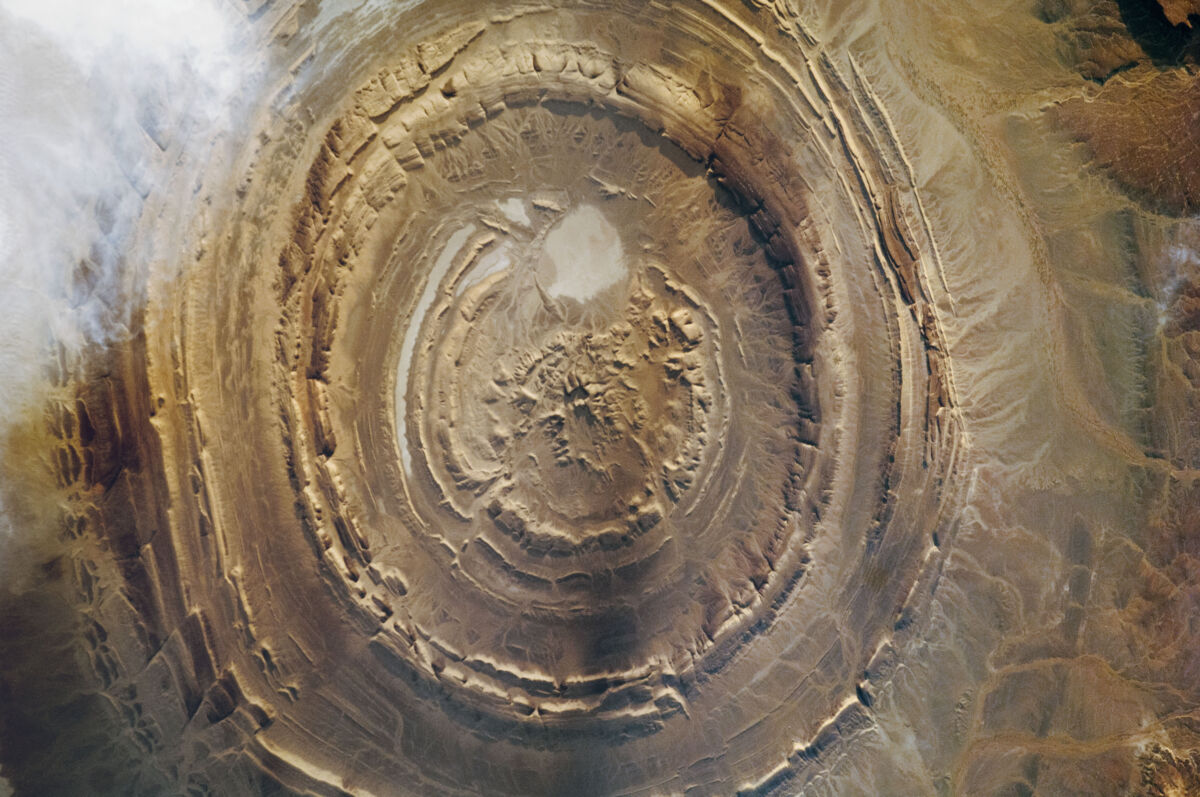
Far out in the western Sahara Desert of Mauritania sits one of the most unusual geological formations on Earth. From ground level it appears like a series of rocky ridges rising gently from the desert floor. But from the air, the pattern suddenly reveals itself. Concentric rings spread outward in perfect circles across the landscape.
This formation is known as the Richat Structure, though it is often called the Eye of the Sahara because of its striking appearance when viewed from above. The circular pattern stretches nearly forty kilometers across the desert, making it one of the largest visible land features in the region.
Early explorers flying over the Sahara during the twentieth century were surprised by the formation. Because of its circular shape, many believed it might be the result of a massive meteor impact. Others speculated that it could be the remains of an ancient volcanic crater.
These ideas persisted for many years, especially because the structure appeared so symmetrical when seen from aerial photographs.
Later geological studies revealed a different explanation. The Eye of the Sahara formed when a large dome of rock slowly rose upward due to underground geological pressure. Over millions of years wind and erosion gradually wore away the softer layers of rock surrounding the dome.
As the rock eroded, alternating layers of harder and softer material created the circular ridges that now define the structure. What remains today is a series of exposed geological rings showing different rock layers that once lay buried beneath the surface.
The formation is made primarily of sedimentary rock, including limestone and sandstone that formed hundreds of millions of years ago when the region was covered by shallow seas. Fossils from ancient marine life have even been discovered within some of these layers.
Although the Richat Structure is extremely large, it is surprisingly difficult to recognize from the ground. Standing among the rocky ridges, a visitor simply sees desert hills stretching across the horizon. Only from high above does the circular shape become obvious.
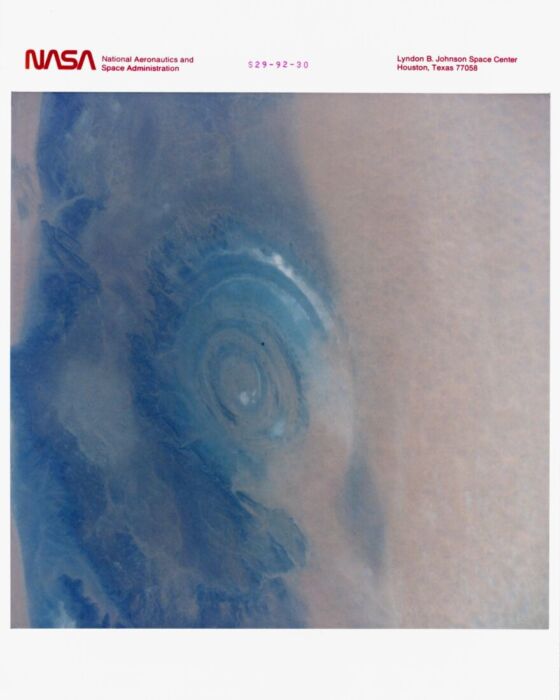
Because of this, astronauts aboard early space missions found the formation particularly useful as a visual marker. Against the endless brown of the Sahara Desert, the Eye of the Sahara appears like a giant target etched into the Earth’s surface.
Today the structure attracts geologists, photographers, and travelers fascinated by unusual landscapes. Satellite imagery and drone photography have revealed the full scale of the rings, with shadows from the ridges highlighting the circular pattern.
Despite its dramatic appearance, the Eye of the Sahara is not the result of a sudden catastrophic event. Instead it represents the slow work of geological forces acting over immense spans of time. Wind, erosion, and shifting rock layers gradually sculpted the formation into the enormous rings visible today.
It is a reminder that the Earth often creates its most striking patterns quietly, shaping landscapes over millions of years until they become visible from the sky.