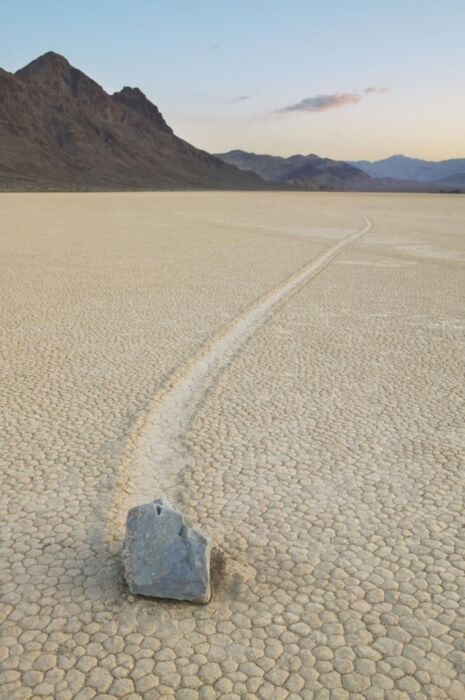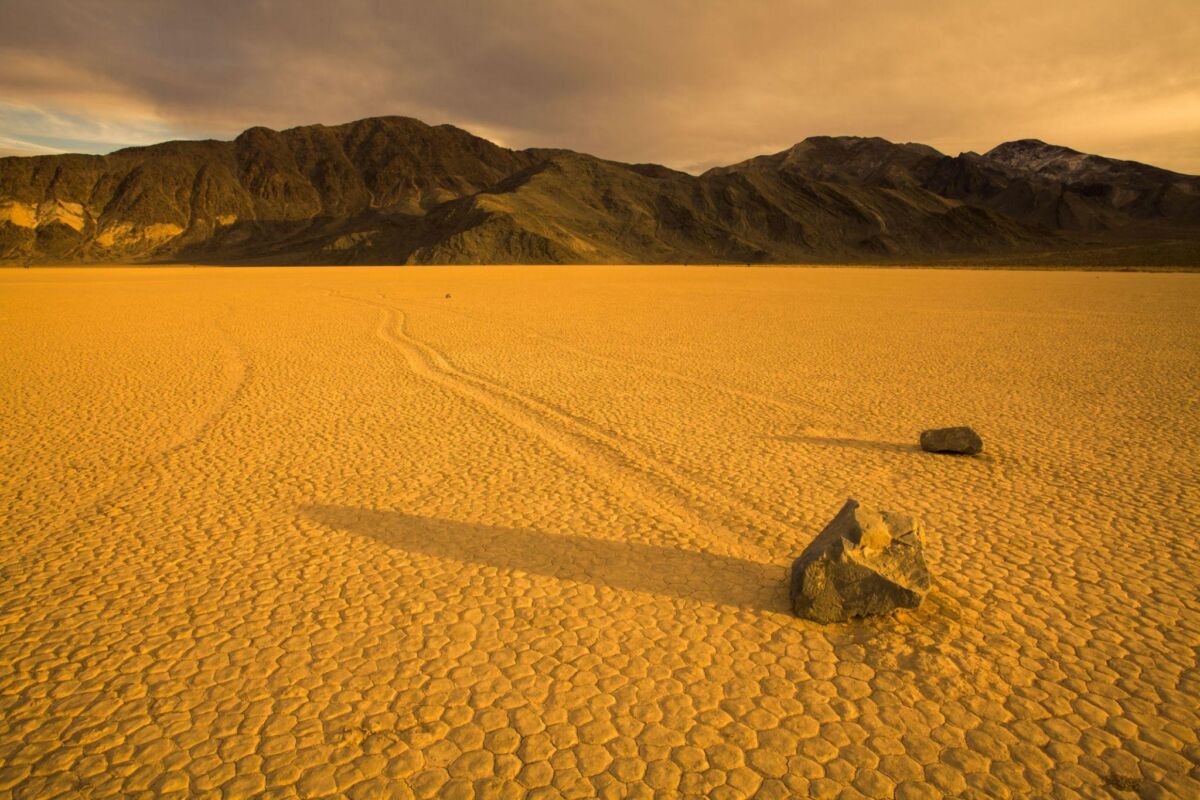
Visitors who walk across Racetrack Playa in Death Valley often notice something strange on the cracked desert floor. Large rocks sit quietly on the surface, yet behind them stretch long winding tracks carved into the dried mud.
Some trails extend for tens of meters. Others twist or curve sharply as if the stones suddenly changed direction. What makes the scene so puzzling is that nobody ever sees the rocks moving.
For decades this strange phenomenon puzzled scientists and travelers alike. The rocks seemed to move across the flat lakebed without any visible force pushing them.
Early theories were imaginative. Some believed powerful winds pushed the stones across the mud after storms. Others suggested magnetic forces or even seismic vibrations might be responsible. Because movement was rarely observed directly, the mystery remained unsolved for many years.
Racetrack Playa itself is an unusual place. The basin is an ancient dry lake surrounded by dark mountains inside Death Valley National Park. During rare winter storms, a thin layer of water sometimes covers the surface of the playa. When the water evaporates, it leaves behind a smooth crust of clay and silt.
The rocks scattered across the playa mostly originate from the nearby hills. Over time they break loose and slowly roll down toward the basin floor. Once they reach the flat surface of the lakebed, they remain there until something causes them to move again.
In 2014 researchers finally documented the movement of the sailing stones using GPS equipment and time-lapse cameras. The explanation turned out to be surprisingly delicate.
On cold winter nights, a shallow layer of water freezes into thin sheets of ice. These sheets can trap rocks inside them like small rafts. When sunlight begins to melt the ice during the day, light winds push the floating ice panels slowly across the surface of the playa.
As the ice moves, it drags the rocks along the soft mud beneath. The rocks slide forward, carving trails into the lakebed before the water eventually evaporates again.
The movement happens extremely slowly. A rock may move only a few meters over several minutes, making the motion difficult to notice without careful observation.
When the mud finally dries, the trails remain etched into the desert floor for months or even years until wind and rain erase them.
Today Racetrack Playa remains one of Death Valley’s most unusual landscapes. Standing among the stones, the long trails stretching across the cracked earth still feel mysterious, even though scientists now understand the physics behind them.
It is a quiet reminder that even simple natural processes can create phenomena that appear almost impossible at first glance.