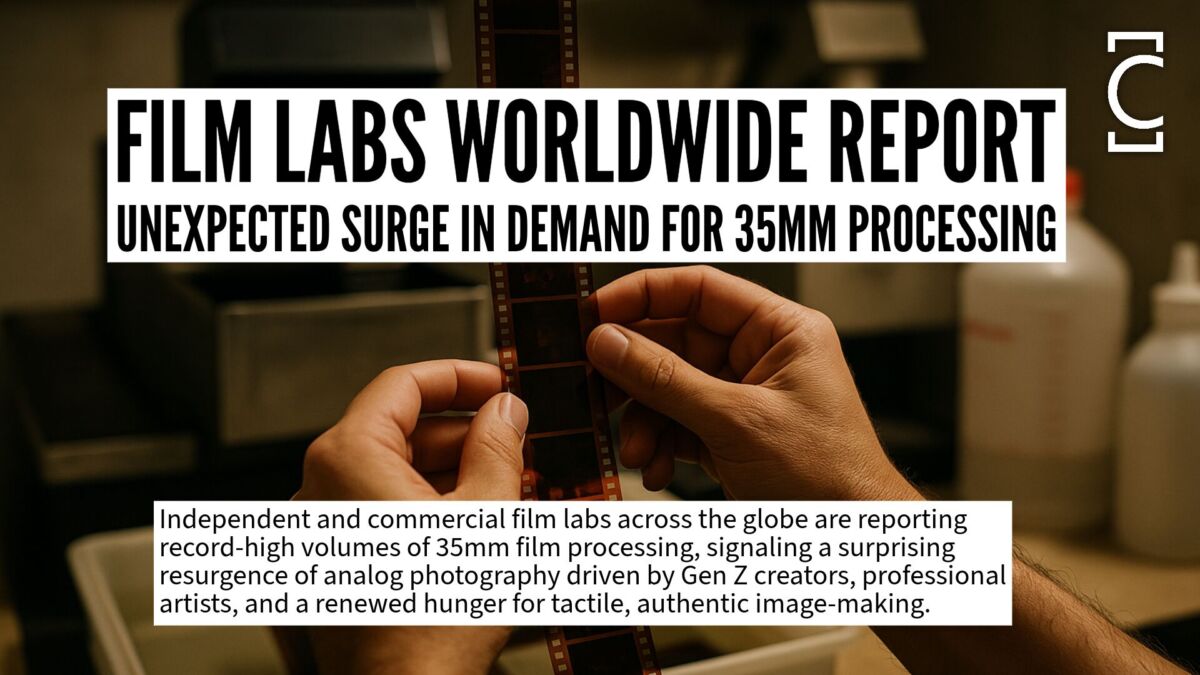
Film labs from Los Angeles to Tokyo are experiencing an overwhelming increase in 35mm film submissions, with many reporting wait times that stretch far beyond anything seen in the past decade. What began as a niche return to analog aesthetics has now grown into a widespread cultural movement, one strong enough to strain supply chains, revive dormant labs, and spark new investment in an industry once assumed to be fading into history. Technicians who spent years managing predictable, manageable volumes now describe their workflows as “brutally nonstop,” with chemicals, paper, and even basic film stocks regularly selling out.
Much of the surge is being fueled by younger photographers — particularly Gen Z — who did not grow up with film but are embracing it with surprising passion. Social platforms such as TikTok and Instagram have played an unlikely role in this revival, turning the slowness and unpredictability of film into a point of creative pride. Videos showing the reveal of developed negatives, the sound of a shutter advancing, and the joy of waiting days for results have gone viral repeatedly, creating a cultural countercurrent to the instant perfection of smartphone photography.
But the resurgence is not limited to hobbyists. Established professionals are increasingly integrating film into editorial, fashion, and documentary projects, citing a renewed desire for visual texture and imperfection. Some editors say film submissions have doubled in the last two years, and agencies are once again budgeting for analog workflows. Many photographers who abandoned film due to cost and availability are now returning because clients specifically request the aesthetic that digital simulations can’t fully replicate.
The surge has created challenges for labs worldwide. Chemical suppliers report supply shortages, particularly in C-41 and black-and-white developers. Some film stocks, including Portra 400 and Fujifilm Superia, have become difficult to source reliably. Several labs have begun limiting intake or introducing tiered processing plans to manage overwhelming demand. A lab owner in London noted, “We’ve gone from steady weekly orders to crates arriving daily. It feels like 1998 again — only back then, we had more staff and more machinery.”
Kodak Alaris has acknowledged the sudden spike in demand and continues to increase film production, though supply is not yet keeping pace. Fujifilm’s continued retreat from consumer film manufacturing has placed additional pressure on the ecosystem, leaving smaller companies like Cinestill, Foma, and Lomography to help close the gap. Analysts believe that unless manufacturing expands significantly, shortages may persist for several years.
Despite challenges, the renewed popularity of film is breathing life into independent businesses. Several labs that once teetered on closure have remodeled, hired new staff, and even expanded services. New labs are opening in major cities, often founded by young photographers who see opportunity where older generations saw decline. Workshops teaching darkroom printing, color development, and analog scanning techniques — skills once considered endangered — are selling out within hours.
The reasons behind the resurgence go deeper than nostalgia. Many photographers describe film as a way to rediscover intention: the need to think before shooting, the discipline of limited frames, the emotional weight of holding a negative. In a world saturated with flawless digital imagery, film offers something increasingly rare — the authenticity of process. One photographer put it simply: “Film feels like a conversation rather than a broadcast.”
Industry observers say this resurgence marks a cultural shift, not a temporary trend. The demand for physical mediums — vinyl records, printed books, handmade art — has risen steadily over the past decade. Film fits into this broader movement: a desire to experience creation with one’s hands, to embrace limitations, and to find meaning in the slow unfolding of an image that cannot be instantly corrected or deleted.
Whether this revival can sustain itself will depend on supply chains adapting and manufacturers recommitting to analog production. But for now, the glow of light leaks, grain, and imperfect exposure is not just alive — it is thriving. Film is no longer returning; it is expanding, carried forward by a new generation discovering the magic of uncertainty, and by a world rediscovering the beauty of patience.