Peakto has always positioned itself as a visual media browser rather than a traditional cataloging application. With version 2.6, Cyme sharpens that identity by solving one of photography’s most persistent problems: duplicate files scattered across multiple storage locations and software environments.
Most photographers do not work inside a single application or on a single drive. Their images exist in Lightroom catalogs, Capture One sessions, exported folders, external hard drives, old backup disks, and sometimes even NAS systems. Over time, this creates massive redundancy. The same image may appear in different resolutions, edits, and formats, making manual cleanup nearly impossible.
Peakto 2.6 introduces AI-powered duplicate and similarity detection that works across the entire connected library, regardless of where files are physically stored. Unlike conventional tools that only analyze one selected folder or catalog at a time, Peakto treats the photographer’s whole archive as one unified system. Once all storage locations and compatible applications are indexed, the AI compares every image against the full dataset.
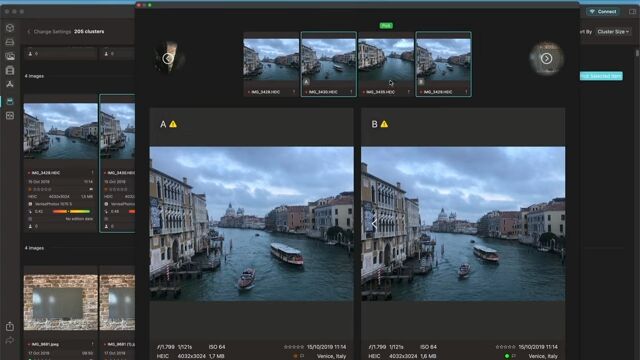
This means that a RAW file in Lightroom, an edited TIFF on an external drive, and a JPEG exported for social media can all be recognized as versions of the same photograph. Peakto groups them visually, allowing the photographer to decide which files to keep and which ones can safely be removed.
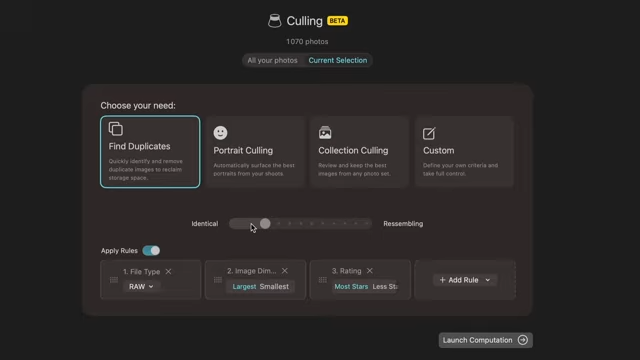
This is not simple filename matching. Peakto analyzes image content. It identifies near-duplicates based on composition, subject, framing, and visual similarity, even when the files differ in format, resolution, or color grading. For long-term archives, this level of recognition is essential.
Peakto 2.6 strengthens its core purpose as a visual hub that works alongside existing creative software. It integrates with:
- Adobe Lightroom Classic
- Adobe Photoshop
- Adobe Premiere Pro
- Capture One
- DxO PhotoLab
- Luminar
- ON1 Photo RAW
- Apple Photos
Instead of replacing these tools, Peakto sits above them. It reads their catalogs, understands their structures, and presents all content inside one interface. Files remain in their original locations. Peakto does not copy or relocate media. It simply creates a unified visual index.
Once indexed, Peakto automatically tags images using AI. It supports visual search, metadata filtering, people recognition, and album creation. Albums can contain photos that physically live in different drives and applications, without duplicating files. This keeps storage efficient while allowing flexible organization.
Cyme describes Peakto 2.6 as moving beyond “local and siloed” culling. That description is accurate. Traditional culling tools are designed for short-term project selection. Peakto 2.6 is designed for long-term archive intelligence.
This distinction matters. A wedding photographer working on one shoot may only need local culling. A documentary photographer or archivist managing decades of material needs a system that understands relationships between files over time. Peakto 2.6 addresses that higher-level requirement.
Performance has also been optimized. Indexing large libraries is computationally heavy, especially when dealing with hundreds of thousands of images. Peakto 2.6 improves ingestion speed and background analysis so the AI can process massive archives without interrupting normal workflow.
Collaboration tools are now more mature through Peakto’s web platform. The web version allows teams to browse shared libraries, review selections, and collaborate remotely. This is designed for studios, agencies, and production teams where multiple people must access the same visual archive.
Pricing reflects two usage models:
- Standard Version
- Available as a subscription or lifetime license
- Includes the macOS application and individual web access
- No team collaboration features
- Subscription starts at approximately $10 per month
- Lifetime license priced around $270 and includes one year of major updates
- Pro Version
- Subscription only
- Designed for teams
- Includes multi-user web access and collaboration tools
- Priced around $25 per user per month
This structure clearly separates personal archive management from professional collaborative workflows.
What makes Peakto 2.6 particularly accurate in its positioning is that it does not attempt to become another editing platform. It remains focused on visibility, organization, and intelligence. It is a control layer, not a creative layer.


For photographers who have accumulated years or decades of material, Peakto 2.6 offers something rare: an objective view of their own archive. It shows what exists, how much is duplicated, and where storage can be reclaimed. It turns chaos into structure without forcing photographers to rebuild their systems from scratch.
Peakto 2.6 is best understood as an archive intelligence engine rather than a simple duplicate finder. It reads visual relationships, understands software ecosystems, and respects existing workflows. In a field where storage grows faster than organization, this version of Peakto feels less like an update and more like a necessary evolution.

- Panasonic LUMIX 40mm f/2 S Lens and S9 Special Edition Announced at NAB 2026 - April 21, 2026
- How to Shoot Alone Without Losing Motivation - April 14, 2026
- How “Community” Became a Marketing Strategy - February 15, 2026