In the dry desert landscape of Chihuahua in northern Mexico, mining operations once uncovered a discovery that seemed almost impossible at first glance. While working deep underground in the Naica Mine in the year 2000, miners drilling through rock suddenly broke into a hidden chamber. What they found inside was unlike anything they had expected.
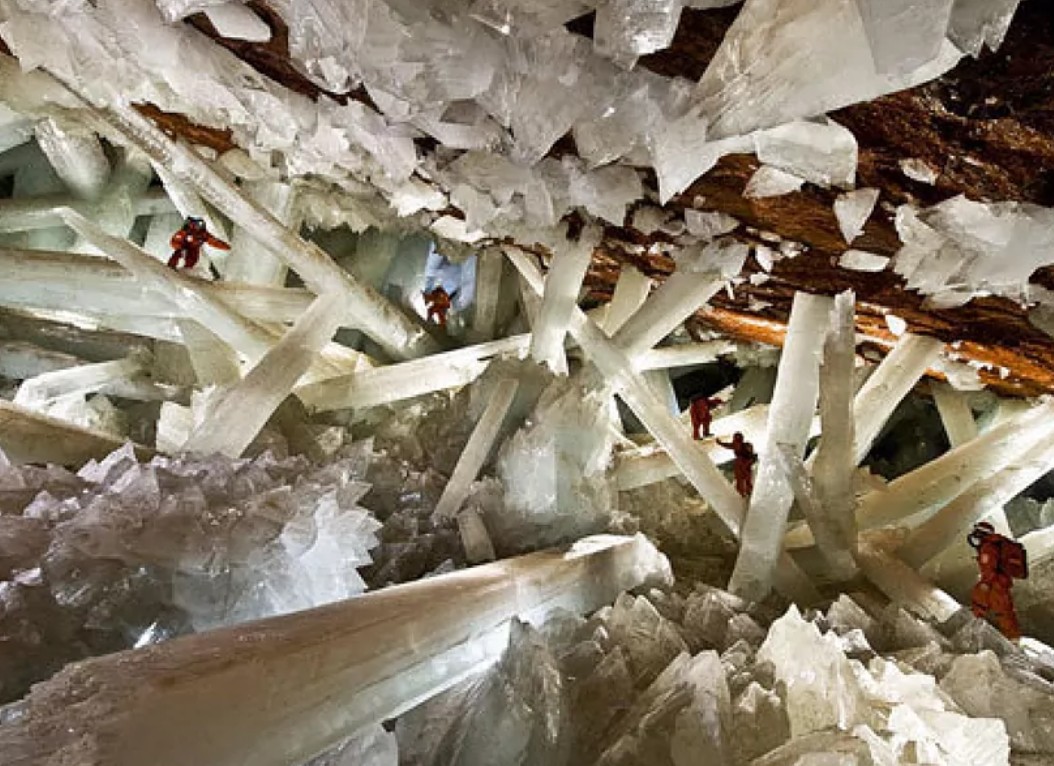
The cavern contained enormous crystal structures stretching in every direction. Some of the crystals were so large that they resembled fallen pillars made of glass. Others rose from the floor like giant beams of translucent stone. The chamber soon became known as the Cave of the Crystals.
Unlike the small quartz crystals often found in rock collections, the formations in this cave are made of gypsum, a soft mineral that can grow into long transparent crystals called selenite. In most environments gypsum crystals remain relatively small, but the conditions inside the Naica chamber allowed them to grow to extraordinary proportions.
Several of the largest crystals measure more than eleven meters in length and weigh many tons. Standing inside the cave feels almost like walking through a forest of crystal columns.
Scientists studying the cave quickly realized that its formation required extremely unusual conditions. For hundreds of thousands of years the chamber remained filled with hot mineral-rich water heated by magma deep beneath the mountain. The water contained large quantities of dissolved gypsum.
As the temperature slowly cooled over immense periods of time, the dissolved minerals gradually began to crystallize. Because the water remained stable for so long, the crystals were able to grow continuously without interruption.
Geologist Juan Manuel García-Ruiz, who led scientific research inside the cave, described the extraordinary scale of the formations.
“These crystals are among the largest natural crystals ever discovered on Earth.”
Exploring the cave itself proved extremely challenging. The temperature inside the chamber can reach nearly sixty degrees Celsius, while humidity approaches one hundred percent. Under these conditions the human body struggles to cool itself.
Researchers entering the cave must wear specialized cooling suits filled with circulating cold water. Even with this protection, scientists can only remain inside for short periods before the heat becomes dangerous.
Because the cave lies within an active mining area, access has always been limited. When pumps used by the mine removed groundwater from the surrounding rock, the chamber became temporarily accessible. Once pumping stops and the water level rises again, the cave slowly begins to flood.
Scientists believe that when the chamber refills with mineral-rich water, the crystal growth process may continue. In other words, the gigantic formations discovered today could still be slowly growing beneath the mountain.
Photographs taken inside the Cave of the Crystals reveal a landscape that appears almost unreal. Massive translucent beams intersect at unusual angles, reflecting light across the chamber walls. The crystals glow softly when illuminated, giving the cavern an otherworldly atmosphere.
Despite its harsh environment, the cave offers scientists valuable insights into how minerals form and grow over long geological timescales. It also demonstrates how stable environmental conditions can produce structures far larger than those usually observed in nature.
Today the Cave of the Crystals remains one of the most impressive geological discoveries of modern times. Hidden deep within the mountains of Mexico, it shows how natural processes operating quietly over hundreds of thousands of years can produce formations that seem almost beyond imagination.