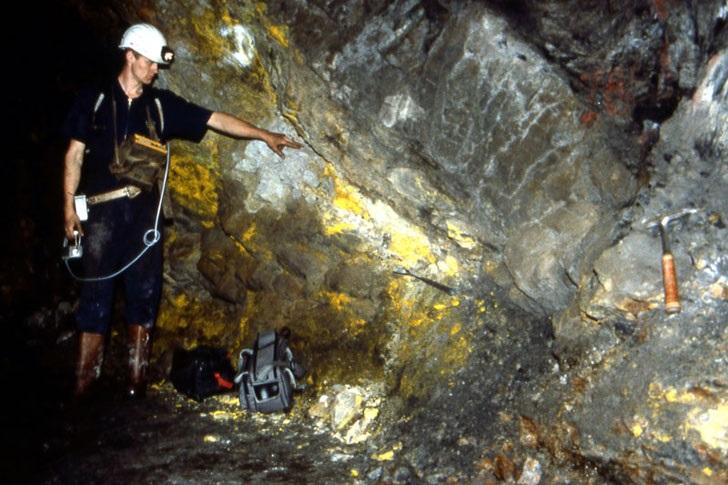
In 1972 scientists working at a nuclear fuel processing plant in France encountered a puzzling anomaly. The facility had received a shipment of uranium ore from the African nation of Gabon, and routine analysis revealed something unexpected. The uranium in the ore appeared to contain slightly less of a specific isotope than scientists normally observed in natural uranium deposits.
At first the difference seemed minor, but to nuclear researchers the measurement immediately raised questions. Uranium found in nature typically contains a predictable proportion of the isotope uranium-235, the form of uranium capable of sustaining nuclear chain reactions. The sample from Gabon showed a noticeably reduced concentration of this isotope.
The missing uranium-235 suggested that something unusual had occurred within the rock long before it was mined.
A team of French scientists began investigating the origin of the uranium deposit in greater detail. Their research soon led them to a remote area in southeastern Gabon known as Oklo, where several uranium mines had been operating for years.
What they eventually uncovered was astonishing.
Nearly two billion years ago, a series of natural nuclear reactors had operated underground in this region. At that distant point in Earth’s history, the concentration of uranium-235 in natural uranium was significantly higher than it is today. This allowed certain geological conditions to produce self-sustaining nuclear reactions without any human involvement.
For a nuclear reaction to occur, uranium atoms must be arranged in such a way that when one atom splits, it releases neutrons capable of triggering additional reactions in nearby atoms. In modern nuclear power plants, engineers carefully design reactors to control this process.
At Oklo, nature had created similar conditions by accident.
Groundwater flowing through uranium-rich rock acted as a natural moderator, slowing down neutrons and allowing chain reactions to begin. When the reaction became too intense, the heat generated by the process caused the water to boil away, stopping the reaction. Once the rock cooled and water returned, the process could begin again.
This cycle likely repeated itself many times over hundreds of thousands of years.
Physicist Francis Perrin, who studied the Oklo site, explained the remarkable discovery in simple terms.
“The conditions that existed there allowed the uranium deposit to behave like a natural nuclear reactor.”
Scientists eventually identified more than a dozen separate reactor zones within the Oklo uranium deposit. These ancient reactors operated intermittently for long periods before eventually shutting down as the uranium-235 concentration gradually declined.
The discovery was remarkable for several reasons. It demonstrated that nuclear chain reactions can occur naturally under the right geological conditions. It also provided scientists with a unique opportunity to study how radioactive materials behave over extremely long periods of time.
Because the reactions occurred billions of years ago, the site offers insight into how nuclear waste products move through rock formations over geological timescales. This information has proven valuable for researchers studying the long-term storage of radioactive materials.
The Oklo natural reactors remain the only known example of this phenomenon on Earth. Their existence reminds scientists that the planet’s geological history includes processes that can seem almost impossible from a modern perspective.
Long before humans developed nuclear technology, nature had already conducted its own nuclear experiments deep beneath the surface of the planet. Hidden within ancient rock formations, these natural reactors quietly operated for hundreds of thousands of years before finally fading into geological history.
Today the Oklo site continues to be studied by scientists interested in both nuclear physics and the long history of Earth’s natural processes.