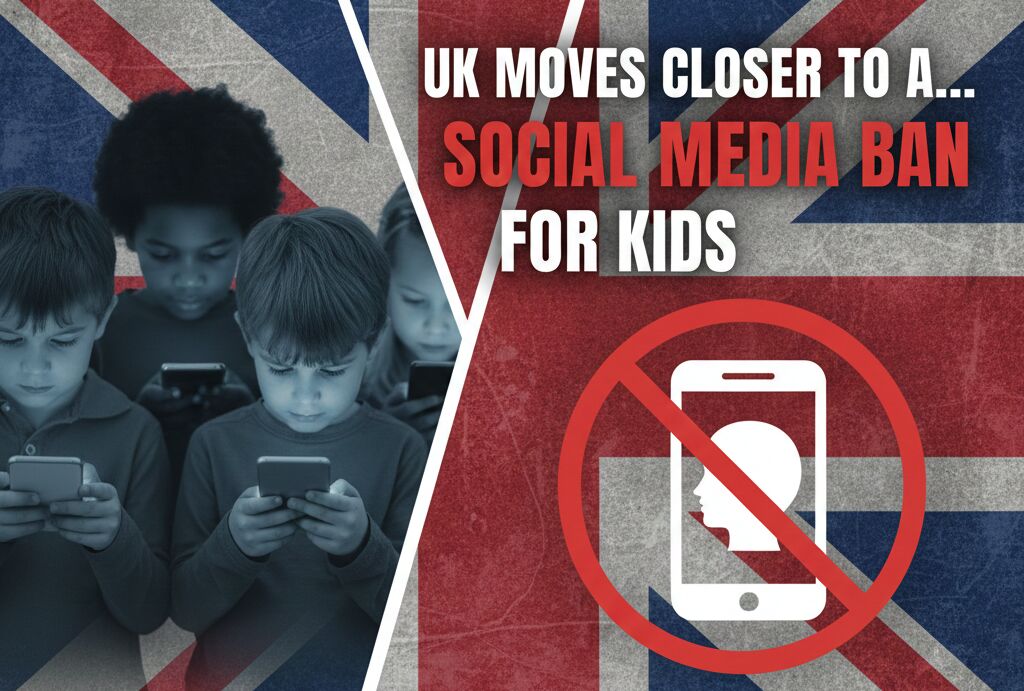
When I first read that the House of Lords had voted to support a ban on social media for under 16s, my reaction was not shock. It was recognition. This has been building for years. The vote did not come out of nowhere. It arrived after endless conversations about anxiety, addiction, attention loss, and emotional damage linked to excessive screen use among children. The difference now is that those conversations have crossed from parental concern into legislative action.
The Lords backed an amendment that would require social media platforms to introduce highly effective age verification systems within twelve months of the law taking effect. That means no more casual age declarations and no more pretending that children are adults online. If enforced properly, this would block under 16s from creating accounts on major platforms. In simple terms, the UK would be following the same path Australia has already taken.
What makes this moment significant is not just the proposal itself, but the strength of political support behind it. The amendment passed with a clear majority, showing that concern over children’s digital wellbeing now extends far beyond party politics. This is no longer a niche campaign driven by a few worried parents. It is a national conversation backed by lawmakers who feel the pressure from their constituencies.
At the same time, the government remains cautious. Prime Minister Keir Starmer has previously opposed an outright ban, preferring to wait for the results of a formal consultation on children’s use of social media. That consultation is set to run for several months and will explore a range of options, including age limits, night-time restrictions, and measures to reduce compulsive use. Officially, the government wants evidence before action. Politically, however, waiting is becoming harder to justify.
And that pressure is not coming from one side alone.
More than sixty Labour MPs have publicly supported stronger restrictions, describing how children in their constituencies are struggling with anxiety, unhappiness, and a lack of focus. Conservative leader Kemi Badenoch has also urged immediate action, arguing that social media is being treated too differently from other areas of child protection. When both sides begin using the same language, it usually means the direction of policy is already set.
This shift is important because of how the debate is now framed. It is no longer about censorship or freedom of speech. It is about safeguarding. Once social media is seen through the same lens as alcohol, gambling, or tobacco, regulation becomes socially acceptable. The moral argument changes. Protecting children becomes more important than preserving unrestricted access to adult platforms.
Australia has played a major role in accelerating this shift. By implementing a national ban on social media for under 16s, it proved that such legislation is not just theoretical. It is enforceable. Whether or not the Australian model succeeds perfectly, it has shown the rest of the world that governments are no longer powerless in the face of technology giants.
That example now sits heavily in front of UK policymakers.
The real challenge, however, lies in enforcement. Age verification is complicated. Strong systems raise concerns about privacy and data security. Weak systems become meaningless. Platforms argue that robust checks are expensive and intrusive. Governments argue that protecting children is worth that cost. This tension is where the future of digital regulation will be decided.
What concerns me is not whether the UK will act, but how carefully it will act. A poorly designed system could create new risks while trying to solve old ones. At the same time, doing nothing has already proven dangerous. Children are growing up inside environments designed for adult attention, adult behaviour, and adult economics. That was never sustainable.
The US, meanwhile, remains hesitant. Although some states have explored restrictions and Senate committees have proposed legislation, a nationwide ban still feels distant. Free speech arguments continue to slow action. But if the UK follows Australia successfully, international pressure will intensify. Policy change often spreads through proof, not theory.
This moment represents something deeper than a single law. It signals the end of an era where technology companies were allowed to shape childhood without limits. Governments are beginning to accept that digital spaces are not neutral. They are environments. And environments shape behaviour, development, and identity.
For years, we allowed children into adult platforms without preparation, protection, or boundaries. That experiment is now being questioned. Whether the UK ultimately passes a full ban or introduces strict controls, the direction is clear. Childhood is being redefined in the digital age, and governments are finally stepping into a role they avoided for too long.
This is not about punishing platforms or restricting freedom. It is about acknowledging that unrestricted access has consequences. It is about restoring balance between technology and development. It is about recognising that children deserve digital spaces designed for them, not borrowed from adult economies.
The UK now stands at a turning point. Its next decision will not just shape national policy. It will influence how democracies around the world rethink responsibility in the age of social media.
And once that line is crossed, there is no returning to the idea that platforms alone should decide how childhood is shaped.

- Panasonic LUMIX 40mm f/2 S Lens and S9 Special Edition Announced at NAB 2026 - April 21, 2026
- How to Shoot Alone Without Losing Motivation - April 14, 2026
- How “Community” Became a Marketing Strategy - February 15, 2026